The Kinko Craftsman: Techniques for Tsuba, Menuki, and Habaki in Japanese Sword Fittings
 * Image is for illustrative purposes only.
Table of Contents
Who Are Kinkoushi?
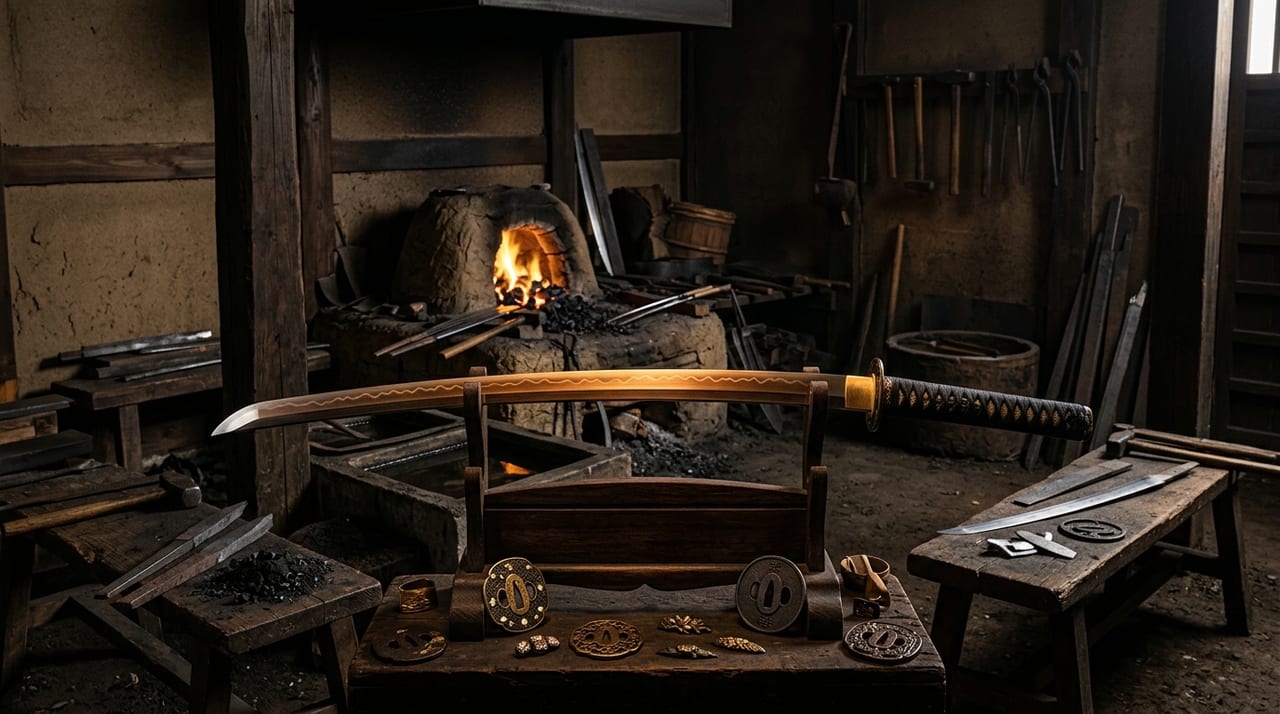
A complete Japanese sword requires not only the blade itself but also numerous metal components such as the tsuba, menuki, fuchikashira, seppa, koiguchi, kurigata, kaeritsuno, and obitodome. These are collectively called "kozaugu" (small fittings) or "tosogou" (sword fittings), and the craftsmen who create them are known as kinkoushi, kinkou, or kozaugu-shi (metalworkers or decorative metalworkers).
The work of a kinkoushi is an entirely separate field from that of a toukou (sword smith), and encompasses diverse techniques including metal sculpture, inlay, and casting. A tsuba or menuki crafted by an exceptional kinkoushi can possess artistic value equal to or exceeding that of the blade itself, and pieces bearing the maker's name are often sold at high prices at auctions both domestically and internationally.
To create a complete koshirae (the mounting that houses the blade), various specialized craftsmen work in collaboration with the kinkoushi, including sayashi (scabbard makers), tsukamakie-shi (handle wrapping specialists who wrap the grip with ray skin and thread or leather), and nurihi (lacquer specialists). Among these craftsmen, the kinkoushi handles all metal components and has traditionally played the role of selecting designs and materials to match the patron's preferences and the aesthetic of the blade.
Explanation of Major Techniques
Takabori and Nikubori: Techniques in which the metal surface is carved in semi-relief to raise patterns such as dragons, waves, and arabesque designs. These reached their most refined form in the work of Edo-period metalworkers centered around the Gotou family. They serve as the focal point of appreciation, comparable to the hamon of the blade, and are the first element viewers notice.
Kebori: A technique in which patterns are expressed through fine line engraving. It is suited to detailed depictions such as animal fur, leaf veins, and water ripples. There are examples of Bizen sword smiths decorating the edges of tsubas with kebori, representing an area where the skills of sword smiths and metalworkers intersect.
Katakiribori: A technique in which a chisel is inserted at an angle to carve deeply on one side only, creating a distinctive line with one edge sharp and the other gently sloped. This enables painterly chiaroscuro effects and is known to have been a specialty of Yokoya Sōmin.
Nunomezougan: An inlay technique in which a hammer is used to create a grid-like pattern of fine marks on the metal surface (nunome), into which thin sheets of gold or silver are hammered and fixed. It is frequently used to apply gold and silver patterns to iron tsubas. It brings particular visual richness to patterns on armor and tsubas.
Suemon: A technique in which portions of a pattern are created separately and affixed to a base plate using soldering or riveting. While it can produce stronger three-dimensionality than takabori, the durability of the joints determines the final quality, requiring extensive experience in metalworking.
Sukasibori: A technique in which holes are pierced in metal to cut out patterns. Natural motifs such as bamboo, plum, chrysanthemum, and butterfly are frequently employed, and the pierced tsubas of Higo tsuba exemplify this technique. The shape and placement of the piercing are among the elements that best express an individual metalworker's character.
Tokin and Tougin: Techniques in which gold or silver is fixed to a metal surface using mercury amalgam (fire gilding) or, in modern times, electroplating. While generally not used in Higo mountings, it is frequently employed in the ornate Edo-style mountings.
Iroie: A general term for techniques employing different metals such as shakudo, shibuichi, and suaka to create color contrasts. It allows subtle color gradations that cannot be achieved with a single metal to be incorporated into patterns.
Characteristics and History of Major Schools
Gotou Family: A lineage founded by Gotou Yujou in the late Muromachi period and continuing as official metalworkers to the Tokugawa shogunate until the end of the feudal era. The "Gotou style," which applies takabori to a shakudo ground and finishes with gold inlay, is valued as the highest-ranked metalwork. Changes in style can be seen across generations in works of the Gotou family, from the first generation Yujou, second generation Soujou, third generation Joeshin, fourth generation Mitsunorl, and so forth.
Yokoya School: A mid-Edo period school founded by Yokoya Sōmin (1670–1733). Characterized by dynamic composition and bold takabori unlike the traditional Gotou style, it established a new aesthetic of applying gold inlay boldly to a shakudo ground. After Sōmin, his students Sōbi, Sōshin, and Sōshun were active during the late Edo period.
Nara School: A school descended from Nara Toshinaga (1667–1737) and counted as one of the Three Nara Masters (Nara Toshinaga, Tsuchiya Yasuchika, and Sugiura Jōi). It is renowned for iron tsubas employing special materials such as nanban-tetsu, characterized by precise natural depiction and distinctive pattern interpretation.
Yanagawa School: A school that rose to prominence from the mid-Edo period onward, with numerous branch families including the Ishiguro and Yanagawa families. It excels at applying delicate takabori to small tsubas and menuki, and is highly appreciated for realistic depictions of animals and plants.
These schools are broadly categorized as "iebori" (house carving) and "machibori" (town carving). The official metalworkers for the samurai class, exemplified by the Gotou family, are called "iebori," emphasizing stylistic consistency and the maintenance of formal standards. Conversely, metalworkers who worked in urban settings, such as the Yokoya, Nara, and Yanagawa schools, are called "machibori," in which individual artistry and exploration of new designs are more readily expressed. In authentication, the basic approach is first to understand the broad category of whether it is iebori or machibori, then to examine the characteristics of individual schools and artisans.
Function and Appreciation by Component
Sword fittings vary in their structural function by component, and each has different points of appreciation.
- Tsuba: Located at the junction between the grip and scabbard to defend the hand, the points of appreciation are the iron character of the base plate, the finishing of the rim (the outer edge of the tsuba), and the overall balance of piercing and carving placement.
- Menuki: Small metal fittings placed on either side of the grip, often positioned where fingers rest when holding it. The artist's individuality is concentrated in the choice of subject matter and the way three-dimensionality is achieved.
- Fuchikashira: A pair consisting of the "fuchi" (which fits near the blade on the grip) and "kashira" (which fits at the end of the grip), typically created as a matching set with coordinated designs. Some compositions divide the same pattern between fuchi and kashira, and these components influence the overall unity of the mounting.
These components may be appreciated individually, or may be preserved as complete sets such as "misho-mono" or "shibuichi-gumi" with the tsuba, menuki, fuchikashira, kogai, and kozuka all by the same artist and coordinated in design. When a complete set is preserved, the consistency of quality across all components is high, serving as evidence of the high quality of the original commission.
Contemporary Kinkoushi — The Transmission of a Disappearing Craft
Contemporary kinkoushi are extremely few in number; there are said to be only dozens of practicing traditional sword fitting metalworkers throughout Japan. Most work in individual workshops or small traditional craft studios, creating new sword fittings as well as restoring and conserving existing pieces.
The difficulty in training successors stems from the fact that acquiring the necessary skills requires a minimum of 5 to 10 years, and the income during the period until completed work is recognized is extremely limited. Some metalworkers have found new avenues in tourism crafts and experiential programs, and workshops offering "tsuba-making experiences" for international visitors have emerged.
The primary tool used by kinkoushi is the chisel (tagane); they employ many different specialized chisels with varying blade shapes depending on the pattern being carved and the technique used. The crafting of the chisel itself is part of the kinkoushi's skill, and many craftsmen do not simply use commercial tools but forge and finish the blade edges themselves. In restoration work, the artisan must infer lost patterns from remaining portions and fill in the gaps, requiring not only carving skill but also knowledge of the stylistic conventions of each school.
A culture of recording and evaluating kinkoushi works as "kinkou-mei" (maker's marks) in a manner analogous to sword smith signatures is gradually taking root. The NBTHK authentication certificates now include the names of the creators of fittings, increasing the value of individual kinkoushi as personal brands. For the overall preservation and development of Japanese sword culture, the transmission of kinkoushi techniques is as essential as that of sword smiths.