Kantō-tachi — Continental-Origin Straight Swords of the Kofun Period and Japan's Unique Transformation
 * Image is for illustrative purposes only.
Table of Contents
What Is a Kantō-tachi?
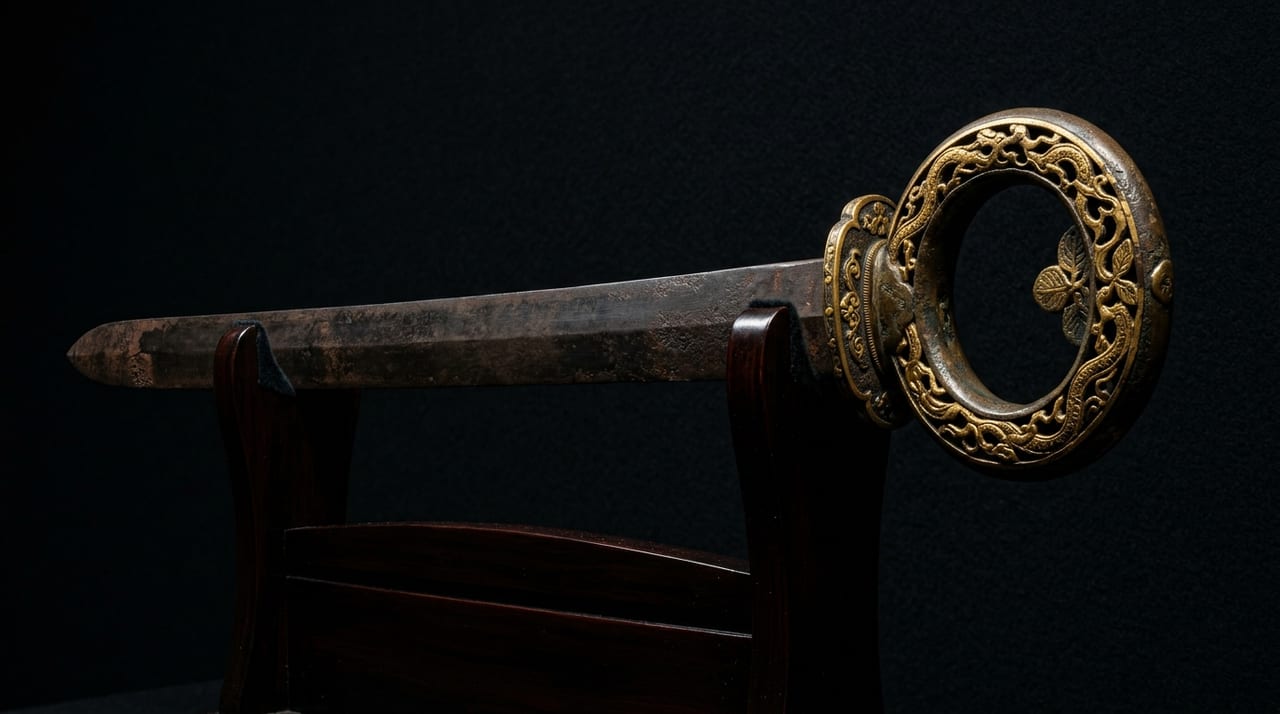
"Kantō-tachi" is the collective term for straight swords bearing a ring-shaped metal ornament at the pommel (tsuka-gashira). "Kan" refers to a circular ring, while "tō/gashira" refers to the ornamental fitting at the end of the tsuka (hilt); the name derives from this distinctive pommel shape. They were used and interred as burial goods primarily in the Japanese archipelago during the Kofun period (late 3rd century to around the 7th century), and are closely associated with the sword cultures of China and the Korean Peninsula. They are one of the indispensable sword types for tracing the origins of the nihontō.
Origins — Direct Importation of Continental Culture and Domestic Production
The prototype of the kantō-tachi is traced to China. From the Han dynasty through the Nanbokuchō period (220–589), straight swords with ring-shaped, dragon-shaped, phoenix-shaped, and other decorations at the pommel were used as prestige goods by rulers, and this culture is believed to have reached the Japanese archipelago via the Korean Peninsula around the 4th–5th centuries.
In the early period of transmission, it is believed that the finished products themselves were imported from the continent; however, by the late 5th to 6th centuries, kantō-tachi were also being produced within the Japanese archipelago. Domestic products, while building on continental and Korean Peninsula prototypes, underwent a unique transformation reflecting Japanese metalworking techniques (so-kan, sanyō, sanrui, dragon motifs, etc.). This process of "reception and transformation" formed the very foundation of subsequent nihontō culture.
Pommel Shapes and Classifications
Kantō-tachi are classified into several types according to the shape of the pommel.
So-kantō (plain ring pommel): The simplest type, bearing only a circular ring. Considered to prioritize practicality over ornamentation, examples are frequently excavated as burial goods.
Sanyō-kantō (three-leaf ring pommel): A type incorporating three leaf-shaped ornaments inside the ring. Influenced by continental three-leaf-pattern metalwork, it became widely prevalent in Japan as well.
Sanrui-kantō (three-pearl ring pommel): A type bearing three jewel-like ornaments inside the ring. "Rui" means a form of stacked jewels, requiring more complex metalworking techniques.
Ryūhō-kantō (dragon-phoenix ring pommel): The highest-grade type, decorated with dragons and phoenixes inside the ring or across the entire tsuka (hilt). Examples are often excavated as burial goods of high-ranking individuals; from the Eta Funayama Kofun in Kumamoto Prefecture, the kokuhō (National Treasure) "Gin Zōgan Meitachi" (collection of the Tokyo National Museum) was excavated and is known as the foremost example of the highest-grade ryūhō-kantō type.
Characteristics of the Blade
The blade of a kantō-tachi is fundamentally a "chokutō" (straight sword) — a straight blade with no sori (curvature). The edge may be single-edged or double-edged, and the blade cross-section may be similar in shape to shinogi-zukuri or may be hira-zukuri.
The nagasa (blade length) varies widely; shorter examples are in the 30 cm range, while longer ones reach over 80 cm. The latter are called "tachi" and are believed to have been intended for use on horseback or in infantry combat. The shape of the junction between the tsuka (hilt) and the blade — the nakago (tang) — also differs greatly from that of later nihontō.
Development of Metalworking Techniques in Japan
Through the production of kantō-tachi, metalworking techniques in the Japanese archipelago advanced dramatically. Zōgan (inlay) techniques using gold, silver, and copper, as well as casting and engraving techniques for kondō (gilt bronze), developed in earnest during this period. The foundation of the tōsōgu (sword fittings) culture from the Nara period onward — refined metalwork pieces such as tsuba (hand guard), menuki, and fuchi-kashira — connects directly to the accumulated technical skills cultivated in the production of kantō-tachi during the Kofun period.
From Kantō-tachi to the Nihontō — The Significance of the Transitional Period
From the late 7th to the 8th century (Nara period), a shift from the direct importation of continental culture to Japan's own distinctive culture advanced across various fields. In swords as well, the transition from the straight sword culture to curved blades began, and as a result of the coinciding tactical changes in cavalry combat in the 9th–10th centuries and the maturation of kaji (smith) techniques, the full-fledged nihontō was completed.
While the kantō-tachi cannot be called the "direct ancestor of the nihontō," it is a sword type that formed an important foundation for nihontō culture in the sense that it received continental culture and nurtured a distinctive metalworking and kaji culture within the archipelago. Most surviving kantō-tachi are held in museum and shrine treasure-house collections, and knowing them as the origin of sword history is indispensable for an essential understanding of the nihontō.
Current Holdings of Surviving Kantō-tachi
Kantō-tachi are artifacts excavated as burial goods from kofun. After excavation, most are preserved and managed as precious cultural properties in the museums and resource centers of the excavation site, shrine treasure houses, or national and prefectural museums. Opportunities for private individuals to newly acquire one are limited; what is routinely bought and sold in the current sword market is primarily later nihontō with sori (curvature), and it is not common for kantō-tachi themselves to be traded. For those wishing to view actual kantō-tachi, the most practical approach is to visit resource centers in the regions where the excavated kofun are located, or museums with permanent or special exhibitions such as the Tokyo National Museum, which holds objects excavated from the Eta Funayama Kofun.
Key Points for Distinguishing Kantō-tachi from Later Nihontō
The following points serve as clues for distinguishing kantō-tachi from nihontō with sori (curvature) that emerged from the Heian period onward.
- Presence or absence of sori in the blade: Kantō-tachi are chokutō (straight swords) and have no sori (curvature) in the blade. A blade with sori is a characteristic of later nihontō.
- Pommel shape: Whether the pommel features a ring-shaped metal ornament (so-kantō, sanyō, sanrui, ryūhō, etc.) is a style unique to kantō-tachi and is not found in the pommel of later nihontō (a structure incorporating hilt wrapping and menuki).
- Provenance and excavation circumstances: Kantō-tachi do not circulate individually; their provenance is often described together with records of the excavated kofun and burial goods.
Frequently Asked Questions
- Q. May a kantō-tachi be called a "nihontō"?
A. A kantō-tachi is a chokutō (straight sword) without sori (curvature) and differs from the nihontō — with sori — that emerged from the Heian period onward in both shape and period of formation. Strictly speaking, it is generally treated as a separate sword type from the nihontō.
- Q. Can a kantō-tachi be purchased today?
A. Most surviving examples are held in museums and shrines as cultural properties and are not objects sold in the general market.
- Q. How does studying kantō-tachi contribute to understanding the nihontō?
A. By tracing how the pommel decoration and blade shape transformed from the reception of continental culture, one can concretely grasp the foundations on which Japan's distinctive sword culture was established.