Design and Equipment of the Kajiba — The Structure and Tool Layout of the Working Space Maintained by Modern Tōshō
 * Image is for illustrative purposes only.
Table of Contents
What Kind of Space Is the Modern Kajiba?
The "kajiba" is a dedicated workspace where a tōshō works tamahagane and forges the blade of a nihontō. Modern tōshō receive approval from the Board of Education of the prefecture where they reside — or, for a tōshō seeking initial approval, from the Director-General of the Agency for Cultural Affairs — before making each sword (Act for Controlling the Possession of Firearms or Swords and Other Such Weapons (Jūtōhō) (e-Gov Law Search) Article 18-2; Regulations for Approval of Manufacturing Art Swords (e-Gov Law Search) Article 2). The kajiba is not merely a "workshop." Because statutory requirements, traditional techniques, and the physical movements of the craftsman all intersect, it demands a uniquely specialized spatial design.
Basic Structure and Building Scale of the Kajiba
Traditional kajiba are most commonly single-story, freestanding wooden structures. Modern examples also use steel-frame or partially reinforced-concrete buildings, but among tōshō the view that "a space where fire is handled is best built in wood" remains firmly entrenched. The reasons given include that wood naturally absorbs and dissipates heat, which moderates temperature fluctuations in the working environment.
A floor area of at least 30–40 square meters is considered the minimum, with 50–80 square meters regarded as ideal. Master tōshō workshops where multiple apprentices work simultaneously can exceed 100 square meters. A low ceiling height of around 2.5–3 m has traditionally been favored to suppress the scattering of sparks. However, with the development of modern ventilation equipment, slightly taller designs can now be seen.
Position and Types of the Furnace
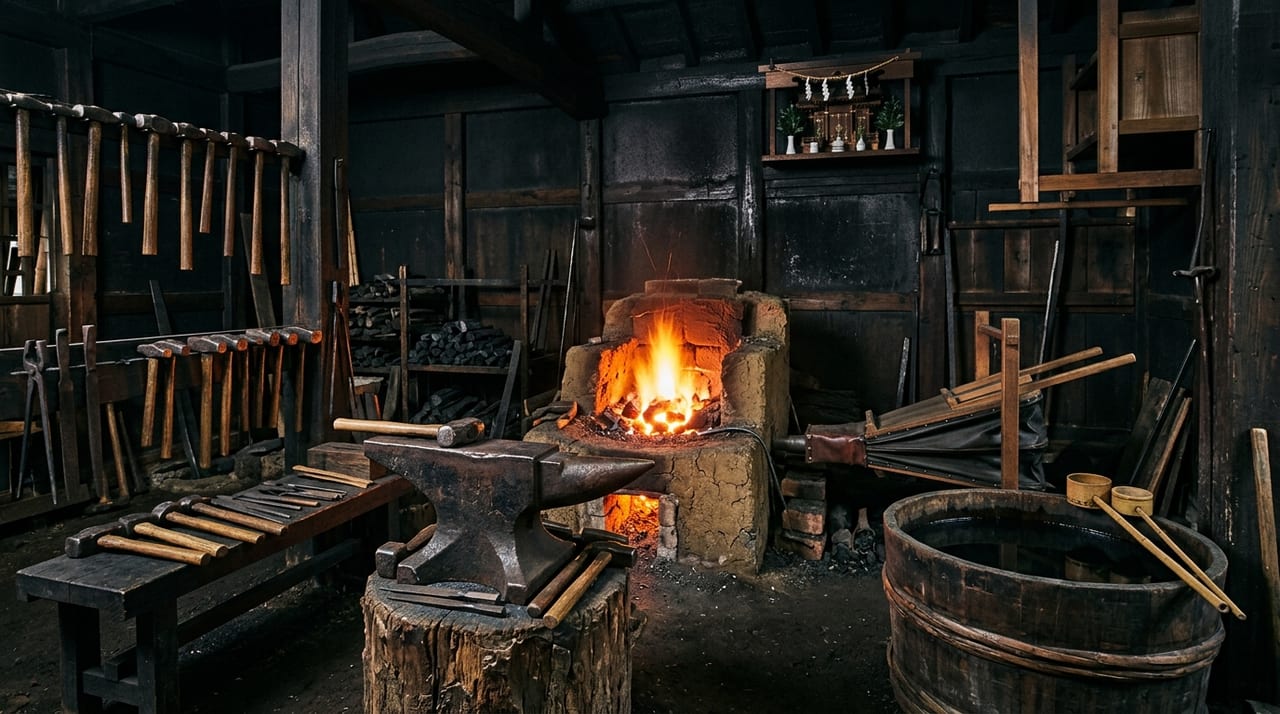
The heart of the kajiba is the furnace (ro) — the heating furnace in which tamahagane is brought to temperature. The furnaces used by modern tōshō can be broadly divided into the following three types.
Jiro: The classical form, in which a pit is dug into the ground, charcoal is placed in it, and air is blown in via the fuigo. Because the furnace is below floor level, it allows the worker to assume a natural forward-leaning posture. Many traditional workshops still use this form today.
Dairo: A form in which the furnace is set on a platform raised above floor level. It permits a more comfortable working posture than the jiro and reduces strain on the lower back. Adoption has been growing in workshops that place emphasis on training apprentices.
Electric and gas furnaces (auxiliary use): Some tōshō also use electric or gas furnaces as auxiliary equipment for low-temperature processes such as yakimodoshi (tempering). For the core processes of tanren and yaki-ire, however, using a charcoal furnace is the norm.
The furnace is often positioned toward the center-rear of the building. In terms of workflow, the ideal arrangement is a straight line running from the entrance through the furnace, the anvil, and the water bucket in that order.
Installation of the Fuigo and Tatara
The device that supplies air to the furnace is the "fuigo" (bellows). Before the modern era, the standard was a box-shaped bellows device operated by foot, known as the "hako-fuigo." In modern workshops, most have replaced it with an electric blower. Some tōshō, however, insist on the traditional tatara and have their apprentices use it during training as well.
Electric blowers present issues of noise and vibration. For this reason, a design in which the blower is housed in a soundproof box outside the building and connected to the furnace by ducting has become more common, as a consideration to neighboring residences.
Placement and Securing of the Kanatoko
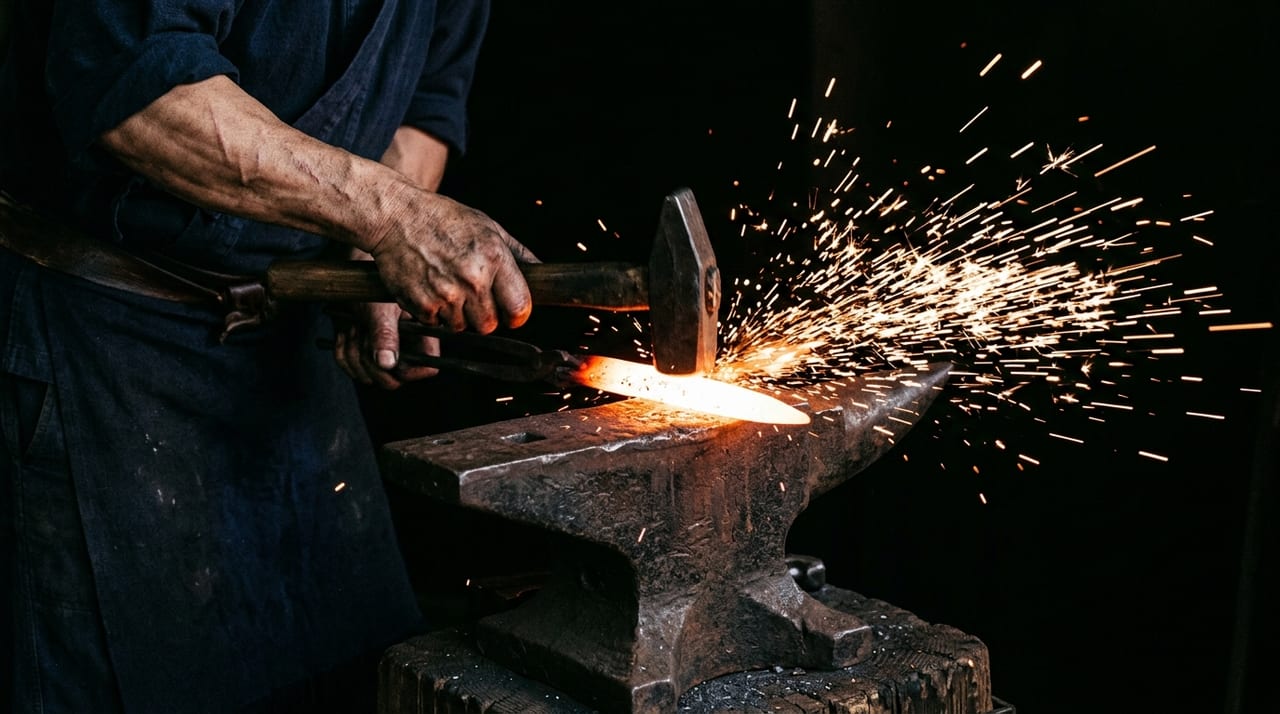
The "kanatoko" (anvil) on which the tōshō swings the hammer is placed beside the furnace — within arm's reach with a simple turn of the body. The kanatoko is made of cast iron or forged steel, and a smooth surface is essential. Weight ranges from 50 kg for small models to over 200 kg for large ones.
Traditionally, the kanatoko is secured either by embedding it directly into the floor or by fixing it to a hardwood (such as keyaki) base. However, anchoring it directly to the floor allows the shock of hammer blows to travel through the floor and throughout the entire building. For this reason, modern designs commonly incorporate vibration-damping materials such as rubber or a sand bed between the kanatoko and the floor.
Mizuoke and Cooling Tank
The water bucket (mizuoke) used for yaki-ire (water quenching) is placed adjacent to the furnace and kanatoko. Controlling the water temperature is a critical factor that directly affects the quality of the yaki-ire, and many tōshō have their own individual management practices — for instance, "use water at a constant temperature even in the depths of winter," or "chill the water with well water or ice water during summer."
Wooden buckets (hinoki or keyaki) have been the mainstream material for mizuoke since ancient times, and many tōshō still insist on wooden ones today. The background is a rule of experience that metal containers may leach trace amounts of ions into the water, potentially having an adverse effect on the yaki-ire.
Ventilation, Smoke Extraction, and Modern Regulatory Compliance
Smoke, carbon monoxide, and dust produced by a charcoal furnace have a significant impact on the health of workers and the surrounding environment. Modern kajiba are therefore required to implement the following ventilation measures.
- Installation of smoke-extraction outlets: A large smoke-extraction hood is fitted directly above the furnace, with ducting running outside for direct exhaust.
- Installation of ventilation fans: Ventilation fans are fitted at a high point in the building (near the roof) to provide forced ventilation.
- Permanent installation of CO detectors: To prevent carbon monoxide poisoning, installing a CO detector near the furnace is recommended.
As a noise consideration for neighboring residences, many workshops also establish a self-imposed rule of restricting hammer work to daytime hours and performing no work at night.
Understanding the Kajiba Deepens Sword Appreciation
Knowing the kajiba provides indispensable context for understanding a nihontō as a work of art. The traces of fire-forging left on a blade, the shape of the hamon determined by the water temperature of the yaki-ire, the thickness and sori of the blade formed by the rhythm of the kanatoko and hammer — all of these were born within the specific space of the kajiba. When you hold a sword, try imagining the craftsman's working space that lies behind it. That is the first step toward deeper appreciation.