What is kaiken — the protective blade of samurai women, the meaning carried by a bride at a wedding ceremony, and the difference from futokoro-gatana
 * Image is for illustrative purposes only.
Table of Contents
What is kaiken — reading and meaning
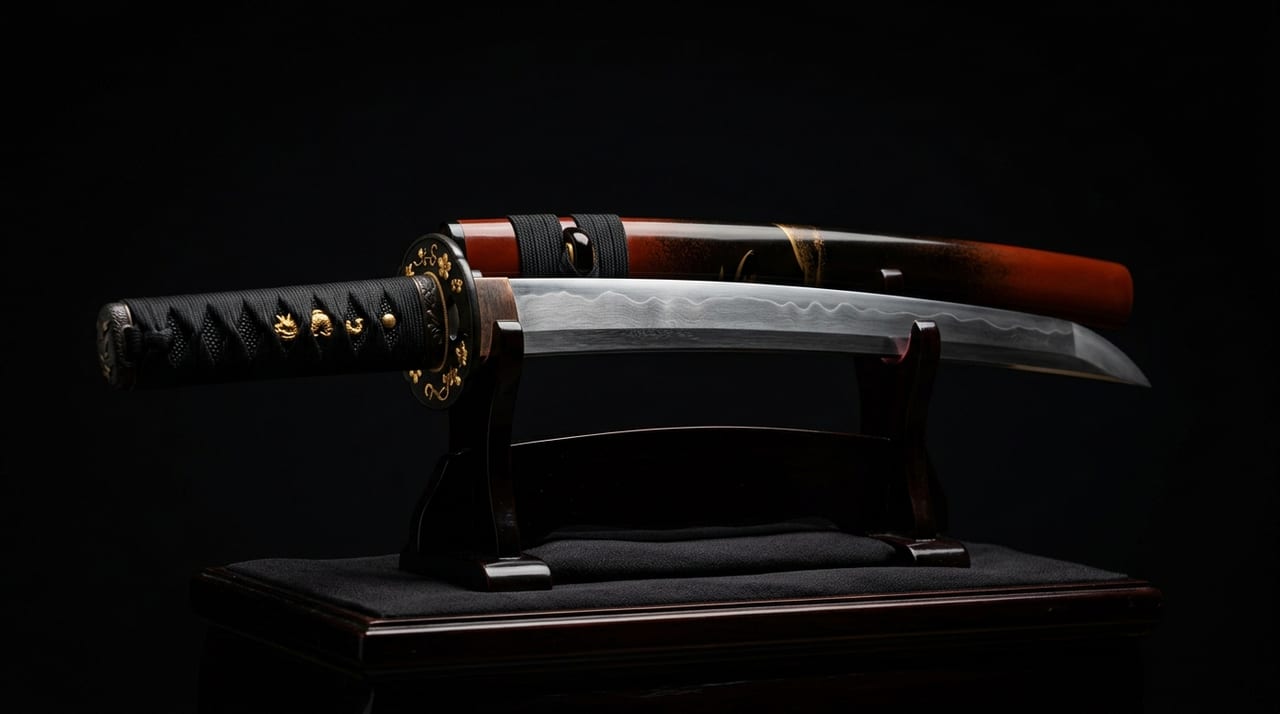
Kaiken is a general term for short bladed weapons concealed and carried in the bosom (futokoro), that is, the front of a kimono. The nagasa (blade length) is generally 6 sun (approximately 18 cm) or less, and the name is a direct rendering of the meaning "a sword hidden in the bosom." The same item is also called "futokoro-gatana," a term that has additionally become established as an idiom meaning "a trusted confidant who serves close to one's lord."
In the classification of Japanese swords, kaiken is a type of tantō. However, whereas "tantō" is a classification name for a blade based on nagasa (blade length) (less than 1 shaku, approximately 30.3 cm), "kaiken" is a term that focuses on the method of carrying and the purpose. Kaiken are customarily housed in a koshirae (mounting) called aiguchi, which has no tsuba (hand guard), and they served three purposes: self-defense, ceremonial use, and ritual suicide.
Differences between kaiken, futokoro-gatana, tantō, and aiguchi
The four terms that are easily confused each differ in what they focus on.
| Term | Reading | What it refers to |
|---|---|---|
| kaiken | kaiken | General term for a tantō concealed and carried in the bosom (named by purpose and carrying method) |
| futokoro-gatana | futokoro-gatana | Synonymous with kaiken. Also used as an idiom meaning "a trusted subordinate" |
| tantō | tantō | Classification name for a blade with nagasa (blade length) of less than 1 shaku (approximately 30.3 cm) |
| aiguchi | aiguchi | Name for a style of koshirae (mounting) with no tsuba (hand guard). Most kaiken use aiguchi koshirae |
In other words, a blade called "kaiken" is, in terms of blade classification, a tantō, and in terms of mounting style, an aiguchi koshirae — the three terms are often different ways of referring to the same object from different angles. The idiom "futokoro-gatana" meaning a capable trusted confidant derives from the fact that kaiken were always kept closest to the master and could be relied upon in an emergency.
Samurai women and kaiken — a history as a protective tool
Kaiken became an essential item for women of the samurai class from the late Muromachi period through the Edo period. In samurai society, women were expected to possess a certain level of martial training as a matter of course, and learning to handle a kaiken alongside the naginata was part of the education of women of the upper samurai class.
The significance of self-defense and ritual suicide In the Sengoku period, kaiken were carried as "tools of resolve" — instruments by which women of the samurai class could take their own lives rather than be dishonored by the enemy in the event of a castle's fall or the death of a husband. This was a practical choice rooted in the samurai's sense of honor, and carrying a kaiken was also a demonstration of the resolve to "end one's own life when the moment came." Records of the Osaka Winter and Summer Campaigns preserve testimony that the women inside the castle held kaiken in hand.
Changes in the Edo period — from self-defense to ceremony In the peaceful Edo era, the practical self-defense function of kaiken faded and its ceremonial significance gradually took over. However, for women of the samurai class, kaiken remained an important symbol of identity, and the custom of concealing one in the bosom when going out continued.
Wedding ceremonies and kaiken — the meaning of a bride in shiromuku carrying a kaiken
The cultural significance of kaiken is most clearly apparent at weddings. At the weddings of samurai and court noble families, kaiken were invariably included among the trousseau items, and this custom has been inherited directly by modern Japanese-style wedding ceremonies. The kaiken that a bride in shiromuku (white wedding kimono) or iro-uchikake (colored ceremonial outer robe) tucks into her obi is, together with the hakoseko (cosmetic pouch) and suehiro (ceremonial fan, equivalent to a folding fan), the centerpiece of "bride's accessories" (hanayome komono), and is a remnant of the bridal attire of samurai families in the Edo period.
The meaning of a bride carrying a kaiken First, it is a symbol of self-defense: "protecting one's own person." Sending a daughter to her new home with a kaiken was a gift of a "guardian blade" from her family of birth, and the meaning of warding off evil spirits and misfortune was also embedded in it. Second, it is a declaration of "the resolve to live in the new household." The samurai spirit of committing fully to the new family and, if the worst came to worst, protecting one's own honor by one's own hand was condensed into one small blade.
Value as property and as craft Kaiken among bridal furnishings had the finest craft techniques applied to their koshirae (mounting) — gold metalwork, maki-e lacquer, and raden (mother-of-pearl inlay) — and served as gifts demonstrating family standing. In many cases the koshirae (mounting) was considered more valuable than the blade itself, and custom pieces incorporating the family crests of both the bride's family and the groom's family were also produced. The koshirae (mounting) of kaiken made for the weddings of the Tokugawa shogunal family and daimyo households stand at the pinnacle of gold metalwork and maki-e art.
Structural features of kaiken — aiguchi koshirae and blade shape
The defining formal feature of kaiken is the "aiguchi koshirae without a tsuba (hand guard)."
Aiguchi koshirae (aiguchi-koshirae) Because there is no tsuba (hand guard), the blade presents an unbroken silhouette from the pommel of the tsuka (hilt) to the mouth of the saya (scabbard). This means that when stored in the bosom, the tsuba (hand guard) does not catch, allowing a swift draw. The name "aiguchi" derives from the way the mouth of the tsuka (hilt) and the mouth of the saya (scabbard) fit together precisely, and the saya (scabbard) is often finished beautifully with lacquer, maki-e, or raden (mother-of-pearl inlay).
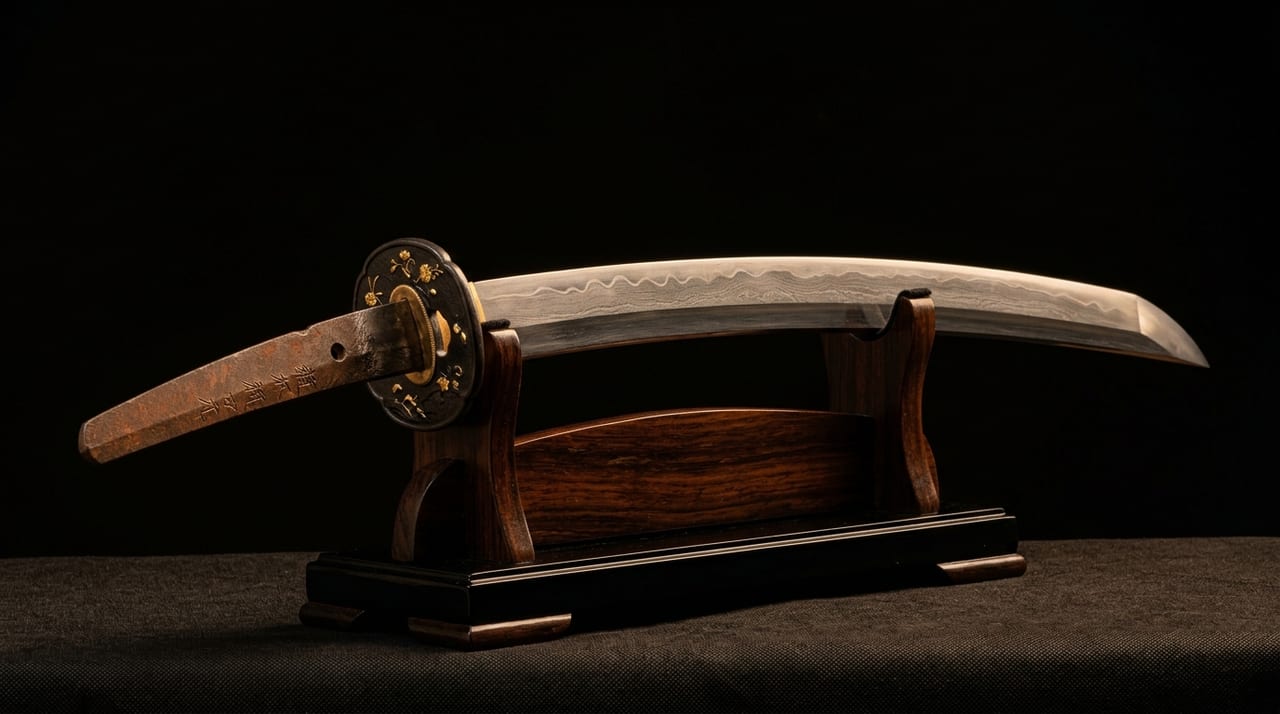
Blade shape The nagasa (blade length) is typically 4 to 6 sun (approximately 12 to 18 cm), and hira-zukuri is the dominant form. Most examples have very shallow sori (curvature) or no sori at all; being suited to thrusting and easy to store in the bosom were the top design priorities.
Metalwork and fuchi-kashira design The metalwork on the tsuka (hilt) and saya (scabbard) is decorated with family crests such as plum blossom, chrysanthemum, and paulownia, as well as auspicious patterns. Kaiken for weddings in particular were a showcase for metalwork craftsmen, and were produced within the same artisan culture as the tōsōgu (sword fittings) craft of the Edo period, including kozuka and menuki.
Surviving masterpieces — kaiken in museums
Domestic museums and art museums hold kaiken that are highly regarded as works of art. Works by master tantō smiths of the Kamakura period — among them Awataguchi Yoshimitsu — have the hira-zukuri, no-sori form suited to kaiken, and many were transmitted as kaiken after being fitted with aiguchi koshirae (mounting) in later ages. The kaiken among the bridal furnishings of daimyo households preserved at institutions such as the Tokugawa Art Museum are known for their magnificent koshirae (mounting) in maki-e and raden (mother-of-pearl inlay), and are examples in which the artistry of the koshirae (mounting) stands out over that of the blade. Regional museums across the country also hold large numbers of bridal kaiken passed down from former daimyo and samurai families, and they are important as records of the regional character of metalwork and lacquer art in various areas.
Modern kaiken — the Firearms and Swords Control Act (Jūtōhō) and purchase/possession
In modern Japan, genuine kaiken (tantō) with a blade are subject to the Act for Controlling the Possession of Firearms or Swords and Other Such Weapons (Jūtōhō), and any piece with a registration certificate (firearms and swords registration certificate) issued by a prefectural Board of Education may be possessed and bought or sold by anyone without a license. This is treated in exactly the same way as tachi and uchigatana. However, even with a registration certificate, carrying one outdoors without legitimate reason is not permitted.
On the other hand, the kaiken used as a bride's accessory in modern wedding ceremonies are almost all replicas without a blade (made of cloth, resin, bamboo substitutes, and the like) and are outside the scope of the Firearms and Swords Control Act (Jūtōhō). If one wishes to use a genuine tantō as a "guardian blade" at a wedding or to pass it down to one's children or grandchildren, the correct approach is to purchase a registered tantō as an art sword and keep it at home.
What is the difference between kaiken and futokoro-gatana?
As physical objects, they are the same thing. Both "kaiken" and "futokoro-gatana" refer to a tantō carried in the bosom; the only difference is the name. In modern Japanese, however, there is a tendency to use them differently: "kaiken" is used in the context of wedding accessories or guardian blades, while "futokoro-gatana" is used as a metaphor for a trusted person, as in "the president's futokoro-gatana."
Why does a bride tuck a kaiken into her shiromuku?
It is a remnant of the custom in Edo-period samurai weddings by which a bride's family would send their daughter with a guardian blade for self-defense. It carries layered meanings: a symbol of self-reliance in "protecting one's own person by one's own hand," a declaration of the resolve to "live through life in the new household," and a ward against evil. In modern weddings, it is common to wear a decorative kaiken without a blade together with the hakoseko and suehiro.
Can kaiken still be possessed today?
Yes, they can. A tantō with a registration certificate requires no license, and purchase, inheritance, and transfer are all legal (notification of change of ownership is required). What is prohibited is "carrying without legitimate reason"; there are no restrictions whatsoever on keeping and appreciating one at home. When purchasing from a sword dealer, it is advisable to always confirm whether a registration certificate is included.
The essence of Japanese culture that kaiken conveys
Kaiken belongs among the smallest class of Japanese swords, but its cultural density is no less than that of the tachi. The structure by which a single small blade serves the triple role of self-defense, ceremonial use, and ritual suicide is a condensation of the notion in Japanese samurai society that "a sword is proof of the resolve to stake one's life," and is also precious evidence of the relationship between women and sword culture. The continuing sight of a bride tucking a kaiken into her shiromuku at a modern wedding ceremony is, beyond mere formality, nothing other than the living transmission of kaiken's original spirit of "resolve and sincerity."