Types of Base Metal in Iron Tsuba — Reading Period and School from Kitae-hada, Color, and Forging Marks
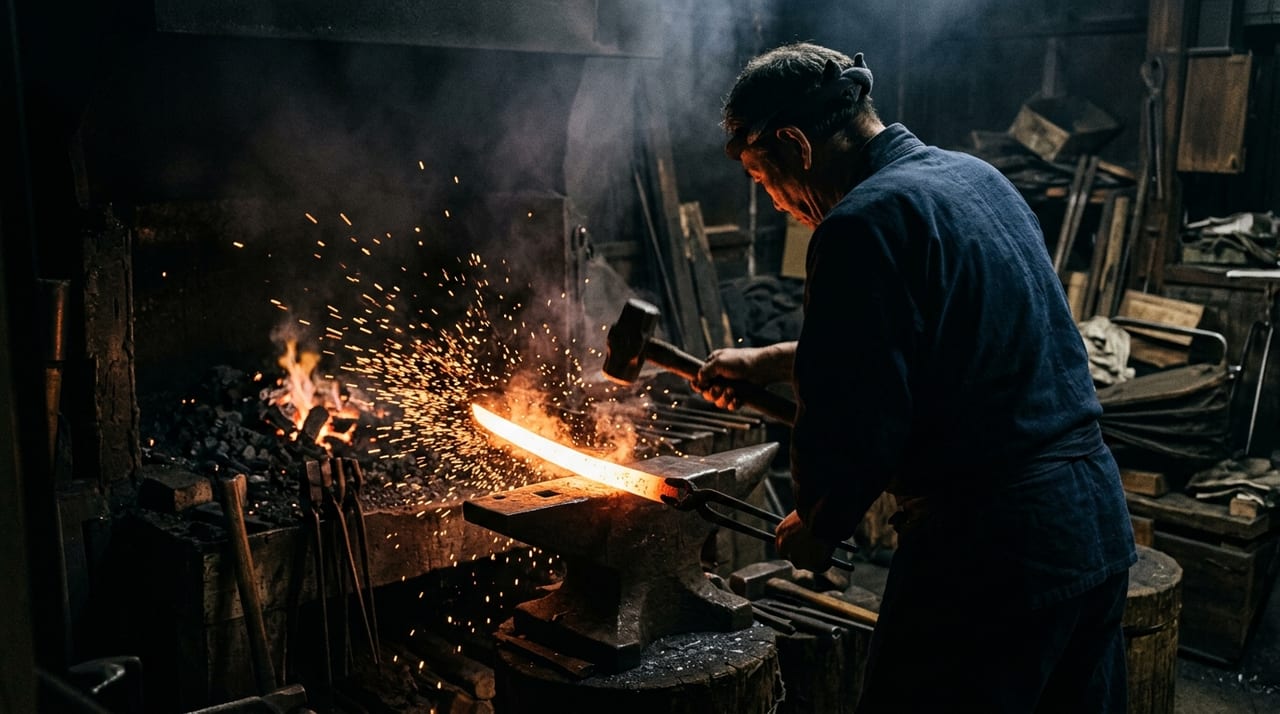 * Image is for illustrative purposes only.
Table of Contents
"The Character of the Jigane" — The Core of Iron Tsuba Appreciation
Just as the "jihada" of the blade — the surface pattern of the iron produced by tanren — is one of the most important evaluation criteria in the appraisal of a Japanese sword, so too does the quality of the "jigane" form the core of appreciation and evaluation in tsuba.
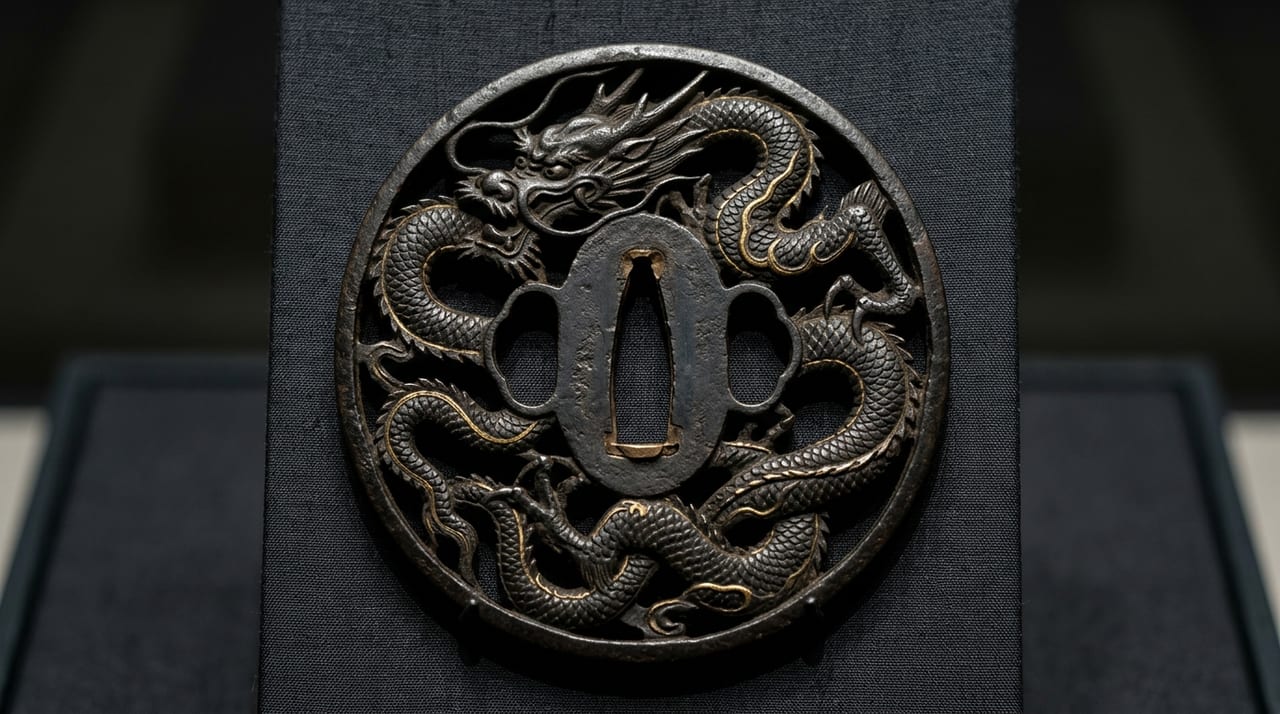
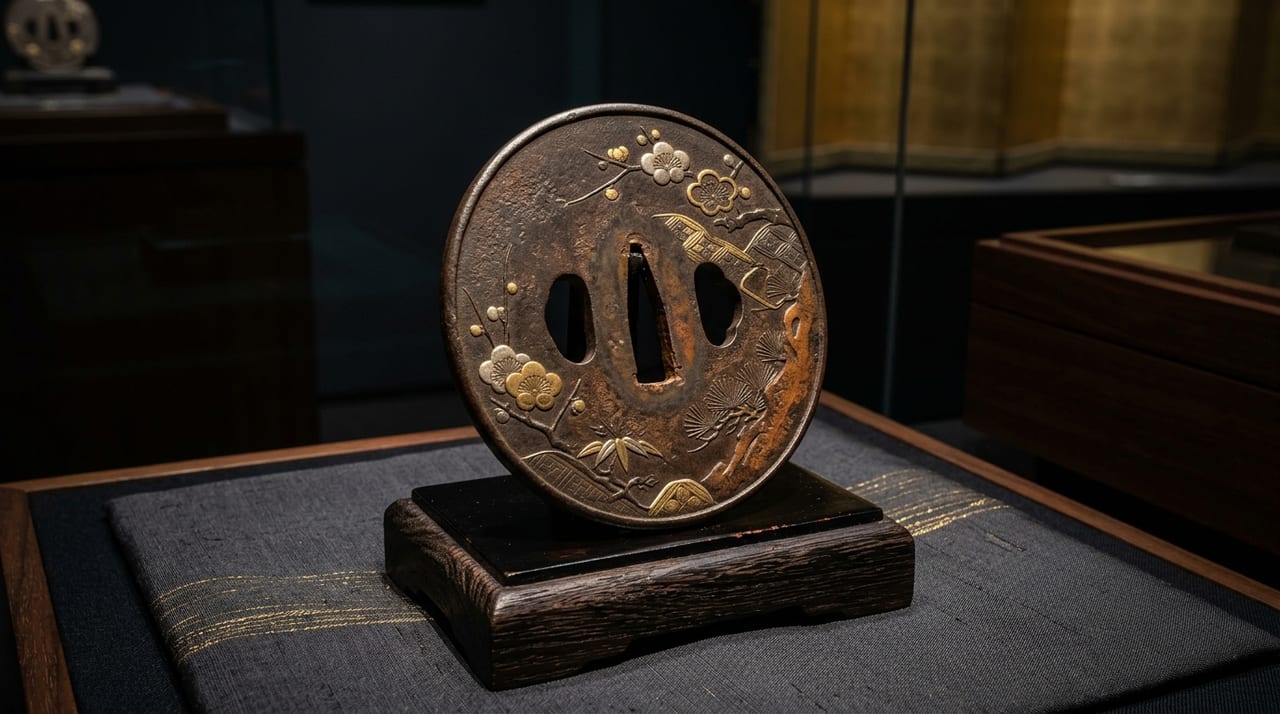
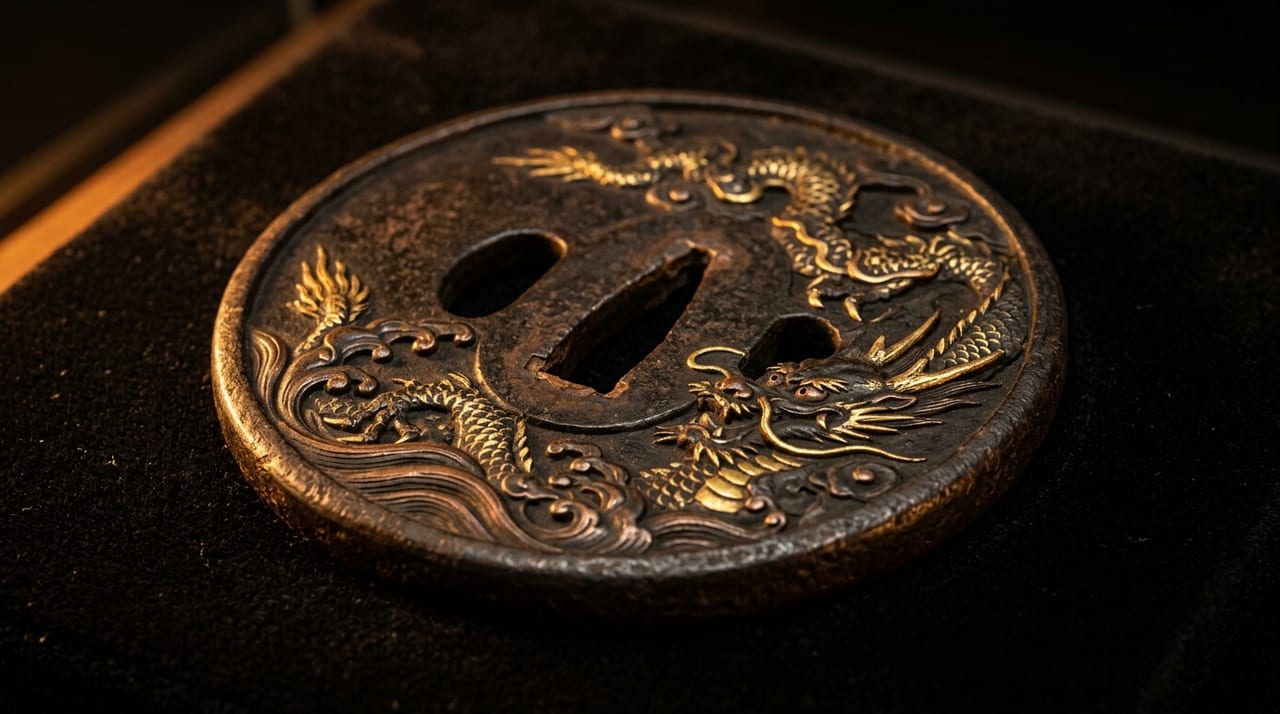
To examine the jigane of an iron tsuba is tantamount to reading how that tsuba was made and what history it has passed through. By observing the koiro (patina), kitae-hada, and condition of the rust comprehensively, the period, school, and state of preservation all come into view. A skilled appraiser may, at the very moment of picking up a tsuba, determine its place of origin and approximate date almost entirely from its weight and texture. So eloquently does the quality of the jigane speak.
The quality of the iron also varies greatly with period and place of production. The "tamahagane" made from sand iron in the medieval period is rich in expression owing to its higher impurity content, while the foreign iron (yasuri-iron, nanban iron) that circulated from the early modern period onward has a uniform composition and a distinctive luster. Reading this difference in materials is the first step in jigane appreciation.
Types and Significance of Kitae-hada
The kitae-hada that appears on the surface of an iron tsuba is produced as a result of the number of tanren passes, direction, and temperature control, and directly reflects the craftsman's level of skill and working habits.
| Surface Pattern | Characteristics | Main Schools/Periods Where Found |
|---|---|---|
| Itame-hada | A flowing pattern like the flat grain of a plank of wood appears on the surface. The number of tanren passes is moderate and the flow of the material is beautifully ordered. The more uniformly aligned the direction of flow, the higher the skill is considered to be. | Found in Shōami and Higo kinkō works; the most fundamental and widely observed surface pattern |
| Masame-hada | A straight, linear pattern like the straight grain of wood. Indicates that tanren is extremely uniform and the directionality of the material is perfectly aligned. A high-quality surface pattern that requires refined finishing. | Ground plate of schools that make extensive use of engraving, such as Kaga zōgan |
| Mokume-hada | A complex, swirling pattern like the figured grain of wood. A complex pattern produced by intentionally changing the direction of tanren, regarded as especially high in aesthetic value as the "wonder of mokume." Natural mokume is difficult to reproduce artificially. | Works of master craftsmen from the mid-Edo period onward |
| Oni-ita-hada | A rough, coarse surface on which tanren marks appear large and rugged. Highly prized by certain collectors as a "rustic beauty" that brings the raw strength of the base material to the fore. | Some works by Shōami and Higo kinkō of the early Edo period |
| Muji-hada | A state in which the surface is uniform and no particular surface pattern is prominent. Plays the role of an unobtrusive backdrop that sets off sukashi carving and high-relief work. | Works of the late Edo period, finely ground and finished |
Color of Rust and Period Identification
The rust (sabi) of an iron tsuba is one of the most important clues for period identification in appraisal, and is the first thing an experienced appraiser's eye is drawn to.
Kuro-sabi (black rust): A stable protective layer composed mainly of iron(II,III) oxide (Fe₃O₄), presenting a deep black to blackish-brown color. Natural kuro-sabi formed through aging is a superior rust that protects the iron from within, and is seen uniformly on the surface of many old masterworks. When lightly touched with a fingertip, it offers a silky resistance.
Aka-sabi (red rust): A corrosive rust composed mainly of iron(III) oxide (Fe₂O₃), presenting a reddish-brown color. It is produced by prolonged contact with moisture, and when it advances it erodes the jigane. Widespread aka-sabi indicates poor preservation conditions, but even in old pieces localized aka-sabi is not uncommon, and in some cases it itself serves as evidence of the long years that have passed.
Koiro (patina): A complex surface state formed naturally over many years, in which kuro-sabi, brown rust, and the luster of the jigane intermingle in a complex way. A complete koiro is extremely difficult to reproduce artificially and constitutes decisive grounds for authentication. The koiro that remains particularly at the edge of the fuchi and on the inner surfaces of sukashi openings is a location where differences from forgeries are most likely to appear, as it is difficult to treat.
Artificial coloring (iro-age): A finish that imitates patina by chemical treatment is called "iro-age." It can often be identified by its unnatural uniformity, strong luster, and disharmony with the kitae-hada. Genuine koiro has partial variation in depth and shade like worm-eaten wood, and changes subtly in hue depending on the angle of observation.
Correspondence Between Period/School and Jigane Characteristics
Grasping the representative jigane characteristics of each period and school is of great help in attributing unsigned tsuba.
Tsuba of the kotō period (Heian–Muromachi): Few survive and they are precious; the jigane is generally thick, and the kitae-hada is often large and coarse. The koiro is deep and complex, and "chikei" — in which the internal structure of the iron appears as reflections — can sometimes be observed. Weight and simplicity are characteristic, and a construction that prioritizes practicality over ornamentation seeps through the jigane.
Higo kinkō (early Edo period onward): The works of the official tsuba-makers of the Kumamoto domain have a distinctive texture known as "Higo iron." The surface has fine unevenness, which creates complex reflections when raking light is applied. The color tends toward black to blackish-brown, and a taut koiro that embodies the martial spirit of the domain is characteristic. The works of Hayashi Matashichi, Shimizu Jingoemon, and others are said to be identifiable at a glance by the distinction of their jigane.
Shōami school: The works of the Shōami clan, which spread across the country, are diverse by region and period, but generally have a uniform jigane with a good balance between sukashi and carving. Kyō-Shōami tends toward a fine, dense itame-hada, while Edo-Shōami tends to have a somewhat coarser surface pattern.
Nanban tsuba (using imported materials): Having a uniform composition or a fine mesh-like structure, they differ clearly from Japanese tamahagane. The surface luster is somewhat metallic and cold, and the way the koiro penetrates often shows a pattern different from Japanese iron.
Practical Jigane Appreciation — Light Sources and Angles of Observation
Appropriate light sources and observation techniques are indispensable for correctly observing the quality of the jigane.
- Making use of raking light (shako): By directing light at the tsuba's surface from an angle, kitae-hada, hammer marks (tsuchime), and fine unevenness stand out in relief. With direct light (light from straight ahead), the three-dimensionality of the kitae-hada is lost, making surface pattern identification difficult. Holding a flashlight at a 45-degree angle and slowly rotating the tsuba makes it easier to grasp the overall picture of the surface pattern.
- Choice of light source: Natural light (diffuse light on a clear day) or incandescent bulbs are ideal. LED lighting and fluorescent lights tend to flatten fine unevenness with their uniform light, and the color of the rust may appear different from reality. Even in museum exhibitions, lighting designs that prioritize light source quality have been increasing in recent years.
- The importance of magnified observation: Using a 10–20× loupe allows clear confirmation of the crystal structure of the rust, the details of the kitae-hada, the state of inlay embedding, and repair marks. The particle structure of the rust is particularly effective for authentication: naturally formed kuro-sabi forms layers of fine, uniform crystals, whereas artificial coloring is often observed as coarse particles floating on the surface.
- The tactile sense of weight and texture: Jigane observation does not rely on vision alone. The sense of weight when held in the hand, the balance of the center of gravity, and the tactile feel of the texture transmitted to the fingertips are also important sources of information. The jigane of old masterworks is said to have a distinctive settled quality born of long years.
Conclusion — The Beauty of the Jigane as a Reflection of the Tōkō's Soul
Inscribed in the jigane of an iron tsuba are the skill of its maker, the quality of its material, and the breath of its age. Just as with the jihada of the blade, the ability to read the jigane of a tsuba deepens tsuba appreciation from a superficial "observation of appearance" into a "decipherment of the interior."
The type of kitae-hada, the color of the rust, and the state of koiro formation each function as independent pieces of information while complementing one another to form a single image of a period and school. It is the answer to which all three point in alignment that constitutes the basis for a reliable attribution.
Iron tsuba that have passed through hundreds of years continue to speak quietly at this very moment. Refining the skill and sensibility to read their words is the true pleasure of jigane appreciation, and the path that leads to the depths of Japanese sword culture.