Imperial Navy Swords — Types and Regulation History of Short Swords, Command Swords, and General Officer Swords, and Their Differences from Army Guntō
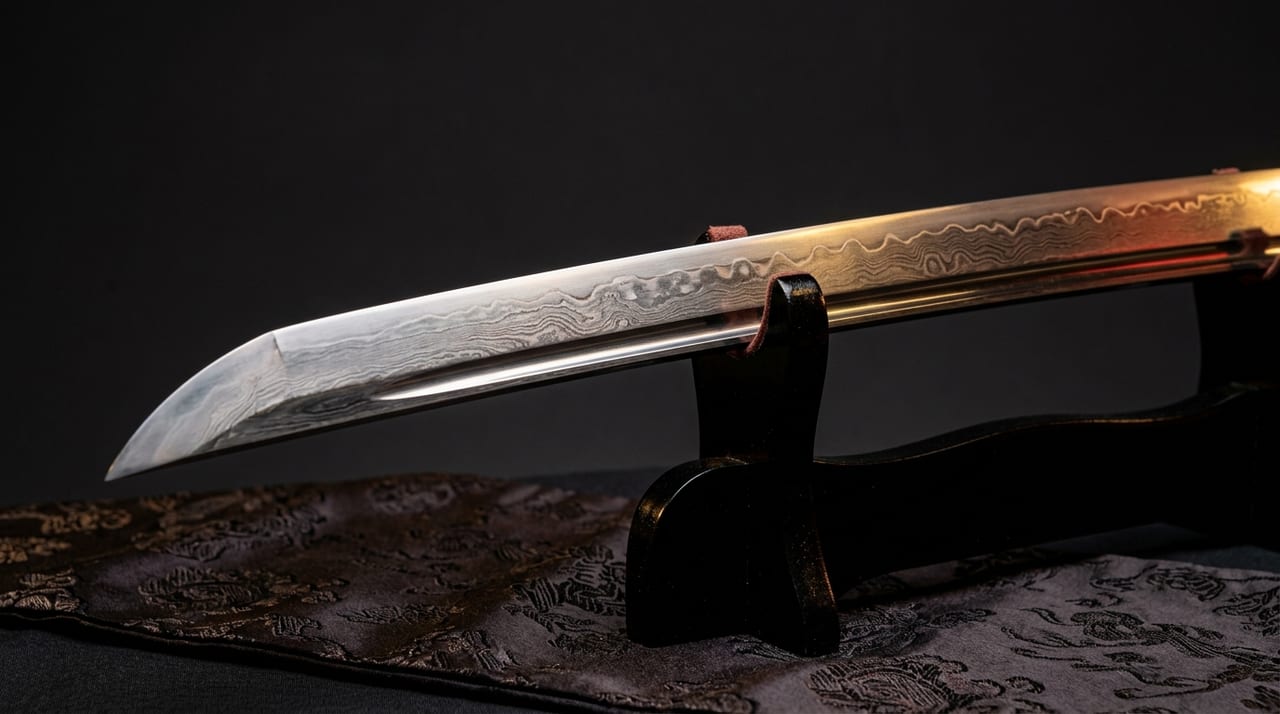 * Image is for illustrative purposes only.
Table of Contents
The Naval Sword System — A Philosophy Fundamentally Different from the Army
While army guntō were designed and developed as "symbols of the samurai spirit in land combat," the Imperial Navy's sword system had a different philosophical background. As is clear from the realities of naval warfare, in which naval guns, torpedoes, mines, and aircraft decided the course of battle, opportunities for close combat were far more limited than in land warfare. For this reason, naval swords had a relatively stronger aspect as "formal dress, ceremony, and rank insignia," and the direction of their standardization reflected this.
At the same time, the navy was also an organization that upheld "pride as military men," and as the Shōwa period progressed, enthusiasm for placing importance on Japanese sword-style command swords grew. Imperial Navy swords are best understood when classified into the following three broad categories.
- Naval tantō
- Naval tachi-style guntō (command swords)
- General officer and marshal swords
This systematic classification forms the basic framework used by modern sword researchers and collectors when organizing military swords in general.
Naval Tantō (Kaigun Tanken) — A Japanese-Western Fusion of the Western Dress Sword
The naval tantō was a ceremonial short sword standardized in the early Meiji period under the strong influence of European navies — in particular the Imperial German Navy and the British Royal Navy. Its character as a "formal dress item" worn at the hip during court attendance, ceremonies, diplomatic occasions, and formal dress aboard ship stood out prominently, and combat use was barely considered.
The nagasa was approximately 20–22 cm (with measured examples at 22.1 cm), and the blade form was double-edged or single-edged. While the form was close to a Western knife, the saya and kashira were decorated with Japanese motifs such as chrysanthemum crests, anchors, and paulownia crests, giving it a distinctive hybrid beauty. The grip portion of the tsuka was made of ray skin or artificial substitute material, and the fittings were finished in gold or silver plating. Since the magnificence of its appearance as formal dress took absolute priority, manufacturing costs were comparatively high, and differences in quality existed according to the officer's rank.
Notably, naval tantō were unified in the form of a "tantō" regardless of rank. This contrasts with the army's use of the guntō (Japanese sword type) as its foundation, and represents one aspect of the navy's distinct formal dress culture. In addition, the precision of the designs and the quality of materials applied to the tantō koshirae tended to be more expensively finished as the officer's rank was higher, and modern collectors can use these distinctions in grade as a reference for appraisal.
Naval Tachi-Style Guntō (Kaigun Tachigata Guntō) — Development of Japanese Sword-Style Regulation Swords
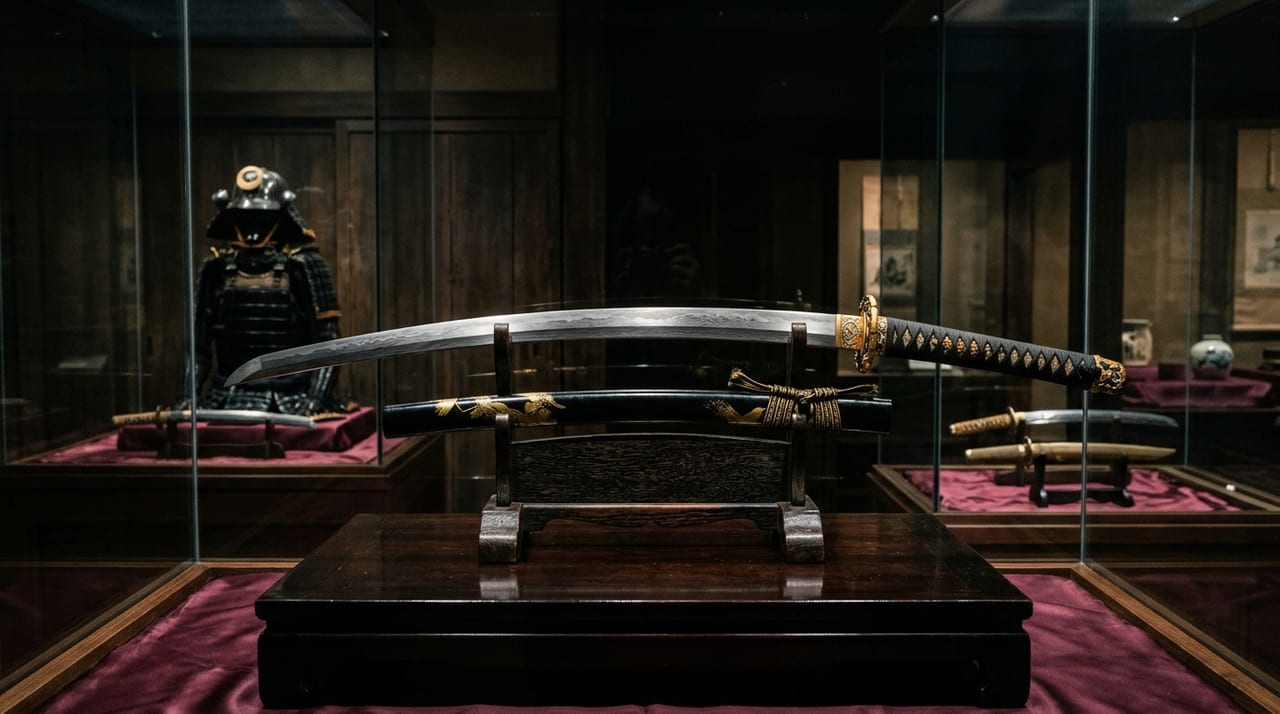
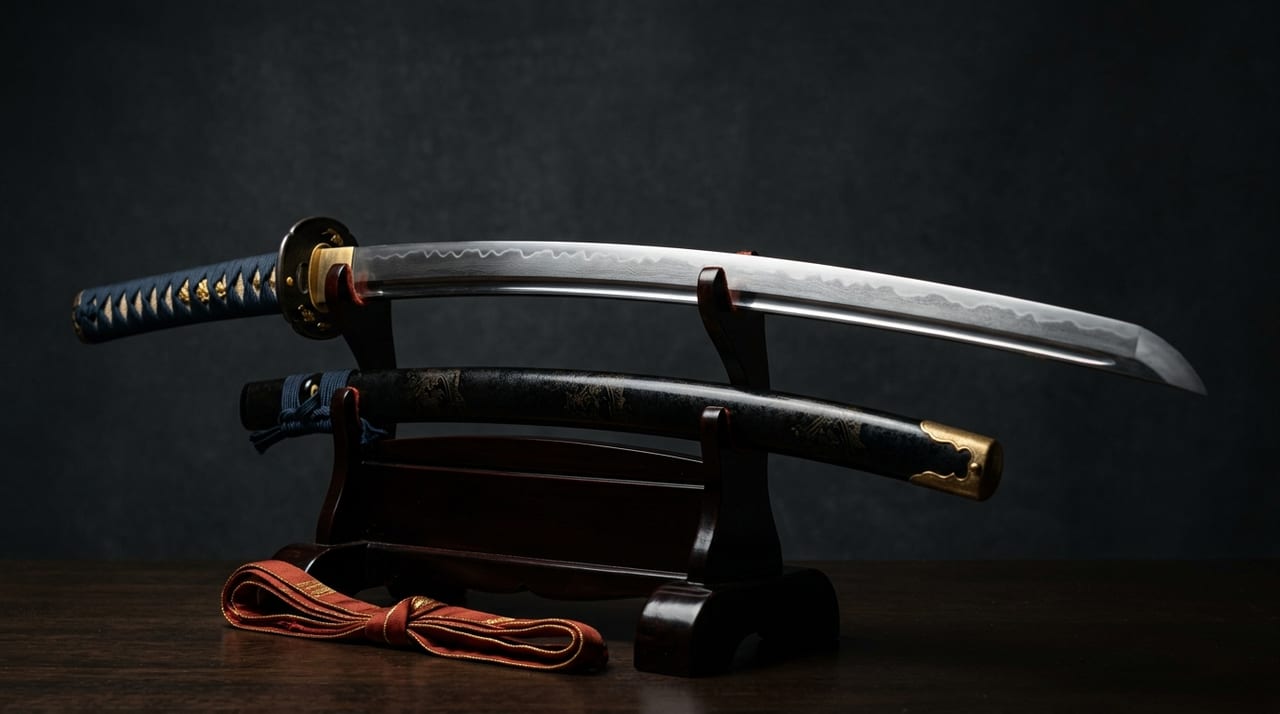
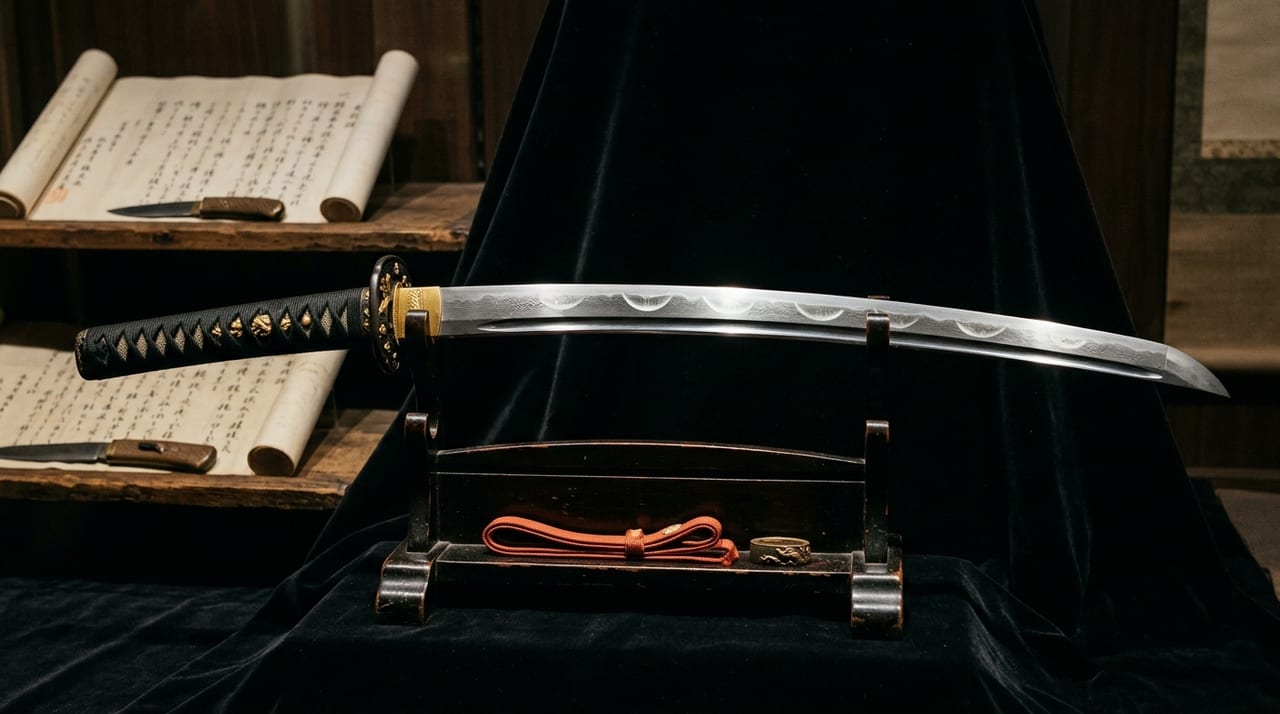
The naval tachi-style guntō was the regulation Japanese sword-type blade carried by officers during combat and regular duties, and functioned as the naval equivalent of the army guntō. Unlike the tantō, it had the form of a Japanese sword and was required to be designed with some degree of consideration for combat. It was commonly known as the "naval command sword," but its official name was "naval tachi-style guntō," and it was formally established in October of Shōwa 12 (1937).
Distinctive features were the tsuba engraved with chrysanthemum crests, and the unique koshirae form equipped with a kurikata and koiguchi. Naval motifs such as anchors, chrysanthemums, and paulownia crests were frequently used in the tsuba design, clearly distinguishing them from the army's pentagram (star) crest.
As for the blade, a wide range existed from traditionally forged blades to factory-manufactured mass-produced items, as with army guntō. During the Shōwa period, fully forged blades produced under the "commissioned tōkō" system were also adopted for naval tachi-style guntō, and their quality was in many cases equal to or higher than that of the army's Type 98 guntō. Also, possibly in consideration of being carried in the confined spaces aboard ship, blades tended to have a somewhat shorter nagasa, though individual variation is large and no blanket statement can be made. Authentic swords born of the commissioned tōkō system command high regard in today's sword market.
General Officer and Marshal Swords — The Highest-Ranking Regulation Swords of the Navy
For senior naval officers of high rank such as admirals, full admirals, vice admirals, and marshals, specially specified regulation swords were established. As rank increased, the refinement of the fittings, the quality of materials, and the intricacy of the designs all increased, and the sword itself functioned as an item of personal adornment that spoke eloquently of one's rank.
Among these, the marshal sword was the highest-ranking regulation sword in the navy. This sword, which only those holding the title of marshal were permitted to wear, was a finest-quality item fitted with gold maki-e and intricate metalwork on the tsuka and saya, and the number produced was extremely limited. Only a handful of surviving examples are confirmed in collections at home and abroad, and their rarity and historical value are beyond measure.
Even the command swords of full admiral and vice admiral class were distinguished by tsuba with chrysanthemum and paulownia crests finely engraved, and gold-plated kurikata and kojiri, creating a visually clear distinction from the regulation swords of ordinary officers. This went beyond a mere matter of aesthetics and also served the practical purpose of visibly conveying the chain of command aboard ship. General officer-class regulation swords were each close to one-of-a-kind, and their manufacturing process was fundamentally different from mass-produced items.
Comparison with Army Guntō — Differences in Regulatory Philosophy
Comparing the sword regulations of the Imperial Army and Navy, philosophical differences emerge as concrete differences in form.
| Item | Army | Navy |
|---|---|---|
| Tsuba design | Centered on the "army star (pentagram)" and "chrysanthemum" | Navy-specific motifs such as "anchor," "chrysanthemum," and "paulownia" |
| Finish of fittings | Type 98 aimed for a rugged, utilitarian appearance | Glossy gold- or silver-plated finishes predominate, with the formal dress aspect foregrounded |
| Timing of regulation development | Progressively standardized Japanese sword-style guntō with Type 94 (Shōwa 9) and Type 98 (Shōwa 13) | Continued to maintain both the formal dress tantō and the naval tachi-style guntō (established Shōwa 12) side by side |
The difference in tsuba design was not merely a design distinction but reflected an intent to inscribe organizational identity onto the sword. The difference in timing of regulatory development is expressed in the fact that tantō culture continued to occupy the core of formal dress until the end, which can be seen as a reflection of the character of the naval organization — a culture that placed importance on international diplomatic ceremony and formal ritual aboard ship.
Notes for Modern Collectors — Authenticity and Appraisal
Naval tachi-style guntō are less common in circulation than army guntō, and complete examples (with matching blade and koshirae) appearing on the collector market are limited. In particular, complete examples with matching blade, koshirae, and naval documentation frequently command higher prices than army Type 98 guntō in equivalent condition.
The greatest concern in appraisal is the existence of "later composite pieces." Examples combining naval tsuba and fittings with army blades, or civilian koshirae with naval-style fittings added afterward, can appear on the market. Determining whether a piece is original requires specialized knowledge that comprehensively examines the casting pattern of the tsuba, the material of the fittings, and the consistency of aging across the koshirae components, and consultation with a sword dealer or researcher is strongly recommended when making a purchase.
Regarding naval tantō, the manufacturer's stamp (both arsenal- and civilian tōkō-produced examples exist) provides a clue for appraisal. Comparing the presence, form, and position of the stamp with specialized reference works that have documented these in detail increases the precision with which the production date and circumstances can be identified. In the current research environment, it is recommended to enhance appraisal accuracy by also utilizing digital archives and specialized academic journals.