The Spiritual Meaning and Iconography of Horimono (Blade Carvings) — Faith and the Prayers of Warriors Told Through Dragons, Kurikara, Bonji, and Hi
 * Image is for illustrative purposes only.
Table of Contents
The Form of "Prayer" Engraved on the Blade
The carvings applied to Japanese sword blades — horimono — are not mere decoration. Most are religious iconographic images from Buddhism, Shinto, and Taoism, giving concrete form to the faith and wishes of the warriors who carried the swords. The designs carved by tōshō or specialist carving craftsmen (horiminoshi) using chisels and small knives carry centuries of spiritual accumulation. This article reads the main iconographic images and their meanings through the lens of spiritual history and iconography, while also organizing practical perspectives to keep in mind when viewing and purchasing swords.
Kurikara (Kurikara-ryū) — Manifestation of Fudō Myōō
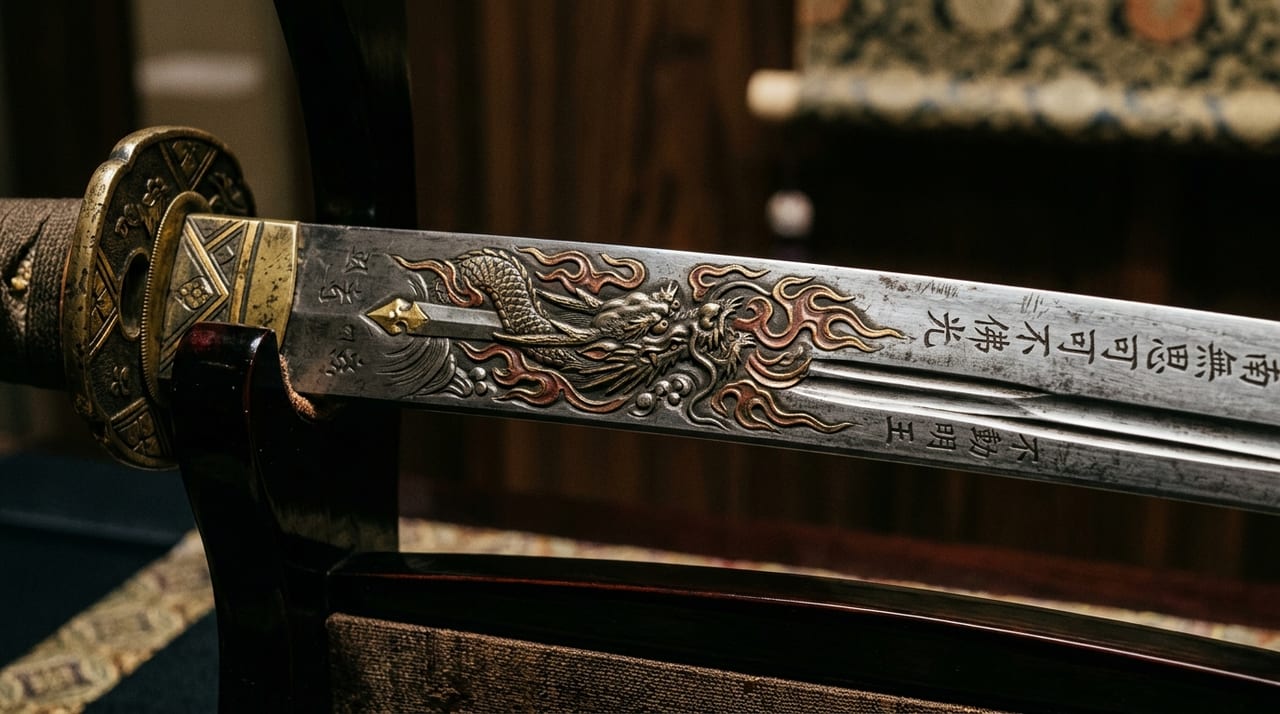
The most widely seen design in blade carvings is "Kurikara." It is an iconographic image of a dragon wreathed in flames coiling around a sword, depicting a dragon entwined on a sword enveloped in flames. The source of this iconography lies in esoteric Buddhist faith in Fudō Myōō.
Kurikara Ryūō (the Kurikara Dragon King) is a manifestation (sanmayagyō) of Fudō Myōō, and the sword and flames symbolize the attributes (jimotsu) of Fudō Myōō — the sword of wisdom that severs earthly desires, and the flames that burn away evil. The dragon is the embodiment of that power. For a warrior to carve Kurikara on a sword blade meant unifying the sword itself with the supernatural power of Fudō Myōō. It was also a declaration of faith: "This sword cuts the enemy by the will of the Buddha."
Kurikara carvings can be seen from the Kamakura period, and became widely prevalent during the Nanbokuchō and Muromachi periods. The craftsman's skill is particularly evident in the expression of the coiling flames modeled after "goma flames," and in the fine carving of the dragon's scales and claws. The depth of the carving, the thickness of the lines, and the way the flame swirls are rendered vary by individual horiminoshi, offering the pleasure of comparing different stylistic approaches to the same Kurikara subject.
Bonji — The Characters of Mantra and Guardian Deities
It is also common for one or more bonji (Sanskrit characters) to be carved on the blade. The most frequently used bonji are as follows.
- Ban: Represents Dainichi Nyorai. The highest deity of esoteric Buddhism, considered to be the very truth of the universe.
- Kān: Represents Fudō Myōō. It has a strong affinity with the sword blade and connects with the idea of regarding the sword itself as goma wood (gomaki).
- A: Represents the seed syllable of Dainichi Nyorai (Taizokai). The symbol of the fundamental Buddha in esoteric Buddhism.
- Un: May represent several Buddhas including Bishamonten, Yakushi Nyorai, and others.
The esoteric Buddhist concept that the entire worldview is condensed into a single bonji character resonated with the aesthetic sensibility of warriors who sought to engrave the universe into the small space of a sword blade. Bonji are not stylized decorative letters but require accurate letterforms and brushstroke sequences close to the correct order of strokes, making an understanding of Buddhist iconography necessary for the horiminoshi.
Hi — The Groove Where Function and Prayer Merge
The elongated vertical groove carved into the hiraji (flat surface of the blade) is called "hi." There are many types, including bōhi (straight groove), soehi (supplementary groove), futasujihi (double groove), and kakingashi (flowing end).
The functional role of hi is weight reduction and rigidity maintenance. Using the same principle as an I-cross-section "beam (hari)," it reduces weight while maintaining rigidity without removing material. It is also said that the air resistance of the hi produces a whooshing sound when the blade is swung, which had a psychological effect in actual combat.
On the other hand, hi also carry religious meaning. In Zen Buddhism, "ittōryōdan" — cutting through delusion with a single sword — is used as a metaphor for enlightenment, and the shape of the hi can be interpreted as a visualization of that sense of "emptiness (ku)." Furthermore, as the folk name "blood groove" indicates, the practical combat role of preventing blood from clinging to the blade became intertwined with folk beliefs, and the meaning of "warding off evil blood" was sometimes attributed to it. Because the width of the hi and the position at which it ends affect the overall impression of the blade's shape, the evenness of the carving and the sharpness of its line are also points of appreciation.
The Combination of Dragon and Sword — The Symbolic System of Martial Power
When a dragon alone is carved (in cases where only a dragon, separate from Kurikara, is carved), its meaning is based on dragon faith in the dragon as "master of water" and "guardian of heaven." In the mythological system of East Asia, the dragon is a symbol of rain, water, fertility, and imperial authority, and for warriors it was an iconographic image praying for the protection of "one who embodies the will of heaven."
The "tsurugi-maki-ryū" (sword-wrapping dragon), in which a sword and dragon coil together, can also be seen as a variant of Kurikara, but when the connection with Fudō Myōō is not explicitly indicated, it is based on pure dragon deity faith. Records also remain indicating that naval commanders who crossed seas and rivers favored this. In the composition of the carving, one may in some cases find a distinction between the dragon ascending toward heaven and the dragon descending toward earth, and the precision with which each individual scale, claw, and whisker is carved reveals the skill of the horiminoshi.
The Dove of Hachiman Daibosatsu — The God of Harmony and the God of War
Carvings of a "dove" are rare but can be understood in connection with faith in Hachiman Daibosatsu. Hachiman is the guardian deity of warriors, and the dove was regarded as its messenger. There are examples of votive swords made at Hachimangu shrines when pledging the protection of archery and swords, with doves carved on the blade.
Contemporary Horiminoshi and the Transmission of Tradition
Contemporary sword blade carvers are extremely few in number throughout the country. Because carving is performed after polishing, the work proceeds under the tension that a single mistake makes it practically impossible to restore the blade. Among contemporary tōkō, some handle carving themselves, but most outsource it to specialist horiminoshi.
When one appreciates carvings with knowledge of the meaning behind traditional iconographic images, one understands that a sword has functioned not merely as a weapon or craft object but as a cultural artifact serving as "a place where humans and deities meet." The name of the Buddha, the messenger of the deity, and the celestial dragon carved on the blade are the very form of the soul of the warrior who wore that sword. Knowing the origins and techniques of horimono provides a reliable guide for savoring a single sword more deeply.
The Perspective of Distinguishing Authentic Horimono — Ubu-bori and Ato-bori
What becomes practically important when viewing and purchasing blade carvings is discerning when the carving was applied. There is a concept that distinguishes between carving planned from the time the blade was forged and applied by the tōshō themselves or a contemporary horiminoshi — called "ubu-bori" (original carving) — and carving added to an existing blade by a different craftsman at a later date, called "ato-bori" (later carving). Whereas ubu-bori is designed as a unity with the blade's shape, kasane, and the arrangement of hi and the placement of the carving, ato-bori tends to produce unnaturalness in the balance of the carving's position and depth, making the condition of the jigane around the carving and the sharpness of the carving's edge comparative points for appreciation and appraisal.
For swords bearing a mei, one also wants to confirm whether the style of the carving is consistent with the style of work of the tōkō and period noted in the mei. The NBTHK kanteisho may record the presence or style of horimono together with elements such as the blade's shape, jigane, and hamon, and it is desirable to cross-reference the contents of the kanteisho with the actual carving before purchasing.
Points to Note for Maintenance and Storage of Blades with Horimono
The carvings of hi, bonji, and dragons have more surface irregularities than the flat surface, making it easy for uchiko powder and old oil to remain in the depths of the grooves. During maintenance, it is desirable to move a soft cloth carefully along the direction of the grooves so that no wiping residue remains deep in the carving. Because it is harder to spread oil evenly over carved areas than over flat surfaces, it is also important to develop the habit of regularly checking whether uneven oil application has occurred.
Regarding storage conditions, as with other blades, the basic approach is to store the sword in a sword bag in a place where sudden changes in humidity can be avoided, laid horizontally in its saya. Since blades with carvings also tend to trap moisture in the depths of the carving, one should take care not to allow too long an interval between maintenance sessions.