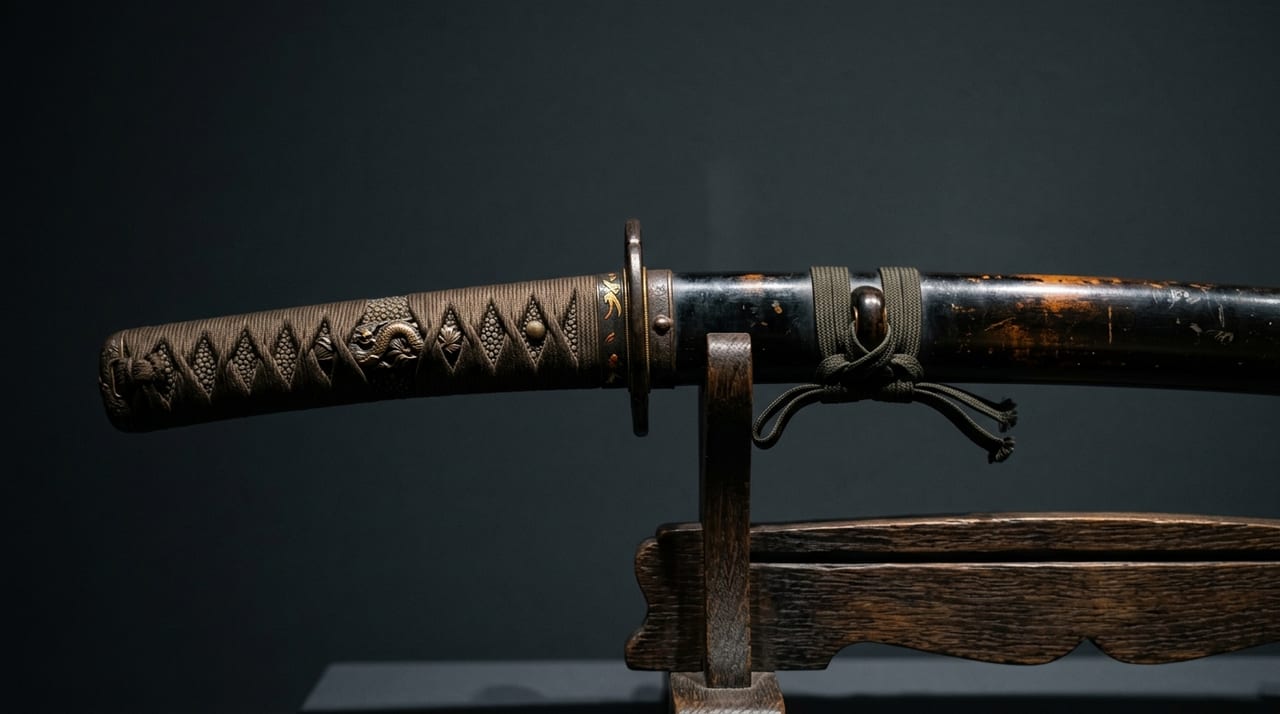
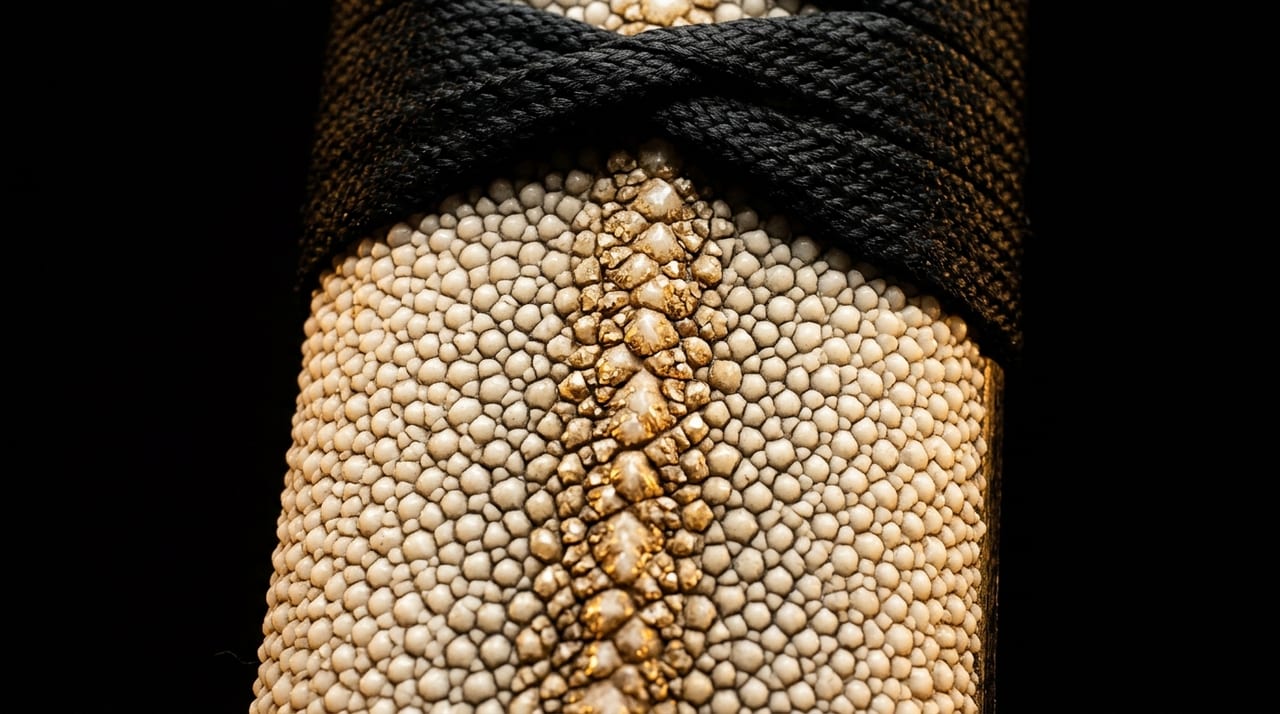
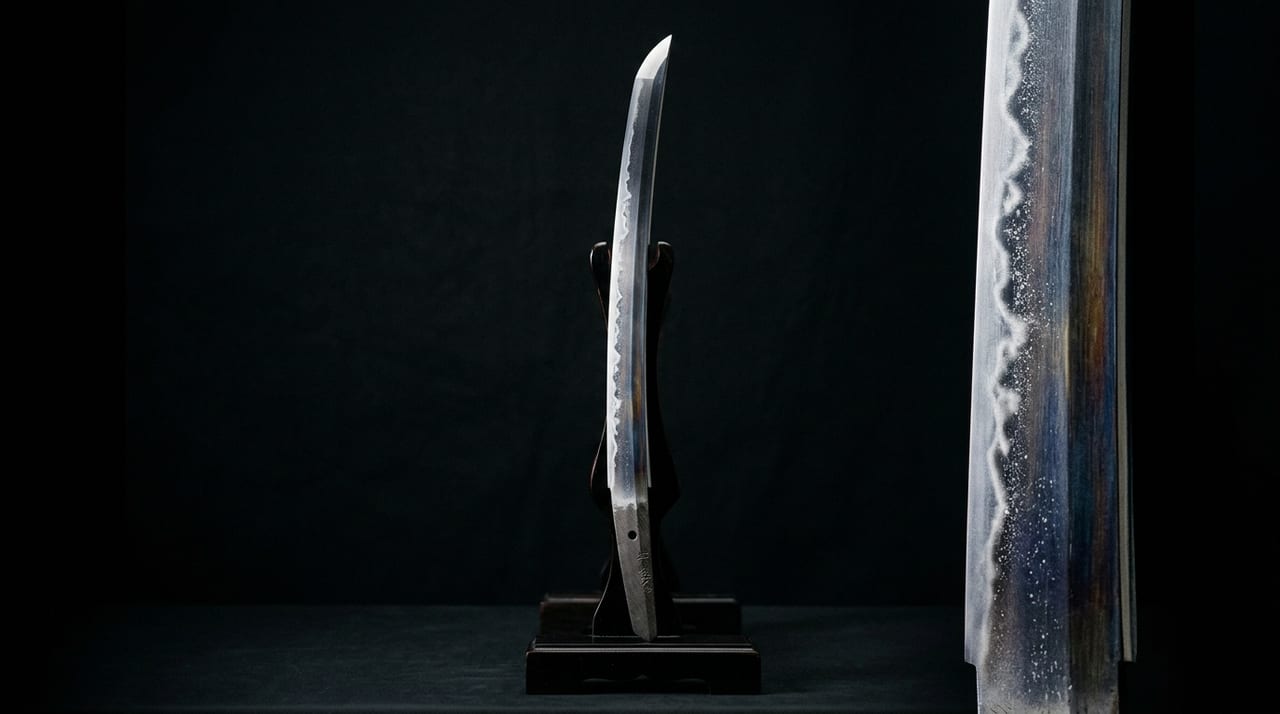
Hamon Typology: Scientific Analysis of Suguha, Choji, Gunome, and Midare
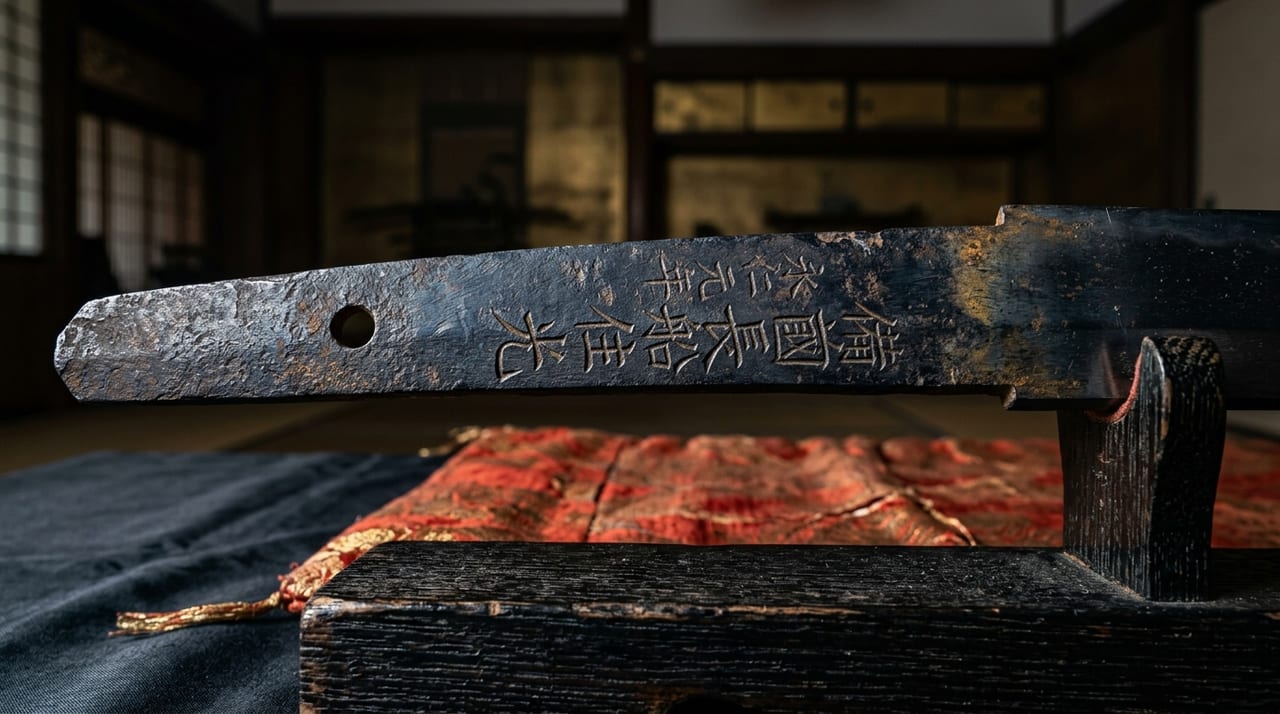 * Image is for illustrative purposes only.
Table of Contents
What is Hamon? — The Essence from a Metallic Structure Perspective
Hamon is both an aesthetically beautiful pattern and a boundary line of metal microstructure created by hardening steel (yakiba). When a sword with tsuchoki (clay application) is rapidly cooled in low-temperature water, the spine (mune) side covered with clay cools slowly and becomes sorbitic structure, while the thin clay area at the edge undergoes rapid cooling and transforms into martensite. The boundary between these two phases creates light scattering, appearing as a visible hamon.
The shape of hamon is primarily determined by three elements: the shape of tsuchoki, the grain size of the abrasive, and the hardening temperature. Blacksmiths apply a paste mixed from clay, water, and charcoal ("tsuchi") several millimeters from the blade edge, and after drying, perform the hardening fire application.
Suguha — The Most Basic Hardening Form
Suguha is a hamon that extends nearly straight along the blade edge, a style favored by sword smiths of the Yamashiro tradition (Kyoto). It is formed by applying the clay evenly in a straight line, leaving several millimeters from the blade. Because the cooling rate is nearly uniform, nie (granular martensite) distributes evenly, and the boundary with boiling effect (somewhat coarse crystals) becomes clear.
The suguha tanto made by the Awataiguchi school is characterized by an extremely narrow "hoso-suguha" from the edge to the boundary, appearing monotonous but actually difficult to control the thinness of the clay. Viewing suguha as "simple" is a layperson's misunderstanding; it is considered the form most directly reflecting a craftsman's skill.
Choji — The Flowering Hamon Refined by the Bizen Tradition
Choji hamon features continuous curved sections resembling clove flowers, a style developed over centuries by Bizen tradition (Okayama) sword smiths. By repeatedly cutting dome-shaped "notches" toward the blade edge at the tsuchoki stage, differences in cooling rate occur during hardening, creating the rounded hamon pattern.
Choji has further subcategories: "o-choji" with large curves, "choji midare" with pointed angles, "sho-choji" with uniform overall curves, and "komi-choji" with asymmetrical mixing of large and small patterns. Pre-Masamune smiths of the Bizen and Fukuoka Ichimonji schools competed in o-choji, while the Osafune school transitioned toward choji midare in later periods.
The shape of the clay for choji is complex, and the finished clay may change shape as it shrinks during drying. Drying control is crucial for choji tsuchoki, with some craftsmen making adjustments right up until hardening begins.
Gunome — Repetitive Wave Patterns Creating Orderly Beauty
Gunome is a hamon featuring repeated wave patterns (sine-curve-like), with technical difficulty between suguha and choji. It is formed by cutting the clay in a saw-tooth wave pattern, with greater uniformity of peak and valley heights and periods indicating higher skill.
Gunome was favored by sword smiths from the Shinto period onward after the Edo period, with Osaka smiths influenced by the Soshu tradition particularly leaving many refined gunome examples. When lines called "ashi" (feet) extending toward the edge appear in the valleys of gunome (lower edge of the hamon), the appraisal value increases.
Gunome midare is an intermediate form between gunome and midare-ba, with wave shapes irregularly disrupted. Distinguishing intentional disruption from loss of control becomes important discernment in sword appraisal.
Midare-ba — Expressing Nature's Ferocity Through Clay Application
Midare-ba is a collective term for irregular hamon mixing gunome, choji, and ashi in complex patterns; while appearing chaotic at first glance, the trained eye discerns intentional design in the tsuchoki. The "o-midare" forged by Masamune of the Soshu tradition is considered the pinnacle of midare-ba, accompanied by "nie-kuzure" where nie scatters like snow within the wildly undulating hamon.
Nie-kuzure is created by selectively thinning the clay and intentionally expanding the rapid-cooling zone. Norihige of the Etchu tradition's midare-ba with "matsukawa-hada" is a unique expression where the forge texture and hamon integrate, with the forging texture's irregularities and hamon boundary appearing fused. This is achieved through an advanced technique of intentionally creating warping during the forging stage.
Comparison of Tsuchoki Techniques Required for Each Hamon Type
| Hamon Type | Clay Shape | Difficulty | Representative Tradition |
|---|---|---|---|
| Suguha | Uniform straight line | Medium (irregularities visible) | Yamashiro |
| Choji | Repeated round dome shapes | High (drying control is key) | Bizen |
| Gunome | Regular wave patterns | Medium-high (uniformity required) | Soshu/Osaka |
| Midare-ba | Complex/irregular | Highest (boundary between intent and chance) | Soshu |
Challenges in Hamon Reproduction Among Contemporary Smiths
Contemporary sword smiths are obligated under the "Firearms and Swords Control Law" enacted after the Showa period to forge swords using traditional methods from tamahagane. However, pre-Edo clay formulations and hardening temperatures were largely transmitted orally, making accurate reproduction difficult.
In particular, the Bizen tradition's o-choji is still considered difficult to reproduce today, with some smiths repeating trial and error over many years. Meanwhile, some contemporary smiths employ modern measurement technologies (scanning electron microscopy and XRD analysis) to study martensite grain size, making today's forging workshop the cutting edge where science and tradition intersect.