Appreciating Fuchi-kashira: The Role and Design of the Fittings That Ornament and Secure Both Ends of the Tsuka
 * Image is for illustrative purposes only.
Table of Contents
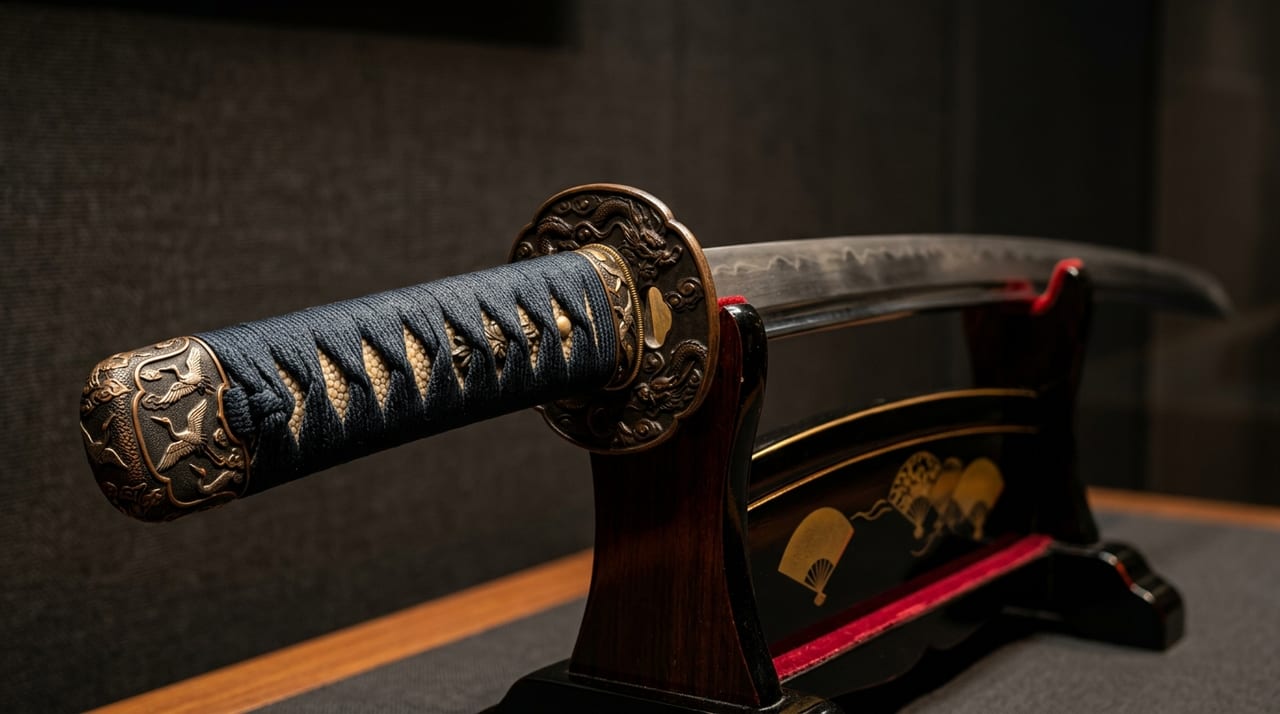
If you look closely at the tsuka of a sword, you will find metal fittings fitted at both ends. The fitting on the side near the tsuba is called the fuchi, and the fitting at the butt end of the tsuka is called the kashira; together, the two are referred to as fuchi-kashira. These fittings, always treated as a matched pair, serve both the practical purpose of reinforcing the tsuka and the decorative purpose of determining the overall impression of the koshirae.
The Role of the Fuchi and Kashira
Each end of the tsuka has the following roles.
- The fuchi is positioned between the tsuka and the tsuba; it tightens the mouth of the tsuka-gi (the wooden core of the tsuka) to prevent splitting and damage.
- The kashira is capped over the butt of the tsuka, protecting the end and contributing to stability in the grip.
Because a wooden tsuka is susceptible to damage through use and age, securing both ends with these fittings was structurally important. The way fittings that originated in practicality eventually evolved into objects of competing artistry is a trait shared with other tōsōgu.
Materials and Techniques
Fuchi-kashira exist in iron as well as in softer metals such as shakudō, shinchū (brass), and shibuichi. Fuchi-kashira with a base of soft metal in particular receive intricate decoration through such techniques as:
- relief carving
- color inlay
- metal inlay
Subject matter ranges widely, encompassing animals, plants, landscapes, and narratives. The skill required to apply three-dimensional carving to the small curved surface of the kashira demanded a high level of craftsmanship in sword-fitting metalwork.
Relationship to Tsuka-maki and Menuki
Fuchi-kashira do not exist in isolation; together with the tsuka-maki (tsuka wrapping) and menuki, they form the tsuka as a whole. Because the upper edge of the fuchi and the side of the kashira are in contact with the start and end of the tsuka-ito wrapping, if the dimensions do not match the tsuka the wrapping will loosen or the fittings will shift. There are styles in which the tsuka-ito is looped over and secured to the kashira, and styles in which the kashira fitting is left largely exposed; the treatment differs according to the style of koshirae. There are also koshirae in which the kashira is made of horn rather than metal; in such cases, the fuchi alone becomes the showcase for the metalworker's art. Knowing this structure allows one to appreciate fuchi-kashira not merely as standalone craft objects but as elements read within the overall design of the koshirae.
The Beauty of Ensemble
One of the attractions of koshirae lies in combining fittings such as the tsuba, menuki, fuchi-kashira, and kozuka so that their subjects and artistic styles are harmonized. There is the composed beauty of unifying everything within a single tradition, and there is also the approach of deliberately introducing variation to enjoy the pleasures of creative pairing; this sensibility for ensemble is what gives koshirae culture its depth. Because fuchi-kashira occupy the center of the grip — the tsuka itself — they are the pivotal element that sets the tone for the koshirae as a whole.
Points of Appreciation
When appreciating fuchi-kashira, first confirm whether the fuchi and kashira harmonize as a pair in terms of subject, technique, and dimensions. Next, examine the precision of the carving on each, the tone of the base metal, and the composition of the decoration. Because many details are difficult to see when the fittings are mounted on the tsuka, focusing on the fittings themselves reveals much about the maker's skill and ingenuity. Turning attention to the ensemble with the menuki and tsuba allows one to savor the koshirae as a single integrated work.
Checklist for Collecting and Purchasing
Here are the points to confirm when seeking fuchi-kashira.
- Whether the fuchi and kashira are an original pair. There are not a few cases in which separate fittings were brought together in later times, so judgment is made by examining the harmony of subject, base metal, carving style, and dimensions. The completeness as a pair is a factor that greatly affects the assessment.
- Checking condition. Examine the fittings for chips in the relief carving, lifting or loss of metal inlay, wear in color inlay, and impact marks. Fittings that have been used mounted on a tsuka will inevitably show wear, so it is important to have your own standard for distinguishing the patina of age from actual damage.
- The presence or absence of a mei. A mei may be inscribed on the base plate of the fuchi, for example, but the mei is only one clue. Regardless of whether a mei is present, the sound approach is to evaluate the quality of the carving itself as the primary criterion.
- Recording dimensions. If the fittings are to be mounted on a tsuka, whether the inner diameter of the fuchi and the size of the kashira match the tsuka-gi becomes a practical concern. Even when collecting fittings individually for display purposes, keeping a record of the dimensions is useful for organizing and comparing them.
It is also not uncommon for only one of the two fittings to appear on the market. Single pieces of outstanding quality do exist, but their assessment differs greatly from that of a matched pair, so be sure to verify carefully what is being offered. The provenance — whether the fitting was removed from a complete koshirae or has been passed down individually from the outset — is also something worth confirming to the extent possible.
Notes on Handling and Storage
| Base metal | Notes |
|---|---|
| Colored metals such as shakudō and shibuichi | The surface patina film is everything. Prolonged contact with bare hands can cause the film to deteriorate from perspiration, so handle the fittings with cloth or gloves and lightly wipe with a soft dry cloth after handling. The use of metal polish or chemical agents is strictly prohibited; stripping the aged patina greatly diminishes the value. |
| Iron | Avoiding moisture is paramount. The basic storage practice is to wrap each fitting individually in soft cloth or paper so the fittings do not knock against one another. |
TOUKENZA introduces listed swords and their koshirae in an online catalogue. Knowing how to appreciate fuchi-kashira — these small fittings — enriches the way one sees the koshirae of a single sword. For any work that interests you, please feel free to reach out through the inquiry form.