The Rhythm of Aiduchi: How Yokoza and Sente Forge in Time Together
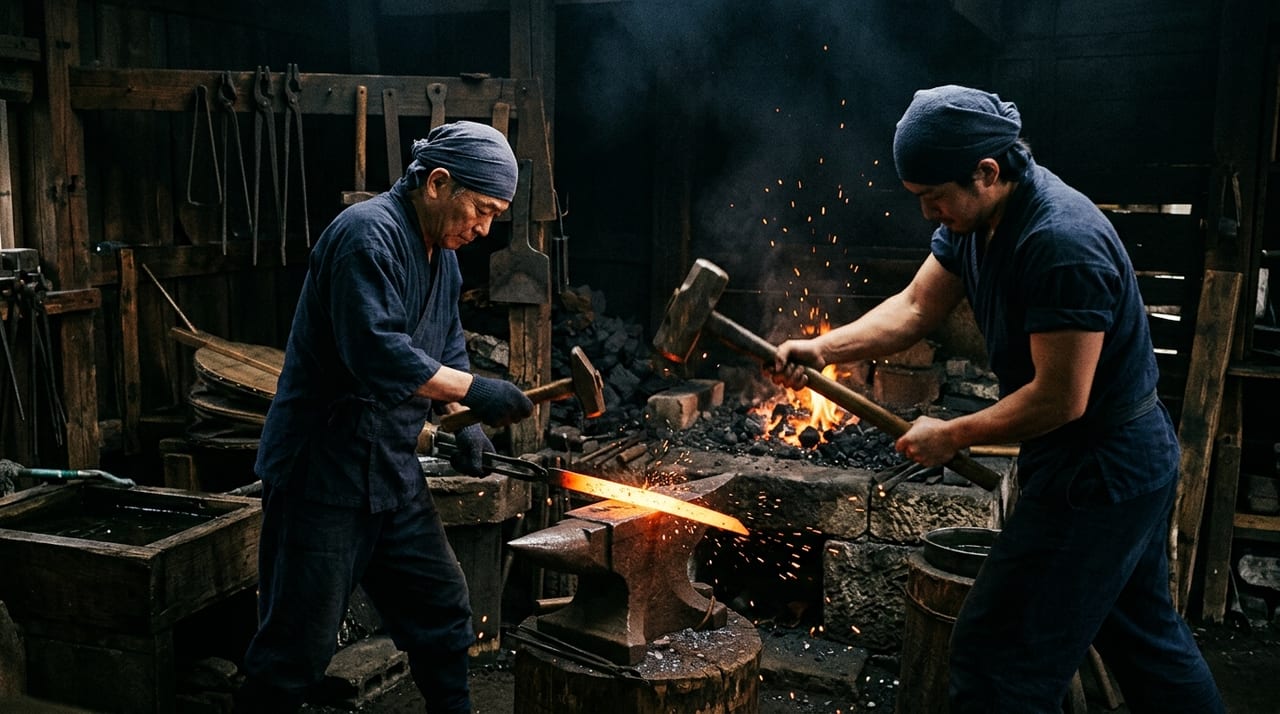 * Image is for illustrative purposes only.
Table of Contents
The Rhythm of Aizuchi—The Forging Tempo and Cooperative Technique Inscribed by Yokoza and Sakite
The Japanese expression "uchiau" (to engage in aizuchi, literally "mutual hammer blows") is used without question in everyday conversation. It refers to nodding in sync with what someone is saying, or adding words that follow the flow of their speech. Yet this phrase carries a vivid etymology born from within the sword smith's workshop. Multiple people surrounding heated steel, striking in unison with their hammers in sustained rhythm—this image of shared labor has survived as a single idiom embedded in the Japanese language. This article explores the technical reality of the act called "aizuchi," and delves into the role divisions and rhythmic structure that support it in the forging workshop.
Aizuchi as Etymology—A Word Born from the Sword Smith's Workfloor
The forging of a sword is not a solitary task pursued silently by a single craftsman. To repeatedly fold and refine a heated steel billet, multiple people must swing their hammers in coordinated breath. The master sword smith at the center of the forge signals with a small hammer, and in response, apprentices and craftsmen swing their large hammers with full force. These reciprocal hammer blows—in other words, the act of "mutually striking with hammers"—are said to be the origin of the term aizuchi.
The reason that nodding in agreement during conversation came to be called "striking aizuchi" is likely because the rhythm of hammer meeting hammer in sword forging was seen as analogous to the rhythm of response in dialogue. When one strikes, the other answers. This repeats. Whether in the realm of words or in the place of making things, this etymology teaches us that the essence of "responding" is the same.
Yokoza and Sakite—Two Roles That Make Forging Possible
Within the forge, the forging process rests on a clear division of roles. The main roles can be organized as follows:
- Yokoza (horizontal seat): The director of forging. Most often the master smith himself, who reads the color, temperature, and deformation state of the heated steel, and judges where and with how much force to strike next. The person who holds the small hammer and signals direction.
- Sakite (first hand): The role of swinging the large hammer in response to the yokoza's signals. Undertaken by apprentices or craftsmen, this person transmits the force of the large blow to the steel in time with the rhythm of the yokoza's small hammer.
- Mukodzuchi (opposite hammer): Standing opposite the yokoza, this role delivers blows in coordination with the sakite. Depending on the scale of the workshop or the stage of work, there may be multiple sakite and mukodzuchi.
The yokoza is both the director of the whole operation and the "eyes" that read the state of the steel. No matter how powerful the sakite's blows, if the yokoza misreads the steel's changes, the finish will be uneven. Conversely, even if the yokoza gives accurate signals, if the sakite's blows miss their mark, the intended effect is lost. These two roles are not equal, yet neither can exist without the other.
The Rhythm of Mukodzuchi—Necessity Born from Temperature and Time
Steel begins cooling the instant it leaves the forge. Blows can be delivered only during the limited window when the steel glows red. To compress the necessary blows into this narrow working window, yokoza and sakite must move their hammers in relentless rhythm without pause.
The signal given by the yokoza's small hammer carries information beyond a simple "strike." The position, strength, interval, and number of hammer blows—through these variations, the yokoza conveys the intent of the work to the sakite. In the stage of rough extension, heavy powerful blows are required; in the stage of uniformly refining the structure, precise delicate blows become necessary. The sakite reads this rhythmic change as a signal and adjusts the force applied each time.
Through the accumulation of repeated blows in a single forging session, the impurities contained within the steel are gradually expelled, and a layered structure with uniformly distributed carbon forms. The process called "folded forging," which allows a Japanese sword to achieve both toughness and sharpness of blade, is realized through this continuous precise rhythm.
Breathing Into the Body—The Meaning of Long Apprenticeship
Considerable years are needed before one can deliver a stable aizuchi as a sakite. At first, one is swung about by the weight of the large hammer, and even striking accurately at the intended spot is far from easy. In the early stages of apprenticeship, before picking up a hammer, many begin by learning the forging process with eyes and ears from beside the yokoza.
There is much to learn through the body. The visual sense of reading temperature from the color of steel, the auditory sense of reading rhythm from changes in the small hammer's sound, and the body technique of swinging the large hammer—moving not just the arms but the entire core to deliver the necessary force to the correct spot. None of these can be conveyed through words alone; they pass down only through actual forging experience.
The slightest timing error causes the blow to miss the intended point on the steel, creating unevenness in the finish. In severe cases, it becomes the source of forging flaws, directly affecting the blade's strength. A break in rhythm is not merely a technical matter; it relates to safety on the workfloor. For this reason, the rhythm of aizuchi has been learned only through repeated practice, never through oral instruction alone.
The Structure of "Breathing" Persists Even as Power Source Changes
It has been long since spring hammers and pneumatic hammers were introduced to the sword forging shop. Scenes of apprentices swinging large hammers have become less frequent, and many workshops now rely on machines to supplement human striking force. Yet the relationship between yokoza and sakite—the one who discerns the state, the one who responds with force—remains as a fundamental structure regardless of the type of power source.
It is still humans who operate the machines, and the yokoza's role in judging the steel's state and determining the machine's timing and strength has in some ways seen even greater demands for precision. The essence conveyed by the expression "breathing together"—the relationship in which one responds accurately to the other's judgment—does not change even as tools change.
Just as the word aizuchi remains woven into everyday conversation, this breathing technique is passed down as a cultural core of Japanese sword-making. By reading the intent the yokoza embeds in each strike's signal and responding to it with accuracy, the sakite eventually grows to become the one who makes judgments—the yokoza. Upon this transgenerational inheritance of breathing rhythm, the technique of forging a single blade has been transmitted unbroken to this day.
The Traces of Collaboration Inscribed in the Object Called a Sword
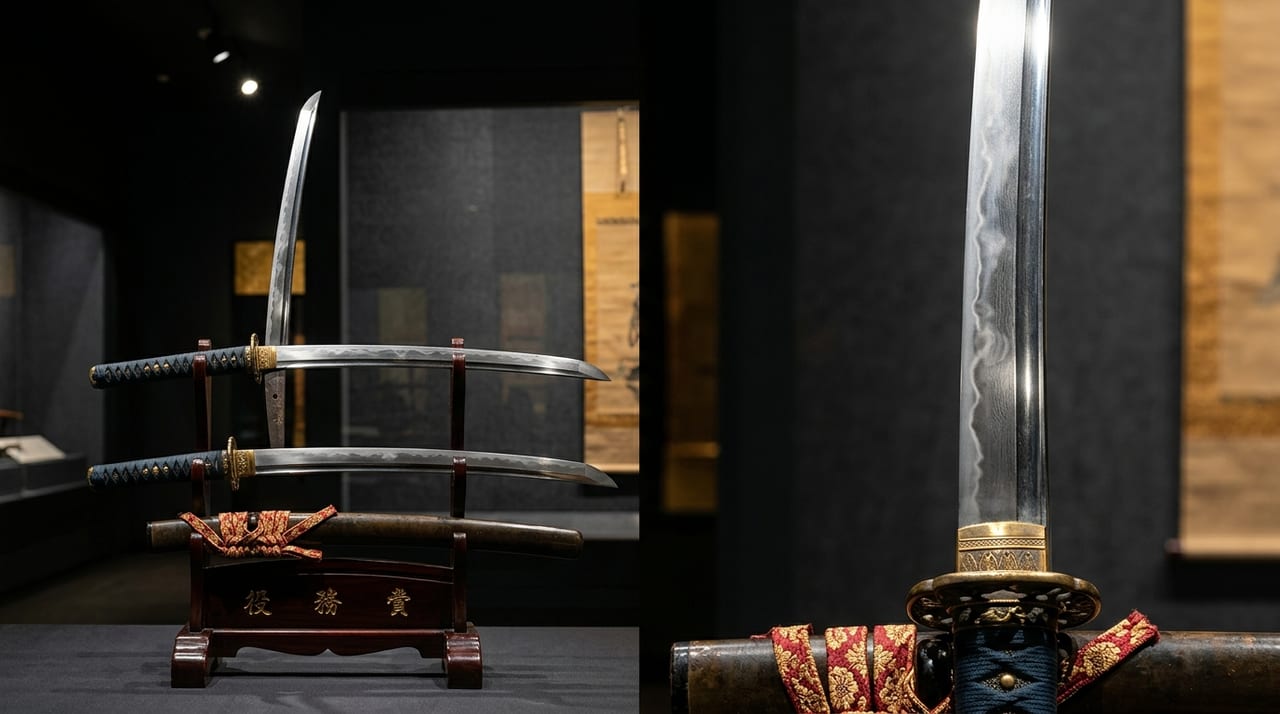
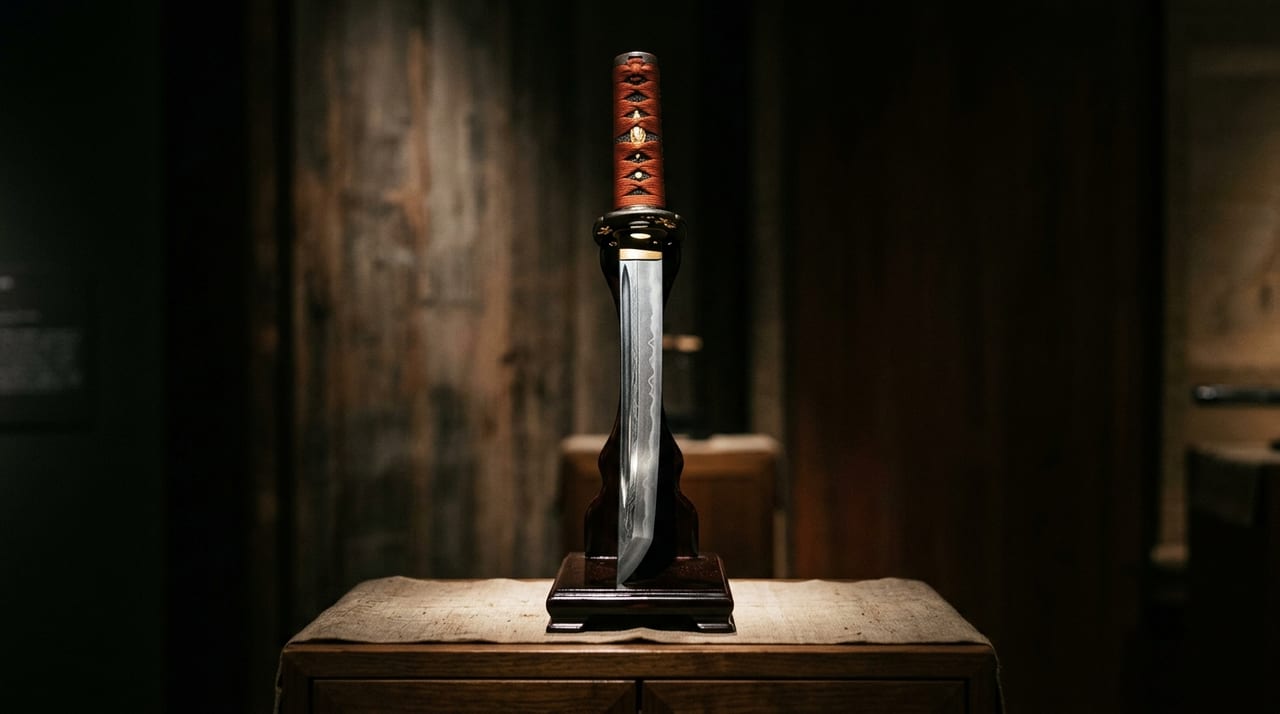
When holding a Japanese sword, the grain patterns visible in the jihada—the flow of grain called itame, mokume, and masame—are formed by folded forging. And that forging is supported by the rhythm of aizuchi struck by yokoza and sakite. The uniform beauty of the jihada is also evidence of two or more people breathing in unison.
Many processes—shaping, clay application, quenching, polishing, and furnishing—await before a single sword is complete. However, in the forging stage that determines the quality of the steel itself, the role played by the aizuchi of yokoza and sakite is fundamental. When viewing a sword in an online catalog, should one pause to contemplate the countless accumulated blows embedded in that blade's grain, the weight of a single sword is felt in an altogether different way.