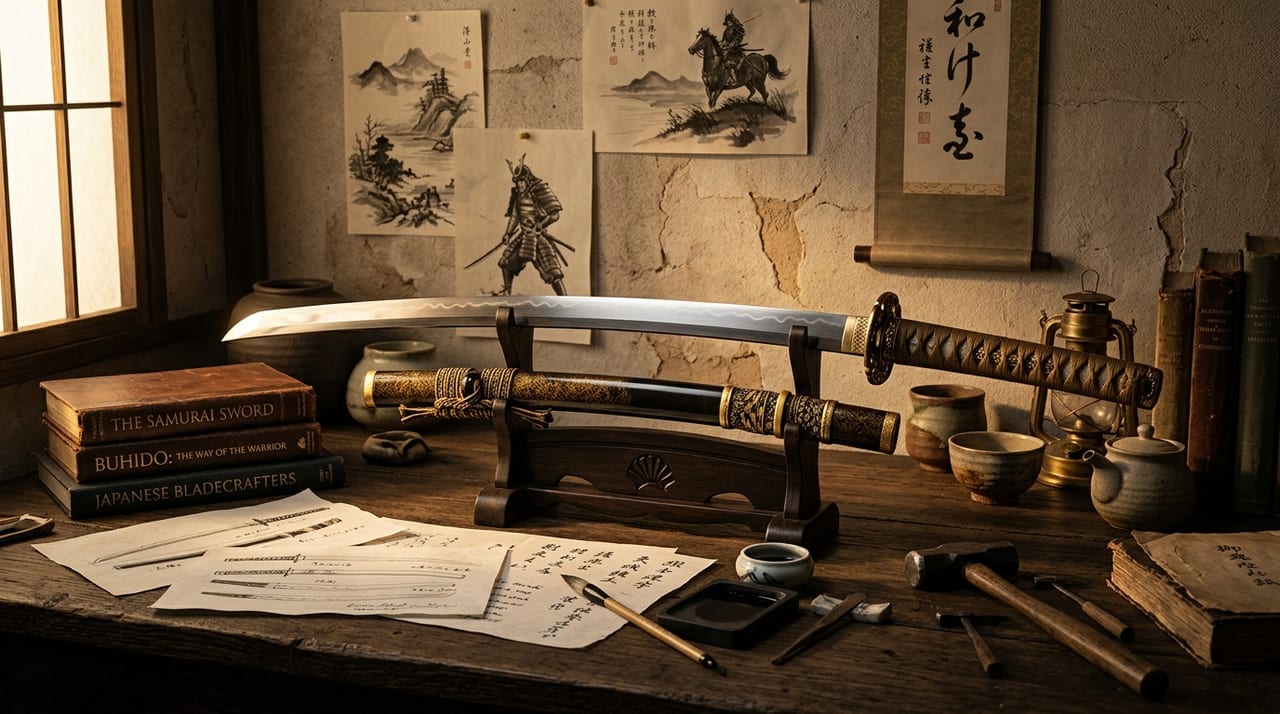
 * Image illustrative uniquement.
Touken Ranbu
刀剣乱舞
Une grande œuvre multimedia combinant un jeu de navigateur, une comédie musicale et un anime qui humanisent les sabres célèbres réels et dépeignent leur bataille contre les révisionnistes historiques. Tous les tôken danshi (guerriers-sabres) qui apparaissent sont fondés sur des sabres japonais réels, et le jeu a créé le phénomène de « tôken josshi » (femmes collectionneuses de sabres) visitant des musées dans tout le pays. Son mérite d'avoir élargi dramatiquement le public de l'appréciation du sabre japonais et de lier les jeunes générations à la culture des sabres est incalculable.
Description
Œuvre Révolutionnaire
Touken Ranbu -ONLINE-, lancé par DMM GAMES en 2015, est une œuvre historique qui a fondamentalement transformé l'intérêt sociétal envers les sabres japonais. Les joueurs incarnent le rôle du « Saniwa » (arbitre divin) et dirigent des guerriers épée personnifiés appelés « Touken Danshi » au combat contre des ennemis cherchant à altérer l'histoire. L'innovation de ce jeu réside dans le fait que chaque personnage est basé sur un vrai sabre japonais. L'affection pour ces personnages s'est naturellement transformée en intérêt pour les vrais sabres, apportant une nouvelle couche de visiteurs, principalement des jeunes femmes, aux musées de tout le pays.
Impacts Culturels
L'impact culturel était considérable – de longues files se sont formées lorsque le Musée National de Tokyo a présenté Mikazuki Munechika, et l'exposition du Heshikiri Hasebe au Musée de la Ville de Fukuoka a établi un record de fréquentation. Au Musée Tokugawa, le financement participatif a été utilisé pour le projet de restauration et d'exposition publique du Shichitai-kiri Mitsutada, un sabre brûlé lors des raids aériens de la Seconde Guerre mondiale, créant une situation sans précédent où les dons des fans ont directement contribué à la protection du patrimoine culturel. Touken Ranbu a dépassé le simple divertissement, apportant une transformation substantielle à la protection du patrimoine culturel japonais et aux opérations des musées.
Expansion Transmédia
Les adaptations scéniques 2.5D, y compris les comédies musicales et productions théâtrales de Touken Ranbu, ont connu un grand succès, avec Touken Danshi effectuant une véritable chorégraphie sur scène, exprimant de manière tridimensionnelle la beauté des mouvements des sabres japonais. Les séries animées telles que « Touken Ranbu -Hanayamaru- » et « Katsugeki Touken Ranbu » ont créé des fans internationaux de sabres japonais par la distribution mondiale, jouant un rôle dans la transmission de la culture des sabres japonais au monde. Chez Touken-za, nous proposons des authentiques ko-katana et shin-katana connectés aux mêmes écoles et lignées de forgerons qui ont créé ces sabres légendaires, vous aidant à transformer les liens formés avec les sabres rencontrés dans le récit en véritables expériences d'appréciation.
Sabres réels présentés
Mikazuki Munechika
Ranked as the foremost of the Five Legendary Swords of Japan, this Heian-period tachi was forged by Sanjo Munechika and is designated a National Treasure, housed at the Tokyo National Museum. The sword's name derives from the crescent moon-shaped uchi-noke visible on the blade, and its elegant form continues to enchant viewers even after a thousand years. It exemplifies the typical Heian tachi form with slender proportions and deep curvature, and the hamon displays an elegant composition of small irregular patterns with small te. In Touken Ranbu, it boasts overwhelming popularity as the oldest swordsman character and drew crowds of fans to its special exhibition at the Tokyo National Museum. Sanjo school, based in Kyoto, was one of Japan's oldest sword smith collectives, and its aesthetic principles laid the foundation for the later Yamashiro tradition.
Heshikiri Hasebe
A prestigious blade by master smith Hasebe Kunishige of the Nanboku-Cho period, a heavily polished work without a maker's signature. It earned its name "Heshikiri" (crushing cut) from a severe anecdote in which Oda Nobunaga used it to cut through a shelf and the tea attendant hiding beneath. Later granted to Kuroda Kanbei (also known as Josui), it was passed down as a Kuroda family treasure and is now housed at the Fukuoka City Museum as a National Treasure. The hamon, called hitatsura, features burns across the entire blade in a robust composition characteristic of the powerful style of the Nanboku-Cho period. The influence of Touken Ranbu significantly increased museum visitors and greatly contributed to regional cultural tourism.
Shichitai-kiri Mitsutada
A renowned blade attributed to Mitsutada, founder of the Bizen Osafune school. It earned its name from an episode in which Date Masamune severed a retainer along with a candle stand. It passed from the Date family to the Mito Tokugawa family but was damaged during the 1923 Great Kanto Earthquake, becoming a burned blade. For many years it was difficult to display, but a restoration project by the Tokugawa Museum made possible its public presentation in its burned state. Crowdfunding centered on Touken Ranbu fans raised substantial donations, making it a symbolic example of how the game directly contributed to cultural heritage preservation. Mitsutada is known for his ornate toji-ranba hamon and represents the aesthetic sensibilities of the Bizen Osafune school.
Dai-Kurikara
A tachi transmitted through the Date family, featuring on its blade a horimono carving of the Kurikara dragon, an incarnation of Fudo Myoo the Immovable. The Kurikara dragon is depicted as a serpent coiled around a sword, revered among the samurai as a symbol of Fudo Myoo in esoteric Buddhism. Treasured by the Date family and transmitted to Sendai domain, it is believed to have deep connections to Date Masamune. The tradition of horimono carving on Japanese swords developed from the Kamakura period onward, with diverse subjects ranging from Buddhist motifs to natural phenomena inscribed on blades. Horimono was not merely decoration but a spiritual practice through which owners imbued their swords with faith and intention.
Tsurumaru Kuninaga
A tachi by Gojo Kuninaga, a renowned Kyoto smith of the Heian period, now held as imperial regalia under the management of the Imperial Household Agency. It took its name "Tsurumaru" from its elegant form reminiscent of a crane. Its characteristic Heian profile—slender with deep curvature at the hilt—embodies the primordial beauty of the Japanese sword. Its lineage, passing from the Adachi family to Oda Nobunaga and then to Emperor Meiji, epitomizes how Japanese blades were inherited among those in power across the ages. The Gojo school, along with the Sanjo school, represents the apex of Kyoto smithcraft, establishing a refined aesthetic grounded in the capital's courtly culture.
Tonbo-kiri
Counted among the Three Greatest Spears of Japan, this large yari features a wide leaf-shaped point. Famous as the beloved spear of Honda Tadakatsu, one of the Four Heavenly Kings of Tokugawa. It earned its name from the anecdote that a dragonfly landing on the tip was bisected instantly. Honda Tadakatsu, embodying the Mikawa warrior spirit, survived numerous Sengoku battlefield encounters without sustaining a single scratch, according to tradition. Currently held in private collection but entrusted to the Sano Art Museum for periodic public display. Like the Japanese sword, the spear was forged from tamahagane Japanese steel, and the forging techniques shared much in common with sword smithcraft.
Voir les sabres japonais authentiques
Voir les sabres japonais authentiquesCette page a pour but de présenter la culture du sabre japonais et n'est affiliée à aucune des œuvres mentionnées.