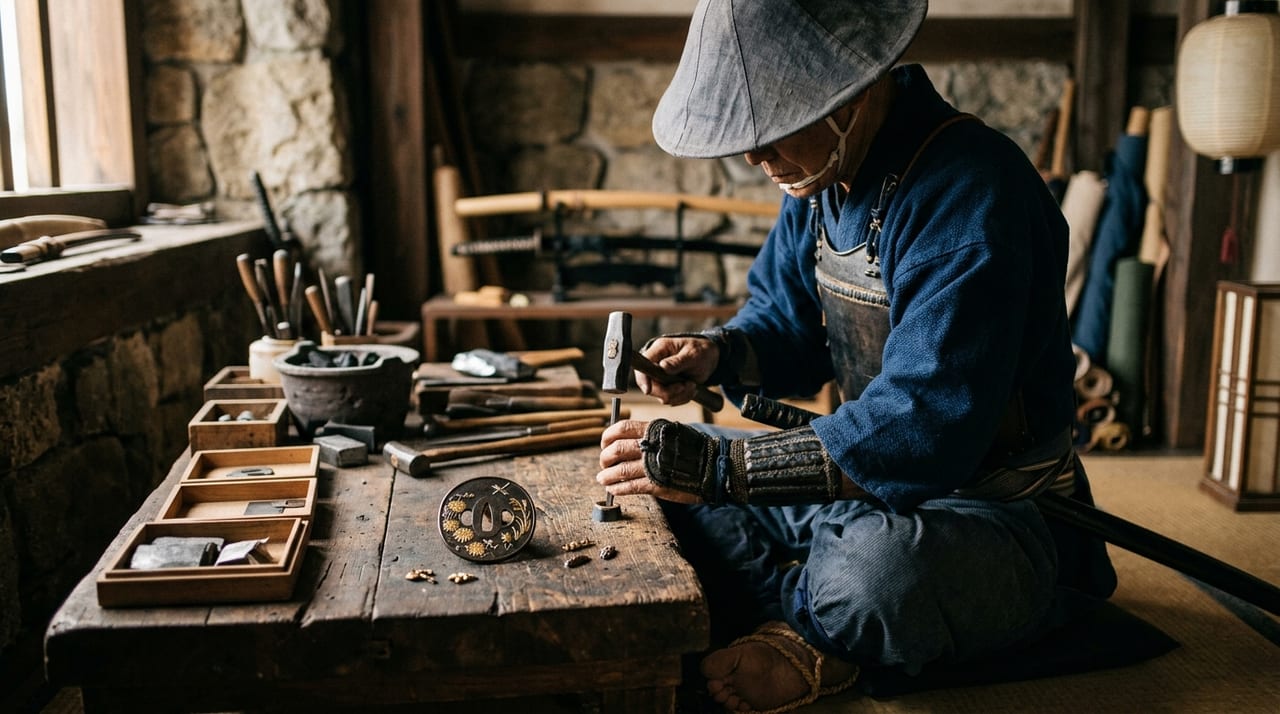
 * Image is for illustrative purposes only.
Tsuchiya Yasuchika
土屋安親
Master Sword Fittings Artisan of the Mid-Edo Period
Description
Tsuchiya Yasuchika (1670-1744) was a sword-fittings metalworker (kinkō) who represented the mid-Edo period, and a rare craftsman who, while learning from the Nara school, brought his own distinctive style to maturity. His meticulous technique and rich artistry exerted a great influence on later generations.
Yasuchika was born in Tsuruoka, Dewa Province (present-day Tsuruoka City, Yamagata Prefecture), the son of a samurai retainer of the Shōnai Domain, and from childhood he set his sights on the path of metalwork. At first he studied under Satō (Shōami) Yoshihisa, a fellow native of the region. In 1703 (Genroku 16) he went to Edo and became a pupil of Nara Tatsumasa (he is counted, together with Nara Toshinaga and Sugiura Jōi, among the "Nara Sansaku," the three masters of the Nara school). He gradually went beyond that framework to pioneer a realistic expression of nature. His style, which depicts plants, animals, insects and other subjects with astonishing minuteness, captivated the sword enthusiasts of the time, and in the Shōtoku era he was taken into service by Matsudaira Yorisada, lord of the Moriyama Domain.
His range of works extended across tsuba, kozuka, fuchi-kashira, menuki and more. Representative pieces include the "Hoshiami Chidori Sukashi Tsuba" (openwork tsuba with drying nets and plovers) and the "Hamamatsu Chidori-zu Tsuba" (tsuba with beach pines and plovers), both designated Important Cultural Properties. He skillfully used different materials, including gold, silver, copper, shakudō and suaka, and by employing the iroe technique (an inlay technique combining dissimilar metals) he brought rich color and texture to his works.
His style was called the "Yasuchika style" (Yasuchika-fū), and it gave rise to many successors and imitators. Yokoya Sōmin was a representative machibori (independent town carver) of the same period. Standing alongside Yasuchika as a leading figure of Edo metalwork, he formed one of the great schools of Edo metalwork. Yasuchika's works were highly esteemed not only in Japan but also in the West from the Meiji period onward, and they are still held today by museums and art galleries at home and abroad.
Metalwork as sword ornamentation gives a sword a value on a different plane from the performance of the blade itself. Within the world of sword-fittings metalwork (kinkō), Yasuchika established a realm of art that went beyond mere decoration. His work embodies the Japanese sword as a thing that unites the functionality of a weapon with the beauty of an artwork, and it is a precious heritage that conveys the depth of sword culture to the present day.
Notable Swords
- Hoshiami Chidori Sukashi Tsuba (Important Cultural Property)
- Hamamatsu Chidori-zu Tsuba (Important Cultural Property)