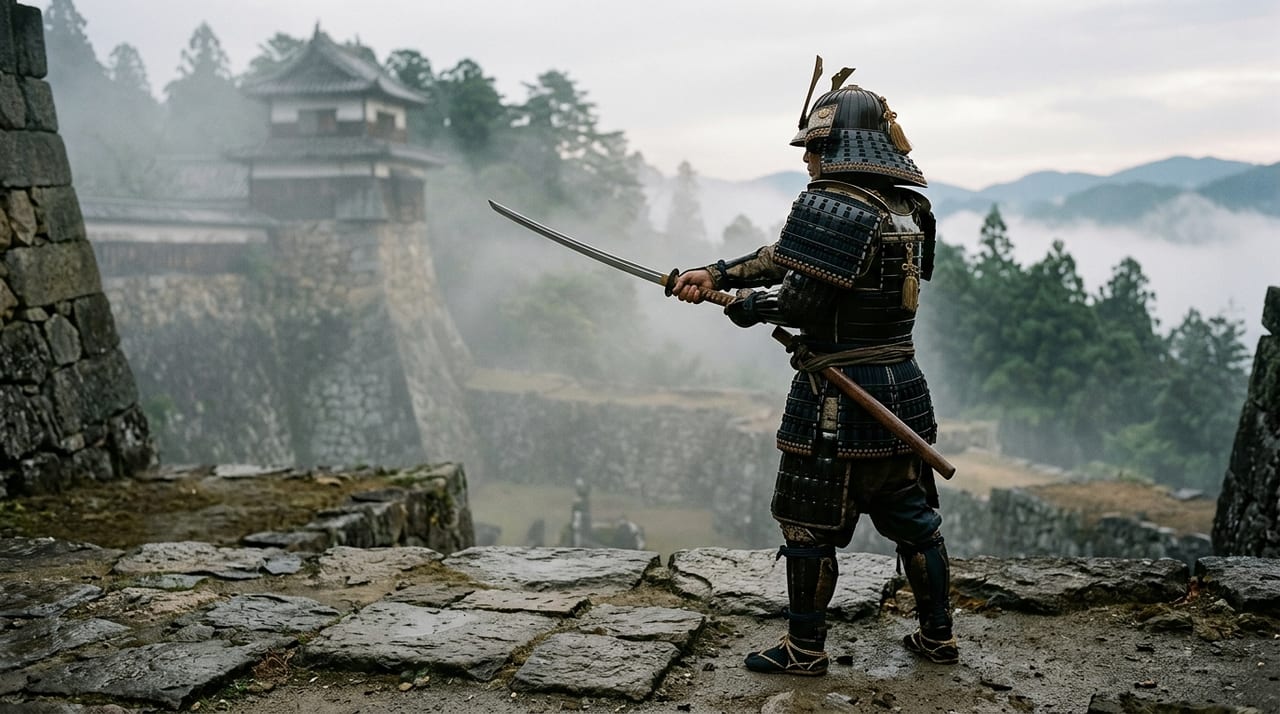
 * Image is for illustrative purposes only.
Ono Jiroemon Tadaaki
小野次郎右衛門忠明
Master of Ittō-ryū and Shogunal Sword Instructor
Description
Ittōsai's Foremost Disciple
Ono Jiroemon Tadaaki, born in Eiroku 8 (1565), was a swordsman who inherited the Ittō-ryū sword art as the foremost disciple of Itō Ittōsai Kagehisa and attained the highest position available to a swordsman, that of sword instructor to the shogunal household of the Edo bakufu. Ittōsai is said to have traveled the provinces, fought countless swordsmen, and never once lost, a swordsman without peer under heaven. It was Tadaaki, however, who inherited his technique most deeply. The fundamental idea of Ittō-ryū is the principle that countless techniques arise from a single sword and that these ten thousand techniques in turn return to one. Its swordsmanship philosophy, which discards superfluous complexity and concentrates on a single point of essence, continued to influence many swordsmen throughout the Edo period.
The Path to Shogunal Sword Instructor
In Bunroku 2 (1593), Tadaaki was taken into service by Tokugawa Ieyasu with a stipend of 200 koku and became sword instructor to Hidetada, Ieyasu's son. At this time he changed his name from Mikogami Tenzen to Ono Jiroemon Tadaaki. When Hidetada became the second shogun, Ittō-ryū established a firm position as a shogunal household sword art alongside Yagyū Shinkage-ryū. Through Tadaaki's service to the shogunal house, Ittō-ryū gained official authority that went beyond that of a mere school and spread throughout the entire warrior society.
Ittō-ryū Principles and Techniques
The principles of Ittō-ryū are extremely simple yet profound. It is thought that Ittōsai instructed his disciples using the "Goten" (Five Points), said to be the essential forms of Chūjō-ryū, and according to the Ono family's transmission, Tadaaki is said to have added a set of five kodachi forms. Beyond the Goten, teachings such as Kiriotoshi and Hosshatō are passed down in common within the Ittō-ryū lineage. The Ittō-ryū swordsmanship, which placed particular emphasis on the chūdan stance, became the prototype of the basic posture "chūdan no kamae" in later kendō, and to this day it forms the foundation of Japanese kendō. Tadaaki's swordsmanship pursued the ultimate simplicity of staking everything on a single strike delivered from a straight chūdan stance, known as the "seigan no kamae."
Naminohira Yukiyasu and Kamewari-tō
Among the anecdotes concerning Tadaaki and swords, the story of his entry as a disciple of Ittōsai is well known. Tadaaki, then going by the name Mikogami Tenzen, challenged Ittōsai, who had come to Kazusa Province, holding a 2 shaku 8 sun Naminohira Yukiyasu. Ittōsai, holding a piece of firewood about 1 shaku long, promptly took the sword from him, and the next day Tadaaki is said to have asked to become his disciple. It is also said that Ittōsai's sword, the "Kamewari-tō," was granted to Tadaaki along with the transmission of Ittō-ryū after he won a duel against his senior fellow disciple Zenki. Another account holds that it was bestowed before the duel, and that the name derives from Tadaaki slashing Zenki, who was hiding behind a jar, together with the jar. The Kamewari-tō was handed down through generations of the Ono family, and in the Meiji period it was transmitted to Yamaoka Tesshū together with the transmission scrolls.
The Ono Family and the Transmission of Ittō-ryū
After Tadaaki's death, Ittō-ryū was carried on by the Ono family as "Ono-ha Ittō-ryū" and, throughout the Edo period, maintained its position as the family of sword instructors to the shogunal house. Since the time of Mikogami Tenzen (Tadaaki's former name), Ittō-ryū developed by dividing into several lineages, including Ono-ha and Nakanishi-ha, and it remained one of the major schools of the Japanese sword arts up until the bakumatsu period. The Ono family's Ittō-ryū also influenced newer bakumatsu schools such as Hokushin Ittō-ryū and Kyōshin Meichi-ryū, and its influence is immeasurable.
The Unity of Swordsmanship and Spirit
The greatest teaching Tadaaki sought to convey through Ittō-ryū was the truth that swordsmanship is not merely a combat technique but is completed only when mind, body, and sword become one. "Ittō" literally means a single sword, but it is also a spiritual concept meaning "one path" and "one truth." The philosophy of Ittō-ryū, that all the myriad changes arise from a single point, resonates with the Buddhist idea of "one is many," and it elevated swordsmanship beyond a martial art into a path of spiritual cultivation. This depth of thought is the reason Ittō-ryū continued to hold an intellectual authority beyond that of a mere sword school within the warrior society of the Edo period.
Notable Swords
- Kamewari-tō (the sword carried by Itō Ittōsai. Said to have been granted to Tadaaki after he won a duel against his senior fellow disciple Zenki; later transmitted from the Ono family to Yamaoka Tesshū)