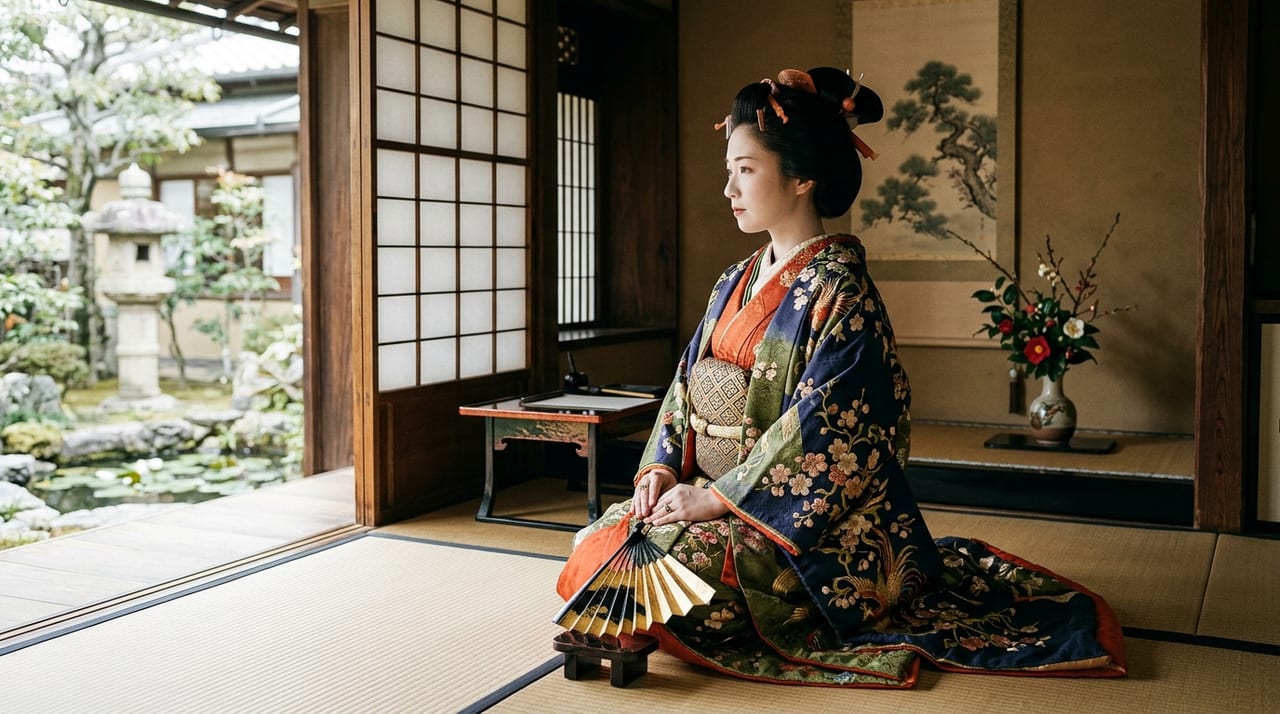
 * Image is for illustrative purposes only.
Nene (Kōdai-in)
ねね(高台院)
The Consort Who Outlasted an Era
Description
The Birth of Kita no Mandokoro
Nene (later Kōdai-in), born in Owari Province in Tenbun 18 (1549), received the title "Kita no Mandokoro" as the principal wife of Toyotomi Hideyoshi. As the wife of the ruler of the realm, she was a woman who held a central position in the Toyotomi regime. Her birth father was Sugihara Sadatoshi and her adoptive father was Asano Nagakatsu. Nene was raised as an adopted daughter of the Asano family, to which her aunt had married. Her marriage to Hideyoshi is said to have taken place around Eiroku 4 (1561), making her his companion from the time when Hideyoshi was still an unknown lower-ranking samurai. The relationship between Nene and Hideyoshi went beyond a mere lord-retainer bond or a political marriage. It was a true marital bond, and behind Hideyoshi's rise to success there was always Nene's support from within the household.
Marital Bonds and Politics
Nene's political talent lay hidden in her quick wit and the trust others placed in her. It is well known that Oda Nobunaga sent a courteous letter to encourage Nene, who was troubled by her husband Hideyoshi's infidelity. Nobunaga called Hideyoshi a "bald rat" (hage-nezumi) and advised her that, since she could never again find a wife like Nene, she should not indulge in jealousy but should conduct herself with dignity as the principal wife. This anecdote shows that Nene, beyond merely being Hideyoshi's wife, was respected by Nobunaga as an individual in her own right. Nene, who had no children of her own, raised relatives of Hideyoshi and of her own family, including Katō Kiyomasa and Fukushima Masanori, as adopted children and retainers.
Hideyoshi's Death and the Split of the Toyotomi House
After Hideyoshi died in Keichō 3 (1598), power struggles intensified within the Toyotomi regime. Nene is said to have worked with Yodo-dono to act as guardian of Toyotomi Hideyori and to have been involved in mediating when the seven generals' attack on Ishida Mitsunari occurred. In Keichō 4 (1599), she left Osaka Castle and moved to Kyoto Shinjō. Caught in a delicate position between her obligation to Hideyoshi and her pragmatic dealings with Tokugawa Ieyasu, Nene continued to hope for the survival of the Toyotomi house. At the Battle of Sekigahara, because many of the warriors Nene had raised joined the Eastern Army (Tokugawa side), the prevailing view had long been that Nene had in effect supported the Tokugawa side. In recent years, however, there is also research holding that she worked with Yodo-dono on matters such as peace negotiations.
Construction of Kōdai-ji temple
In Keichō 11 (1606), Nene built Kōdai-ji temple in Higashiyama, Kyoto. This was a magnificent temple for praying for the repose of Hideyoshi's soul, and its construction was supported by Tokugawa Ieyasu. The buildings, gardens, and works of art of Kōdai-ji temple are known as masterpieces that embody the essence of Momoyama culture. In particular, the group of gold maki-e furnishings called Kōdai-ji maki-e shows the highest standard of art of the Azuchi-Momoyama period.
Reconciliation with the Tokugawa and Longevity
Nene lived long after Sekigahara and died in Kan'ei 1 (1624), aged 76. Her later years were devoted to prayer and cultural activities at Kōdai-ji temple, and she continued to live on after the Toyotomi house was destroyed in the Summer Campaign of Osaka. Although there is a theory that she was in conflict with Yodo-dono, the mother of Toyotomi Hideyori, some recent research holds that they were on cooperative terms. Nene never lost her affection for the Toyotomi house until the end.
The Last Witness of Toyotomi Culture
Nene's life of more than seventy years was the path of a living witness who experienced the most turbulent era of Japanese history. As the wife of one of Oda Nobunaga's retainers, she experienced the upheavals of the Sengoku period. As the principal wife of the ruler of the realm, she stood at the peak of Azuchi-Momoyama culture. Having witnessed the fall of the Toyotomi house, she continued to live on in the Tokugawa era. Nene was a rare figure who witnessed the entire era from the Sengoku period to the early Edo period. The items associated with Nene that are still preserved at Kōdai-ji temple are among the most important pieces of evidence conveying to later generations the cultural heritage of the great Azuchi-Momoyama era.