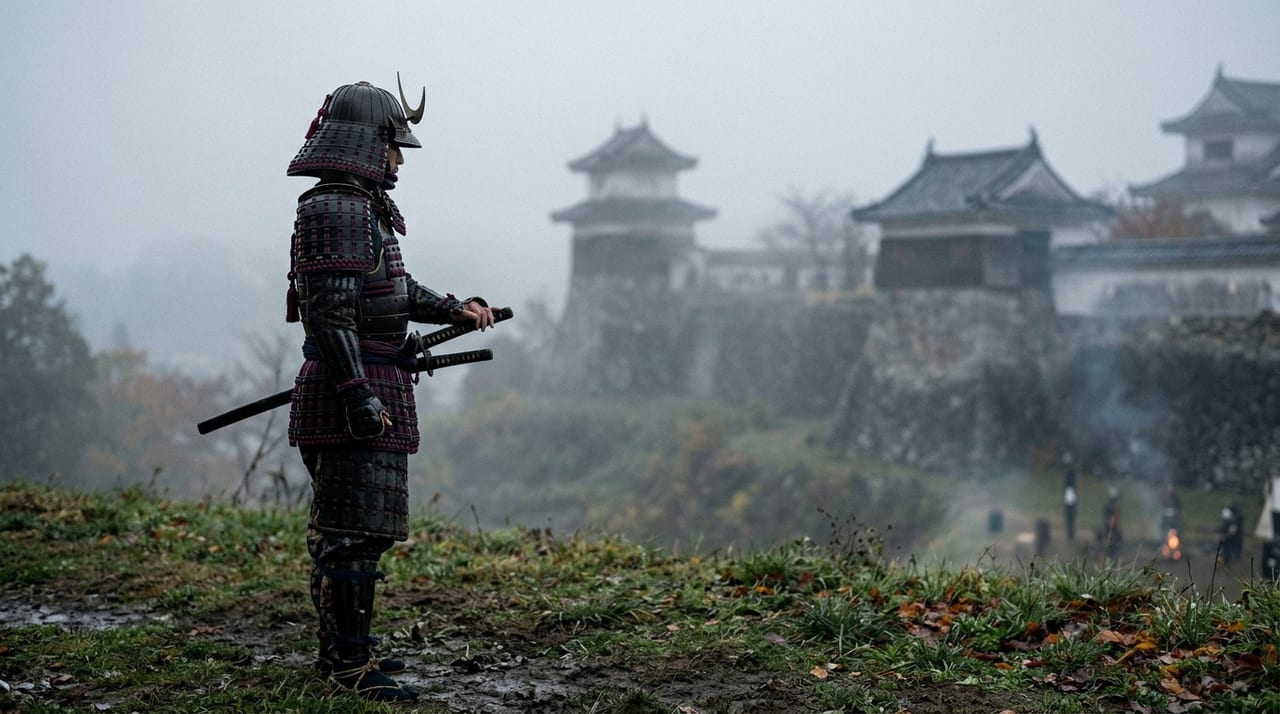
 * Image is for illustrative purposes only.
Hayashizaki Jinsuke Shigenobu
林崎甚助重信
Founder of Iaijutsu
Description
Birth of the Founder of Iaijutsu
Hayashizaki Jinsuke Shigenobu, said to have been born around Tenbun 11 (1542) in Hayashizaki village, Murayama District, Dewa Province (present-day Murayama City, Yamagata Prefecture), is a sword saint whose brilliant name has been left to later generations as the founder of iaijutsu, one of the most important schools in the history of Japanese martial arts. Shigenobu's childhood name was Tamijimaru, and his common name was Jinsuke. His life began with tragedy in childhood. When Shigenobu was a boy, his father, Asano Kazuma, was ambushed and killed by Sakagami Shuzen over a grudge. The boy, who carved his father's resentment into his heart, vowed to avenge him and devoted himself to mastering martial skills.
Divinely Granted Iaijutsu
Shigenobu is said to have received a divine revelation in a dream after a hundred days of devotional retreat at the Hayashizaki Myōjin shrine in his home area. In that dream, the principle of a technique for drawing the sword and cutting down an enemy in an instant is said to have been revealed to him. This divine revelation is the foundation of iaijutsu, and Shigenobu built the foundation of Shin Musō Hayashizaki-ryū on this teaching. Whereas conventional swordsmanship presupposed combat with the sword already drawn, iaijutsu was a revolutionary martial art that completed drawing and cutting in one instant from the state of the sword sheathed in its scabbard. This idea, which regards the everyday posture of wearing the sword as a martial stance in itself, rests on a profound philosophical insight that saw the daily life of the samurai and martial skill as one.
Avenging His Father and Warrior Pilgrimage
After the retreat, Shigenobu finally killed Sakagami Shuzen, his father's enemy, and achieved the goal he had long held. Having accomplished the revenge, Shigenobu set out on a warrior pilgrimage, traveling throughout the country. Along the way, he fought swordsmen in various regions and continued to prove the overwhelming effectiveness of his iaijutsu. It is said that Shigenobu's iaijutsu was so fast that the contest was decided before an opponent could even draw his sword, and that it was completed with economical, wasteless movement. While traveling through the provinces, Shigenobu trained disciples and spread iaijutsu, a new martial system, throughout Japan.
Unity of Sword and Scabbard
In the iaijutsu of Hayashizaki-ryū, the relationship between sword and scabbard has a philosophical meaning that goes beyond the relationship between a tool and its storage case. The scabbard not only protects the blade but also plays an active role in the techniques of iaijutsu. In Hayashizaki-ryū, the scabbard itself functions as part of the weapon, including the operation of the "koiguchi," in which the scabbard is sent forward to draw out the blade quickly, and techniques that use the scabbard to deflect an opponent's attacks. Tradition holds that while Shigenobu was in retreat at the Hayashizaki Myōjin shrine, he wore a family great sword of 3 shaku 2 sun 3 bu at his waist and practiced drawing it day and night, and that he is said to have used a long-hilted long sword.
Succession and Development of Hayashizaki-ryū
The Shin Musō Hayashizaki-ryū founded by Shigenobu later branched into many schools and developed further. His disciple Tamiya Shigemasa founded Tamiya-ryū, and from that lineage Musō Shinden-ryū and Musō Jikiden Eishin-ryū further branched off. These schools form the mainstream of today's iaido. In addition, schools influenced by Hayashizaki-ryū brought a revolution not only to iaijutsu but also to the handling of the sword in swordsmanship in general, and had a great influence on Japan's martial culture as a whole. The idea of "battō soku zan" that Shigenobu created went beyond a mere combat technique to become a cultural heritage deeply rooted in the Japanese sense of beauty and spirituality.
Iaijutsu and Spiritual Training
Hayashizaki-ryū iaijutsu has the character of a path of spiritual training as well as a practical combat technique. Shigenobu valued the cultivation of character through martial training and taught that the forging of the mind should accompany the mastery of technique. Focus of the mind at the moment of drawing the sword, reading of distance, and the single cut taken at the right moment all cultivate, at once, calm judgment in ordinary times and quickness in emergencies. Shigenobu's philosophy rested on the profound recognition that carrying a sword is not merely bearing a weapon, but embodying with one's body the resolve of a samurai who always lives alongside death. This spirit continues to be passed down in modern iaido and has become a lighthouse guiding the souls of everyone who carries a sword.
Notable Swords
- A family heirloom great sword of 3 shaku 2 sun 3 bu (he is said to have worn it at his waist and practiced drawing day and night during his retreat at the Hayashizaki Myōjin shrine)
- Tachi by Nobukuni (said to have been dedicated to the Hayashizaki Myōjin shrine on his way home after he had avenged his father)