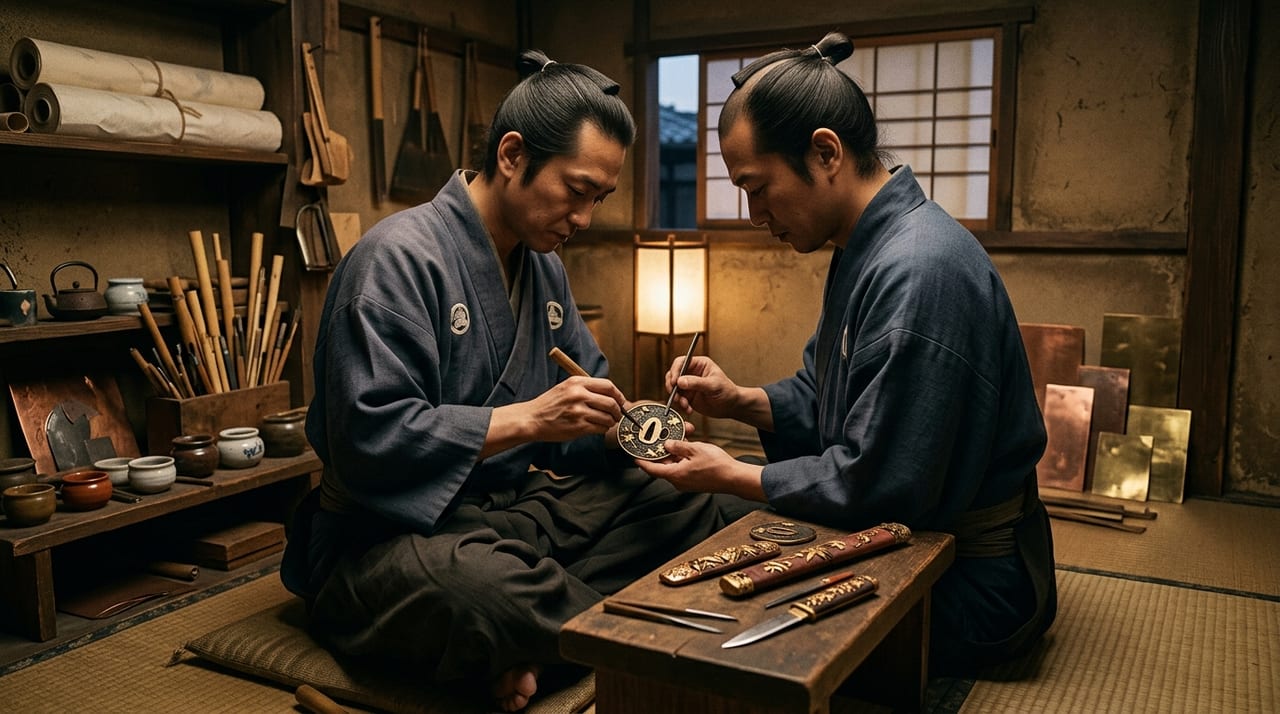
 * Image is for illustrative purposes only.
Gotō Yūjō
後藤祐乗
Muromachi-period sword-fittings metalworker and founder of the Gotō Shirōbei family
Description
Gotō Yūjō (1440–1512) was a sword-fittings metalworker active in the late Muromachi period, and the founder of a distinguished metalworking house known as the "Gotō family." Serving the Ashikaga shogunal house, he specialized in producing sword ornamental fittings (such as the mitokoromono, the set of three fittings consisting of the kozuka, kōgai and menuki), and established a style that became the model for sword-fittings metalworkers in later generations.
Yūjō is said to have come from Mino Province (present-day Gifu Prefecture). According to traditions transmitted within the Gotō family, he at first served as a close attendant to Ashikaga Yoshimasa, but later, at Yoshimasa's command, took up sword-fittings metalwork as his profession. The "Gotō style" he established is characterized by exquisite decoration: a shakudō ground (an alloy of copper and gold) forms the base, and patterns are rendered in high-relief carving (takaniku-bori) on a nanako ground. Its dignified depictions of animals, plants and auspicious motifs were widely embraced in warrior society.
Yūjō's successors generation after generation inherited the post of official metalworker as heads of the Gotō family, forming a major school of metalwork that continued into the Edo period. In particular, the line continued with Sōjō (second generation), Jōshin (third), Kōjō (fourth), Tokujō (fifth), Eijō (sixth), Kenjō (seventh), Sokujō (eighth), Teijō (ninth) and Renjō (tenth), each of whom was active as the foremost sword-fittings metalworker of his era.
No surviving work bears Yūjō's own signature, but the short-sword mounting (chiisagatana koshirae, Important Cultural Property) held by the Maeda Ikutokukai is regarded as his masterpiece, and he is accorded the highest esteem in the history of sword-fittings metalwork in Japan. The Gotō style he created greatly enhanced the value of swords as works of art, and became a symbol of the spirit and aesthetic sense that warriors invested in the swords they wore.
Notable Swords
- Chiisagatana koshirae with peony and lion design, Maeda Ikutokukai (Important Cultural Property)