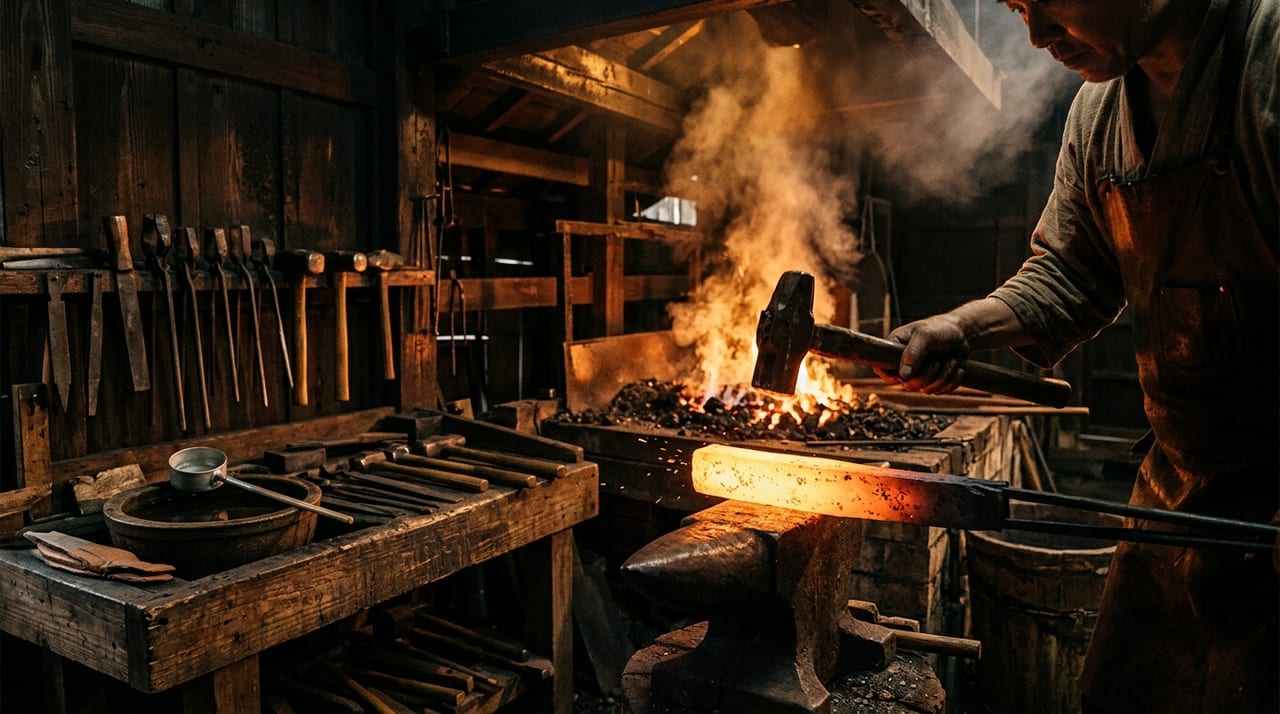
 * Image is for illustrative purposes only.
Sa Yasuyoshi
左安吉
Description
Sa Yasuyoshi was a swordsmith who worked in Hakata in Chikuzen Province (present-day Fukuoka City, Fukuoka Prefecture) during the Nanboku-chō period. He is known as a member of the Chikuzen Samonji school (Chikuzen Samonji-ha), which established the Sōshū-den tradition in Kyūshū. The founder of the Samonji school, Ō-Sa (Samonji), is counted among the Ten Great Disciples of Masamune (Masamune Jittetsu) and was a master who brought Masamune's techniques to Kyūshū. Yasuyoshi, as a disciple within that lineage, conveys to the present day the actual development of the Sōshū-den in Chikuzen during the Nanboku-chō period.
Yasuyoshi's blades clearly show the bold Sōshū-den character distinctive of the Chikuzen Samonji school. The jigane shows itame with well-flowing grain, and the Sōshū-den-type forging surface is rich in chikei and jinie. Set against the slightly dark iron color typical of Kyūshū blades, the bright nie of the Sōshū tradition stands out, and the overall impression is one of strength held beneath a restrained surface. The hamon is mainly gunome and notare, with kinsuji and sunagashi appearing abundantly. It boldly expresses the typical nie-centred style of the Sōshū-den, inherited from his lineage. Among the large-scale midare examples that reflect the spirit of the Nanboku-chō period, there is a strength that answers the practical demands of the warrior society.
The Chikuzen Samonji school produced many disciples, from Ō-Sa through Yasuyoshi, Yukihiro, Kunihiro, and Yoshisada, and it is recorded in the history of swords as a distinguished school that supported Kyūshū's sword culture from the Nanboku-chō to the early Muromachi period. Yasuyoshi is known as a smith with a relatively large number of extant works among them, and he is an important figure in discussing the practical development of the Sōshū-den in Kyūshū.
His signatures include "Sa Yasuyoshi" and "Sa Yasuyoshi saku," and works are extant mainly in the form of tantō. In terms of taihai, he strongly displays the bold form of the Nanboku-chō period, and representative examples are large tantō with a nagasa exceeding 30 centimeters and a broad mihaba.
At present, the meibutsu "Hitotsuyanagi Yasuyoshi," which was owned by Hitotsuyanagi Naomori, held by the Tokyo National Museum, and a tantō dated Shōhei 12 (1357), held by the Inuyama Castle Hakutei Bunko, are both designated Important Cultural Properties. As a member of the Chikuzen Samonji school, which transmitted the lineage of the Ten Great Disciples of Masamune to Kyūshū, Yasuyoshi's name is an indispensable point of reference for understanding the Nanboku-chō sword history, especially the development of the Sōshū-den in the provinces.
Famous Works
- tantō, signed Sa Yasuyoshi (named Hitotsuyanagi Yasuyoshi, Important Cultural Property)
- tantō, signed Sa Yasuyoshi saku, dated Shōhei 12, 2nd month (Important Cultural Property)