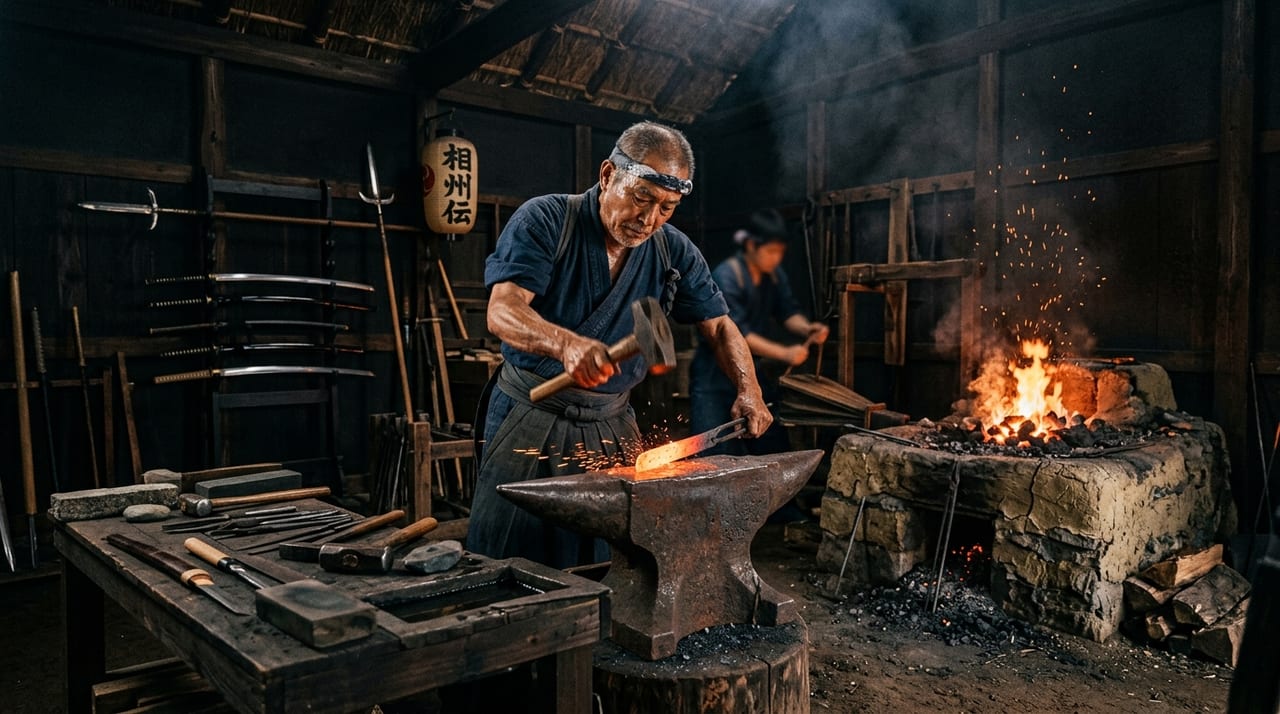
 * Image is for illustrative purposes only.
Nanki Shigekuni
南紀重国
Description
Nanki Shigekuni was a smith of the shintō period, active from the Keichō to the Kan'ei era. His common name was Monju Kurō Saburō. His home province was Yamato (present-day Nara Prefecture), and he is said to belong to the late line of the Tegai school of the Yamato-den tradition. In the early Edo period he was employed by Tokugawa Ieyasu at Sunpu and made swords there. Later, he followed Tokugawa Yorinobu, the tenth son of Ieyasu and founder of the Kishū Tokugawa house, when Yorinobu was transferred to Wakayama, and he moved to Kishū (present-day Wakayama Prefecture). Thereafter the name Nanki Shigekuni continued for eleven generations as the house smiths of the Kishū Tokugawa family, with the first generation as its progenitor. His works forged in Wakayama are signed “Nanki ni oite Shigekuni kore o tsukuru” or “Nanki ni oite Shigekuni,” and he is counted among the representative masters of the Keichō shintō, the transition from kotō to shintō.
The style can be broadly divided into two kinds. One is works in the suguha-chō style based on the Yamato-den, in which a suguha temper is hardened into steel with masame, showing an archaic elegance. The other is works with midare temper that admire the superior smiths of Sōshū, following the styles of Shizu and Masamune and showing nie-deki, with strong nie combined with chikei and kinsuji in the temper and steel. A major feature of Shigekuni is that he skillfully used these two distinct styles, the Yamato style and the Sōshū style. His particular strength was his dense, finely forged steel (jigane) with a lustrous quality. Works with a broad blade width and thick, heavy backs in an imposing taihai are also extant and reveal his high level of skill.
Tokugawa Ieyasu and Tokugawa Yorinobu, whom Shigekuni served, were rulers of the nation and great daimyō ranking with the leading houses of the Gosanke. The family of Shigekuni, who were house smiths to these lords, was treated as a house of smiths of high rank. Under the protection of the influential Kishū Tokugawa daimyō house, the tradition of sword-making was passed on. The second generation was Monju Kinsuke, and later he called himself “Monju Shigekuni” and left many works with the two characters Monju in the signature. Thus the line of the first generation flourished in Kishū over the generations.
In evaluation, the first Nanki Shigekuni is ranked among the superior shintō smiths (shintō jōsaku), and his forging skill was highly valued. His swords are listed as yoki-wazamono in the Edo-period evaluation register Kaihō Kenshaku. The breadth of his work, in which he mastered both the Yamato-den and the Sōshū-den at a high level, and the quality of his steel have been appreciated by later generations. As a representative master of Kishū and as the progenitor of the Nanki Shigekuni line, his name remains in the history of the sword.
Famous Works
- Katana, signed Oite Nanki Shigekuni zōsu (Wakayama Prefectural Museum)