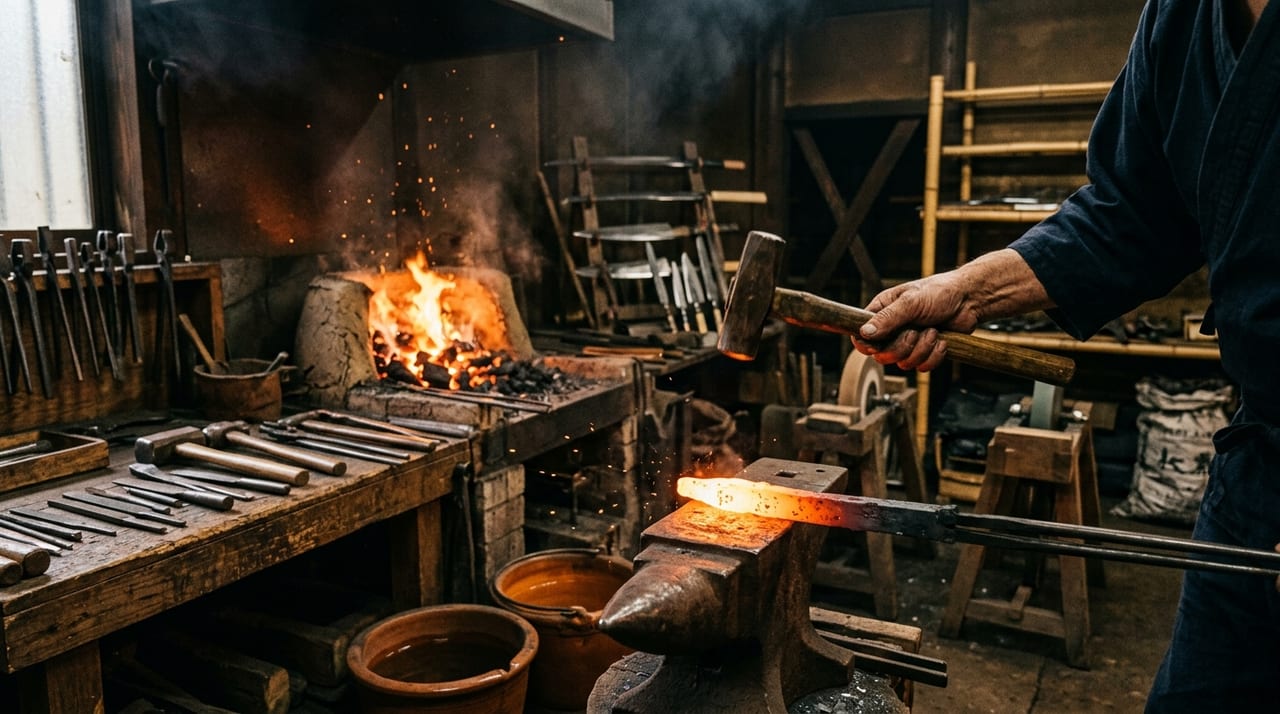
 * Image is for illustrative purposes only.
Mutsu-no-kami Daido
陸奥守大道
Description
Mutsu-no-kami Daidō and the Origins of Seki Swordsmiths
Mutsu-no-kami Daidō was a swordsmith from Seki in Mino Province (present-day Seki, Gifu Prefecture) who was active from the late Muromachi period through the Azuchi-Momoyama period. His initial name was "Kanemichi." He first forged blades in the Seki area. In 1569 (Eiroku 12), he received the titles Saemon-no-jō and Mutsu-no-kami and was granted the character "dai." He is said to have changed his name to "Dai-Kanemichi" and then to "Mutsu-no-kami Daidō."
Move to Kyoto and Establishment of the Mishina School
Daidō is said to have later moved to Gifu, and joint works with Horikawa Kunihiro are also transmitted. In the Bunroku era, Daidō is said to have gone up to Kyoto with his four sons, settled at Nishinotōin-Ebisugawa in Kyoto, and continued forging blades there. This lineage became the founder of the group of Kyoto swordsmiths later known as the Mishina school (Mishina-ha).
Style
Daidō's style features a finely refined, tightly forged jigane with well-developed mokume-hada, slightly raised in texture. He tempered a gunome-chōji-midare pattern with a bright, clear nioiguchi, and many of his works show pronounced sunagashi.
Disciples (Four Sons) and Assessment
Daidō's four sons, Iga-no-kami Kinmichi, Izumi-no-kami Kinmichi, Tanba-no-kami Yoshimichi, and Etchū-no-kami Masatoshi, all achieved mastery as swordsmiths and raised the Mishina school to become a representative group of swordsmiths in Kyoto. As the founder who transmitted the forging techniques of the Mino tradition to Kyoto, Daidō holds an important place in the history of swords of the Shintō (new sword) period.
Related Swordsmiths
堀川国広
Soshu tradition (New Sword)Horikawa Kunihiro
Momoyama to Early Edo period (New Sword genesis era)
山浦真雄
Sōshū and Bizen traditionYamaura Saneo
Late Edo Period (Shinshintō era)
肥後守輝広
ShintōHigo no Kami Teruhiro
Azuchi-Momoyama to early Edo period (around Keichō)
越前下坂
Sōshū tradition lineage (Shintō period)Echizen Shimosaka
Early Edo period (Shintō era)