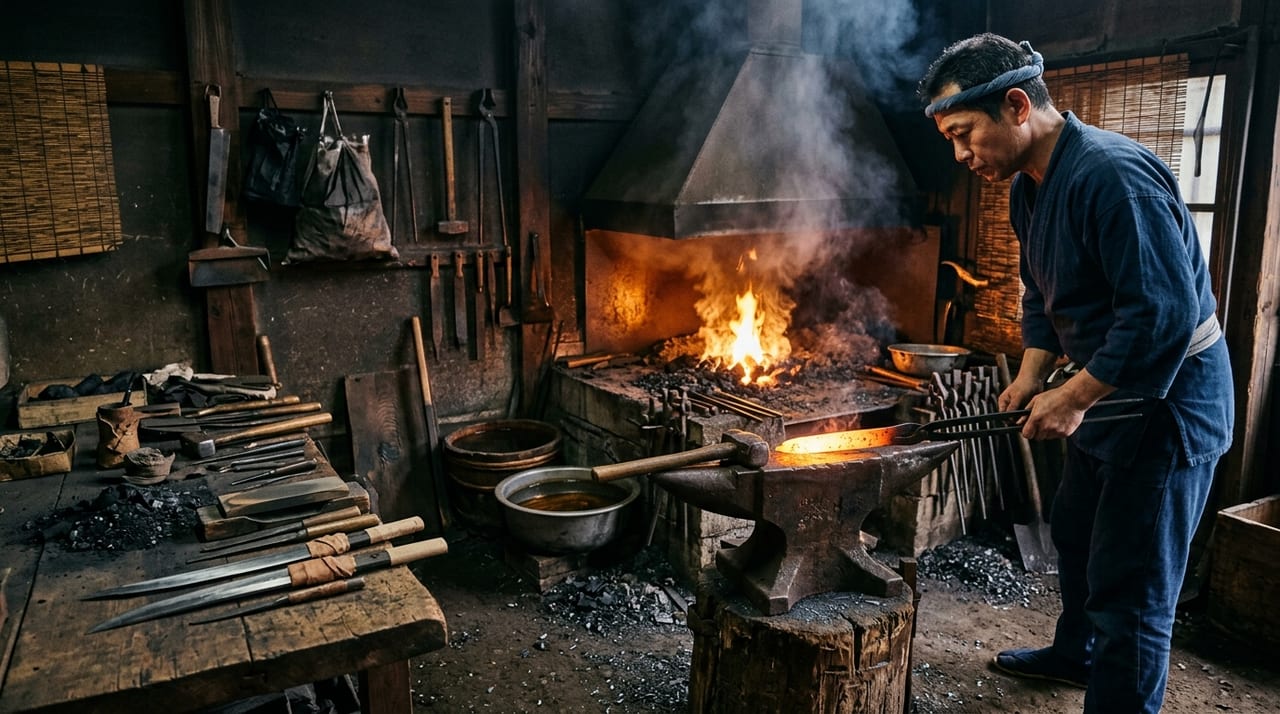
 * Image is for illustrative purposes only.
Horikawa Kuniyasu
堀川国安
Description
The Horikawa School and Kunihiro's Circle—Kuniyasu's Position
Horikawa Kuniyasu was one of the representative swordsmiths of the Shintō period, active primarily during the Keichō and Genna eras (1596–1624) in Horikawa, Kyoto. His master was Horikawa Kunihiro—a master craftsman who integrated the Sōshū and Yamashiro traditions and established the foundation of Shintō-period Yamashiro smithing—and Kuniyasu, who like Kunihiro came from Hyūga Province, was one of his disciples.
Kunihiro's workshop included such accomplished craftsmen as Dewa no Daijō Kuniji, Kawachi no Kami Kunisuké, Izumi no Kami Kunisada, and Echigo no Kami Kunitomo, who later established their own schools in various regions. Among them, Kuniyasu is known as a smith who closely carried on his master's style.
The Horikawa School's Sword-Making Environment—Kyoto as the Intersection of Samurai Culture
Kyoto during the Keichō era was a time of upheaval, as hegemony shifted from the Toyotomi to the Tokugawa. Horikawa Kunihiro, responding to the demands of warlords who came to Kyoto during this period, established his own Shintō style by fusing the bold activity characteristic of the Sōshū tradition with the refined jigane of the Yamashiro tradition. Kuniyasu trained under this master and honed his skills amidst the samurai culture and sword demand of Kyoto.
The Horikawa workshop received many commissions, and in Kunihiro's later years many works are said to have been made by his pupils on his behalf. Kuniyasu continued to forge within this environment. Tempered by his master's high standards, Kuniyasu's technique transcended mere imitation and achieved its own distinctive perfection.
Characteristics of His Swords—Master-Influenced Sōshū Copies and Yamashiro Refinement
Kuniyasu's swords inherit his master Kunihiro's Sōshū copies while showcasing a unique world that maintains the dignity of the Yamashiro tradition. His representative katana (Important Cultural Property, Tokyo National Museum) has a bold sugata with a wide mihaba, shallow sori and an ō-kissaki; its hamon is notare mixed with gunome, with a rough, nie-laden nioiguchi.
The jigane is an itame with a visibly standing grain, and overall his style carries on the bold spirit of his master Kunihiro.
Historical Significance of the Horikawa School—The Departure Point of Shintō-Period Yamashiro
The activities of the Horikawa school, with Horikawa Kunihiro as its founder and disciples like Kuniyasu, formed the core of Shintō-period Yamashiro smithing. Within the flow of sword culture that spread from Kyoto throughout the nation in the early Edo period, the influence of the Horikawa school is immeasurable. The fact that workshop fellows such as Kunisuké and Kunisada established their own schools in Osaka and elsewhere testifies to the abundance of talent in Kunihiro's circle.
As one of these disciples, Kuniyasu transmitted his master's technique and spirit, and is remembered in the history of Japanese swords as an important swordsmith who supported the golden age of Shintō-period Yamashiro smithing.
Tōken-za and Horikawa Kuniyasu
Tōken-za introduces Horikawa Kuniyasu as a swordsmith who exemplifies the reverence for master-disciple transmission in the Shintō period. Kuniyasu's technique, refined under the giant Kunihiro, holds significance not merely as the evaluation of a master craftsman alone, but as the legitimate bearer of the great tradition of the Horikawa school. Kuniyasu's works, fusing the boldness of the Sōshū tradition with the refinement of the Yamashiro tradition, embody the diverse possibilities of Shintō-period Japanese swords.
Famous Works
- katana signed Kuniyasu (Important Cultural Property, Tokyo National Museum)