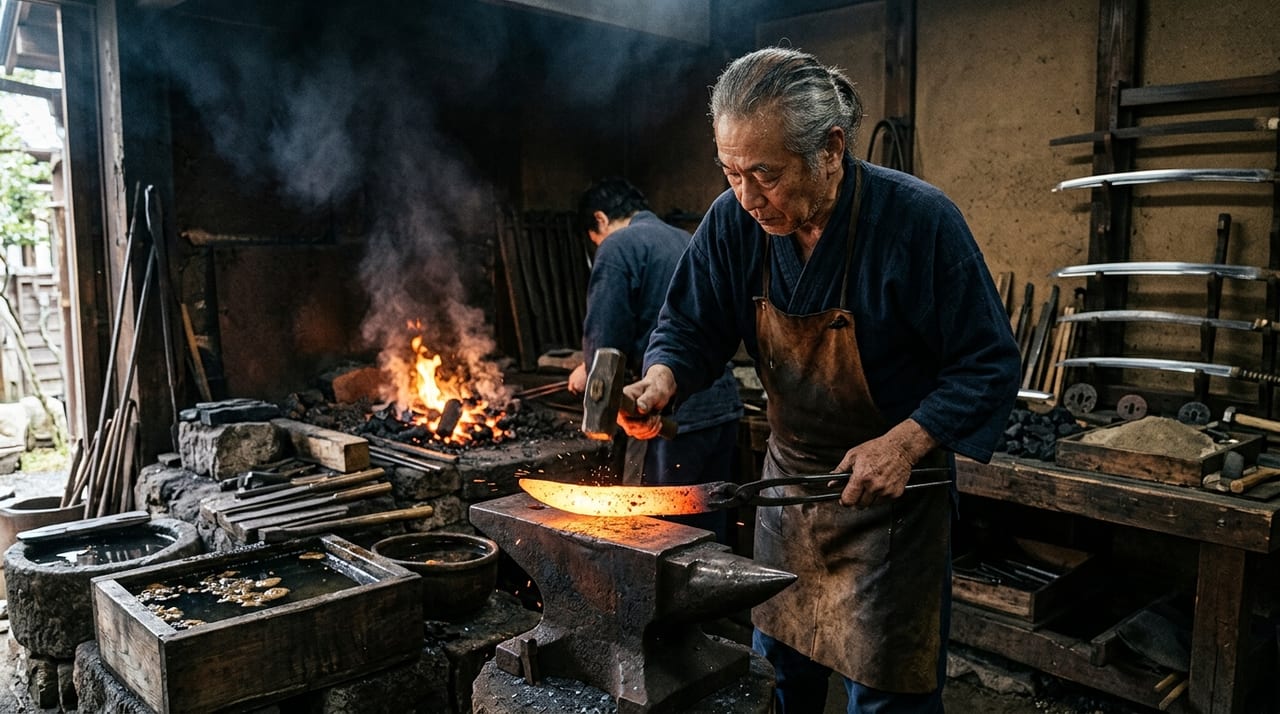
 * Image is for illustrative purposes only.
Hizen Tadahiro
肥前忠広
Description
Hizen Tadahiro and His Era
Hizen Tadahiro (first generation) was a swordsmith of Hizen Province (present-day Saga and Nagasaki prefectures) who flourished in the early Edo period, and the name was adopted by the founder of Hizen swords, first-generation Tadakichi (Hashimoto Shinzaemon), when he received the title Musashi no Kami in Kan'ei 1 (1624). In other words, first-generation Tadahiro was first-generation Tadakichi himself—a master swordsmith who established the great Hizen tradition. The name "Hizen Tadahiro" is widely recognized in Japanese sword history as a brand representing Shintō-period Hizen smithcraft and is sometimes counted among the Five Great Masters of the Shintō period.
First-generation Tadakichi (later known as Tadahiro) was supported by the Saga Domain of Hizen Province and established in the Hizen region the techniques he had learned from Umaihida Akahisui of Kyoto. As the official swordsmith of Saga Domain, he led his workshop and was a key figure in bringing Hizen smithcraft to national recognition (his son, Omi no Kami Tadahiro, became the second generation and further developed the tradition).
The Edo period saw the effective end of warfare, and swords transformed from practical weapons to symbols of samurai status and ultimately works of art. Hizen swords responded to this era's demands by maintaining high standards of consistency in quality and beauty, earning the support not only of samurai from various domains but also of merchants, wealthy farmers, and other segments of society.
Hizen Tradition: Techniques and Style
The defining characteristic of Hizen swords lies in the steel called "Hizen ko-itame-hada." This grain is far more tightly packed and uniform than ordinary ko-itame, possessing a smoothness and luster reminiscent of pear skin. In the world of sword appraisal, it is said that "Hizen jigane is recognizable at a glance," so distinctive is its character. The crystal-clear beauty of the jigane was Hizen's greatest selling point.
The jigane seen in Tadahiro's works represents a further refinement of this Hizen ko-itame-hada, with uniform and fine plate-like particles and evenly distributed ji-nie across the entire surface. The crystalline radiance emanating from the jigane shifts subtly in color tone depending on the angle of light, captivating the viewer without end.
In hamon, Tadahiro excelled in suguha (straight blade), and he forged multiple varieties of suguha patterns—medium suguha, small-nie suguha, and others—at the highest standards. The hamon line runs with perfect precision, without a single wavering point; the nie is uniform and deep, and the blade edge settles in a calm, refined manner. Subtle sunagashi patterns occasionally appear within the blade, creating an impression of inner vitality within stillness. This "refined straight blade" became widely known as the hallmark of Hizen swords and Tadahiro.
The form of both tachi and katana exhibits the standard style of the early Edo period. The blade width is standard, the thickness is substantial, the curvature is moderate, and the overall impression is one of strength and refinement. The point ranges from medium to slightly small, crowned with an elegant tip shape.
First-Generation Tadahiro's Stylistic Achievement
First-generation Tadakichi, also known as first-generation Tadahiro, took as his foundation the straight blade strongly influenced by the Yamashiro tradition that he had learned from Umaihida Akahisui of Kyoto, while clearly establishing the distinctive character of the Hizen tradition and creating what became known as "Hizen suguha."
Furthermore, Tadahiro invested considerable effort in training disciples, introducing many accomplished swordsmiths to the world. One characteristic of Hizen smithcraft is its consistency in quality, which resulted from the rigorous technical instruction that Hizen masters like Tadahiro provided to their disciples. In other words, the era of Tadahiro was when the "Hizen quality brand" was being promoted.
Nationwide Influence of Hizen Swords
Records from the Edo period indicate that domains throughout Japan commissioned and purchased Hizen swords, and the quality of Hizen swords was recognized nationally. In particular, when distant domains sought tachi and katana, they frequently selected Hizen swords for their assured quality. This demonstrates how the reputation for high quality that Tadahiro established was maintained across the ages.
Moreover, Hizen swords were so popular that counterfeit versions proliferated widely, and cases in which swordsmiths from other regions created works in the Hizen style, designated as "Hizen-mono," were not uncommon. This ironically testifies to the strength of the Hizen/Tadahiro brand.
Surviving Works and Cultural Property Designations
A relatively large number of works by Hizen Tadahiro survive to the present day, with multiple tachi, katana, and wakizashi designated as Important Cultural Properties. Works with original tangs are also numerous, with multiple signature forms confirmed, including "Hizen no Kuni Tadahiro" and "Tadahiro." Appraisal certificates consistently praise Tadahiro's works for "the beauty of straight blade and the dignity of Hizen jigane," and his swords are cherished by both modern beginners and experienced enthusiasts alike.
Tadahiro's Legacy and Touken-za
What Hizen Tadahiro's swords embody is the ideal that the Edo period demanded: "stability of quality and elevation of beauty." As the age of warfare ended and the sword transformed from weapon to work of art, Tadahiro was one of the master swordsmiths of the Shintō period who most fully realized this transformation.
Touken-za finds high value not only in the bold, dynamic beauty of old swords but also in the refined beauty of the Shintō period. The refined straight blade of Hizen Tadahiro and the crystalline brilliance of his clear jigane serve as a gateway to the diverse world of Japanese sword beauty for modern enthusiasts. For those encountering Japanese swords for the first time, the clarity of Hizen jigane and the beauty of a single straight blade should resonate directly with their sensibilities.
Famous Works
- 太刀(重要文化財)
- 脇差(重要文化財)
- 刀(重要文化財)