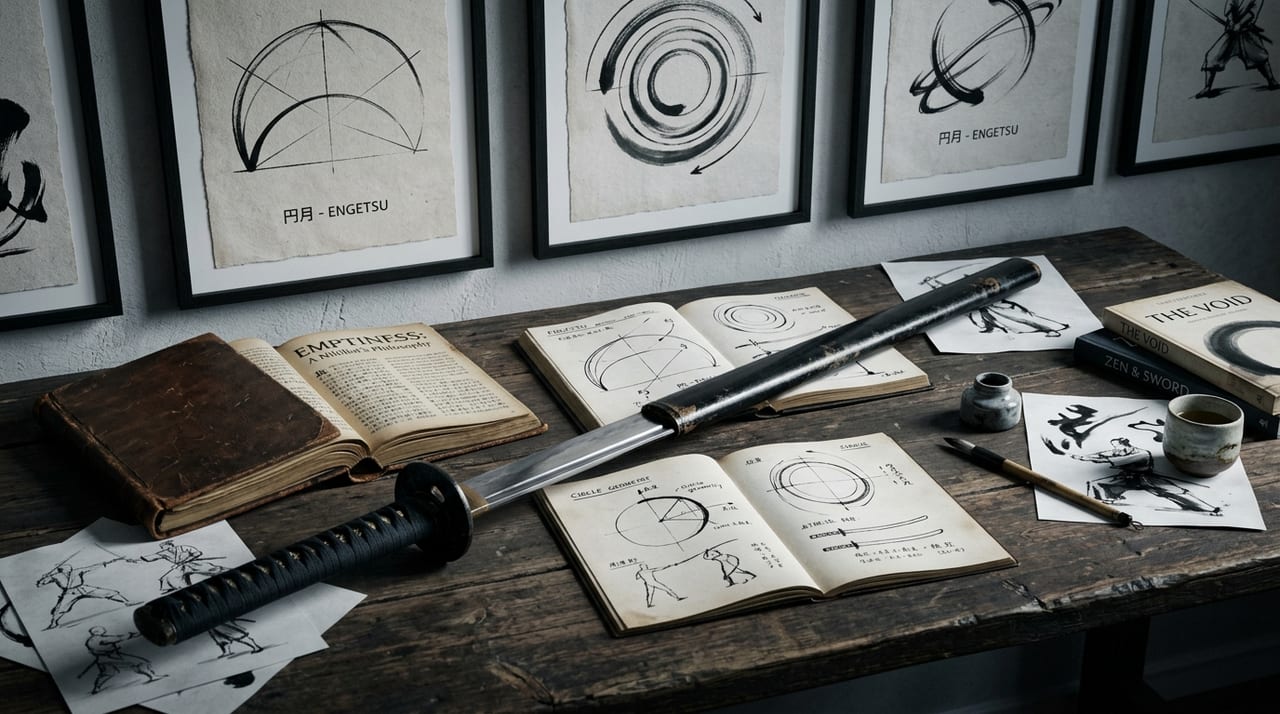
 * Image is for illustrative purposes only.
Nemuri Kyoshiro
眠狂四郎
Novel series by Shibata Renzaburo (1956–1973). Nemuri Kyoshiro — born of a Japanese mother and a Portuguese missionary father — is a nihilistic, solitary swordsman navigating a turbulent era. His signature technique, the 'Full Moon Cut' (Engetsu Sappo), uses a circular spinning motion to draw the opponent's gaze before striking with lethal precision. Adapted into twelve films by Daiei starring Ichikawa Raizo (1963–1969). The aesthetic of the 'lone sword' — blending nihilism and exquisite sword technique — earned international critical acclaim and exerted profound influence on cinematic representations of the Japanese sword in Western film.
Description
Nemuri Kyoshiro — The Aesthetic Legacy of the "Lone Sword" That Shaped Cinematic Katana Worldwide
Nemuri Kyoshiro (Shibata Renzaburo, 1956–1973) is the defining work of the nihilist swordsman genre in Japanese popular fiction — the novel series that established the archetype of the solitary, masterless blade-wielder whose artistry transcends conventional Bushidō loyalty. Protagonist Nemuri Kyoshiro is a mixed-blood ronin born of a Japanese mother and a Catholic missionary father through a black mass ritual — a permanent outsider navigating Edo society, serving no lord, pledging himself to no cause. The twelve-film Daiei adaptation starring Ichikawa Raizō (1963–1969) is recognized internationally as one of cinema's aesthetic high-water marks for Japanese sword depiction.
### The Full Moon Cut — Embodying "He Who Controls the Gaze Controls the Fight"
The Engetsu Sappo (Full Moon Cut) — Kyoshiro's signature technique — draws the blade in a large vertical circular arc that pulls the opponent's gaze and focus into the circle's motion before exploiting the resulting fractional gap to deliver a lethal strike. "Engetsu" (full moon) carries a ritual-mystical connotation: the circle of the full moon's power channeled through the blade. Analyzed through actual sword theory, the technique's core is the establishment of psychological dominance through gaze control — exploiting the opponent's natural tracking reflex to manufacture a gap. This maps directly onto real sword-school teachings about mokuchū (gaze discipline) and the strategic use of sword-tip motion to guide and disrupt an opponent's visual focus.
### The Sword of Nihilism — Technical Perfection Without Bushidō
Kyoshiro's revolutionary position in the Japanese sword-fiction tradition is his explicit severance from Bushidō's value system — loyalty to a lord, devotion to clan, honorable death. For Kyoshiro, the sword is the means of survival and the expression of personal aesthetic, not the instrument of Bushidō service. This represents a conscious foregrounding of the Japanese sword's "tool" and "aesthetic object" dimensions against its "Bushidō symbol" dimension — a distinctive philosophical position within the three-axis framework of Japanese sword understanding.
### Ichikawa Raizō and the Cinema Aesthetics of the Blade
Ichikawa Raizō's performance of Kyoshiro is inseparable from the work's cultural impact: his sword technique and fight choreography (tachi-mawari) represent cinema's highest achievement in the purely aesthetic depiction of the blade in motion. Raizō's swordsmanship strips every unnecessary movement — a distillation to pure form — that visualizes the Japanese sword's "aesthetics of motion" (the strike as moving artwork) at the highest level. Particularly noted by Japanese film critics is Raizō's zanshin (the perfectly still posture held after the killing stroke) — the post-technique spiritual alertness of sword training expressed as cinematic image.
### Influence on Western Film Criticism — Establishing "Cinematic Katana"
The Nemuri Kyoshiro series reached Western film festivals and criticism in the 1960s–1970s, embedding the "aesthetics of the solitary Japanese sword practitioner" into the vocabulary of international film theory. Where Kurosawa's Yojimbo and Sanjuro established the "hardboiled samurai" archetype, Nemuri Kyoshiro established the "nihilist-aesthetic swordsman" archetype — a direct predecessor to the katana aesthetics of Kill Bill, The Last Samurai, and other major Western sword films.
### Perspective for Sword Collectors
Nemuri Kyoshiro is the definitive popular-culture reference for understanding the "Japanese sword as artwork" dimension of sword collecting. The blade in this series is depicted not as a tool but as an aesthetic statement — foregrounding posture, draw motion, the beauty of sheathing — over cutting performance. This "sword as art object" perspective is a fundamental value criterion in Japanese sword collecting, and Nemuri Kyoshiro's cinematic legacy represents its highest expression in popular culture.
See authentic Japanese swords
See authentic Japanese swordsThis page is intended to introduce Japanese sword culture and is not affiliated with any of the works mentioned.