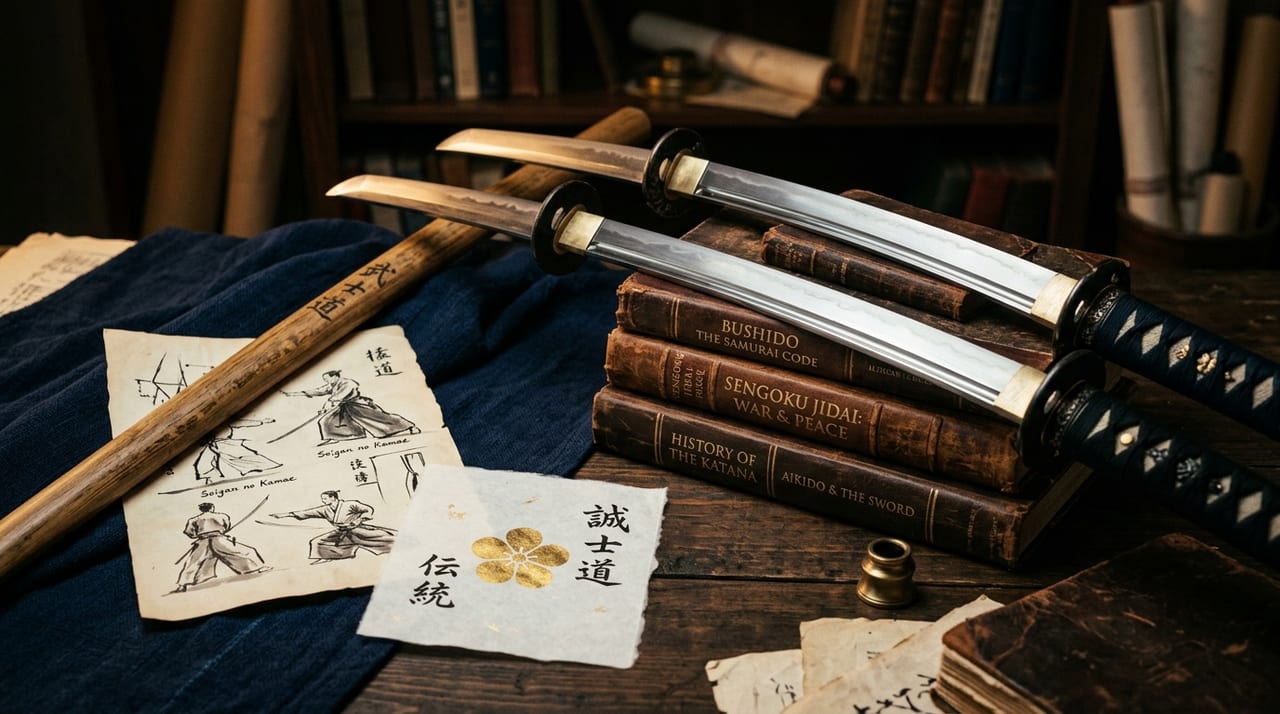
 * Image is for illustrative purposes only.
Mito Kōmon (The Lord of Mito)
水戸黄門
Long-running jidaigeki (period drama) broadcast on TBS from 1969 to 2011 (43 series, 1,227 episodes). A fictional story of Tokugawa Mitsukuni, the second lord of the Mito domain, traveling incognito across Japan. The climax of each episode is formed by the 'Aoi-no-Gomon' (hollyhock crest) seal case and the sword techniques of Mitsukuni's companions Sukezaburō and Kakunoshin. The setting of Sukezaburō's 'Tenryū swordsmanship' (a fictional school) and Kakunoshin's authentic iai school 'Musō Jikiden Eishin-ryū' popularized iai culture to the largest television audience in Japanese history. As the period drama most beloved by ordinary Japanese people, it formed the cultural image of the Japanese sword as a 'blade protecting the people.'
Description
Mito Kōmon — The "Blade Protecting the Common People" Embodied Through the Hollyhock Crest and Iai Swordsmanship
Mito Kōmon (TBS, 1969–2011), the longest-running jidaigeki in Japanese television history with 43 series and 1,227 episodes, is deeply embedded in Japanese popular culture. The climax scene of each episode — "Does this crest not register in your eyes?" as the hollyhock-crest seal (aoi no gomon, Tokugawa family crest) is raised, followed by the sword-battle that precedes it — is one of the most repeated experiences in Japanese period-drama viewing. The work's significance for Japanese sword culture lies in the cultural-historical fact that its sword-battle scenes "popularized iai culture to the largest audience in Japanese television history."
Sukezaburō and Kakunoshin's Swordsmanship — Adopting a Real Iai School
The sword-battle duties of Mito Kōmon fall to two samurai companions of the lord: Sasaki Sukezaburō and Atsumi Kakunoshin. Sukezaburō is established as a practitioner of "Tenryū swordsmanship" — a fictional school name, depicted as "orthodox tachi swordsmanship." Kakunoshin, on the other hand, is established as an iai practitioner of "Musō Jikiden Eishin-ryū" — a real iai school. Musō Jikiden Eishin-ryū originates from Tosa domain (Kochi) and is one of the two dominant schools of modern iaido (alongside Musō Shinden Eishin-ryū), with practitioners throughout Japan. Kakunoshin's iai — the technique of instantaneously drawing from the sheath to cut down multiple enemies in a single motion (battōjutsu) — became the visual symbol of Mito Kōmon's climactic sword-battle sequences.
The "Hollyhock Crest" and "The Authority of the Sword" — Mito Kōmon's Social Symbolism
The structure of Mito Kōmon's climax scene — "reveal the seal → villains prostrate → sword battle" — condenses the social symbolism of "the authority of the Japanese sword." The aoi no gomon is the family crest of the Tokugawa shogunate; raising the seal means "embodying the authority of the shogun." While the seal of authority subdues the villains, for those who refuse to submit, the swords of Sukezaburō and Kakunoshin realize justice. This framework is the simplest and most repetitive television-drama embodiment of the Japanese sword's social role as "a symbol of law and justice." The motif of "the righteous sword that cuts down evil" is the fundamental cultural DNA of Japanese jidaigeki, and Mito Kōmon is the work that inscribed this motif most deeply and over the longest period into Japanese popular culture.
The Real Tokugawa Mitsukuni and Swords
The protagonist Tokugawa Mitsukuni (1628–1700) was a real historical figure — the second lord of Mito domain, known for commissioning the Dai Nihonshi (Great History of Japan). There are no historical records of Mitsukuni actually traveling the country incognito; the series' storyline is almost entirely fictional. However, Mitsukuni is recorded as having deep knowledge and interest in swords, with documented interest in domain weapons-storage management and sword appraisal. The depiction of Mito Kōmon as "an old man who carries no sword himself, protected and served by the swords of young men, who uses their blades to realize justice" embodies the intellectual dimension of Japanese sword culture: "it is not the possession of a sword but the quality of its bearer that realizes justice."
Battōjutsu and the Iai Aesthetic
The defining characteristic of Mito Kōmon's sword-battle scenes is "overwhelming victory in many-against-few situations." Sukezaburō and Kakunoshin subdue dozens of villains without injury every episode — an extreme embodiment of swordsmanship's "sen no sen" (the principle of pre-emptive initiative): "the true sword master overcomes numerical disadvantage by taking the first initiative." Kakunoshin's iai — striking down multiple enemies in the instant of drawing from the sheath — showed "the essence of iaido (achieving maximum effect from a single motion)" to the largest television audience in Japan.
The Grammar of "Cutting Down Evil" — Popular Culture and the Japanese Sword
The motif of "the righteous sword that cuts down evil" that Mito Kōmon embodies is the most fundamental expression of the "justice function of the sword" in Japanese jidaigeki culture. In Edo-period reality, sword-carrying was the privilege of the samurai class; commoners could not carry swords. The framework of "the sword protecting those who cannot carry swords" — "the sword used by those who have it to protect those who cannot" — embodies the important intellectual dimension of Japanese sword culture: "gomino yaiba" (the blade protecting the common people). Mito Kōmon repeated this idea across 43 years and 1,227 episodes, making it the indispensable reference point for understanding the social meaning of sword culture and its deep inscription into the image of the Japanese sword in popular culture.
Perspective for Sword Collectors
Mito Kōmon is an important cultural reference for iai practitioners and sword enthusiasts as the jidaigeki that most widely popularized the real iai school Musō Jikiden Eishin-ryū. Kakunoshin's battōjutsu most widely disseminated "the aesthetics of iai drawing" — the essence of iai: drawing, cutting, and resheathing in a single motion. The cultural motif of "the righteous sword that cuts down evil" is also a key to understanding the process by which the Japanese sword became established in Japanese society not as a "weapon" but as a "cultural and spiritual symbol."
Real Swords Featured
Uchigatana
Iai-tō (Iai Practice Sword)
Musō Jikiden Eishin-ryū school
See authentic Japanese swords
See authentic Japanese swordsThis page is intended to introduce Japanese sword culture and is not affiliated with any of the works mentioned.