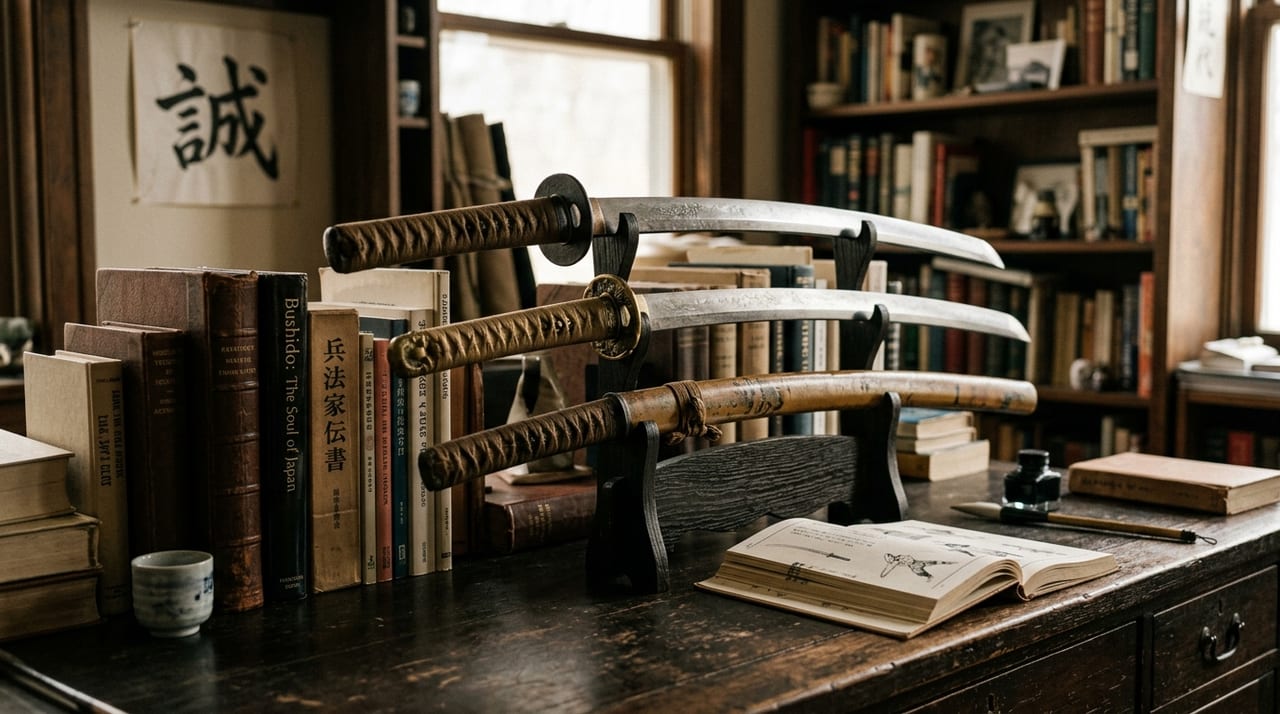
 * Image is for illustrative purposes only.
Katanagatari
刀語
Based on Nisio Isin's serialized historical novel (2007), this is a 12-episode anime series produced by White Fox in 2010. It follows Yasuri Shichika, a 'swordsman who doesn't use a sword,' and the strategist Togame as they journey to collect all twelve perfected extraordinary blades—the 'greatest swords under heaven.' A unique sword-fighting fantasy that philosophically explores fundamental questions: what is a sword? What is a swordsman?
Description
Nisio Isin and the World of Katanagatari
Katanagatari is a 12-volume serialized historical novel originally published monthly by Kadokawa Box beginning in 2007 by Nisio Isin, and was adapted into an anime by White Fox in 2010 with the unique format of one episode per month, each running 45 minutes. The story is set in a fictional Edo period Japan centered on 'Hidari Kamakura' (Left-Hand Kamakura), and follows two protagonists: Yasuri Shichika, the seventh-generation master of the Kyotou School—a 'swordsman who doesn't use a sword'—and Togame, a strategist who seeks his cooperation. Under orders from the Owari Shogunate, the two embark on a journey to collect the 'twelve completed extraordinary blades,' the most perfected of a thousand extraordinary swords forged by the legendary smith Shikizaki Kiki. Nisio Isin's distinctive dialogue-driven prose style and the paradoxical characterization of 'the strongest swordsman who wields no blade' function as a sophisticated critical response to traditional sword-fighting narratives.
The Paradox of the Swordsman Without a Sword
The most fundamental question posed by Katanagatari is a philosophical one: 'What is the sword to a swordsman?' The protagonist, Shichika, embodies the 'Kyotou School' (Empty Sword Style), a martial tradition whose ultimate principle is 'to wield one's body itself as a sword without holding a blade.' This represents an extreme manifestation of the Japanese martial philosophy that 'the body is the sword'—a concept that deeply resonates with Miyamoto Musashi's late-career thesis in the Book of Five Rings: 'The ultimate principle of martial strategy is to achieve victory without a sword.' The users of the 'greatest swords under heaven' that Shichika faces in each arc each possess their own unique martial philosophy and distinctive blades. The narrative is structured as a philosophical journey that methodically examines the diverse manifestations of both the sword and the swordsman. This framework continuously poses questions to the reader and viewer: 'What then is true strength?' 'When is a sword truly necessary?'
The Twelve Greatest Blades and the Diversity of Japanese Swords
The twelve 'greatest swords under heaven' that appear in the story are each 'extraordinary blades' that depart from conventional Japanese sword aesthetics, possessing unique forms and properties. The first, the 'Absolute Blade—the Plane (Kanna),' is a sword that never breaks or chips. The second, the 'Thin Blade—the Needle (Hari),' is pared down to an extreme—lightweight and gossamer-thin. The third, the 'Thousand Swords,' is a massive construct of a thousand blades combined into one. The fourth, the 'Thief Blade—the Armor (Yoroi),' takes a form specialized entirely for defense, resembling Western plate armor. Each embodies a philosophical inquiry into the very concept of the sword. Though superficially these are fantasy constructs, the actual history of Japanese blades encompasses an extraordinary diversity: the tachi, katana, wakizashi, tantou, naginata, and yari—each a distinct tool shaped by different historical moments and martial contexts. The assumption that 'what is a sword?' shifts across time and circumstance. Katanagatari elevates the genuine diversity of actual Japanese swords into the realm of fantasy 'greatest blades under heaven,' thereby exploring Japanese sword philosophy through its own distinctive method.
Exploring the Philosophy of Swordsmanship
Through Katanagatari, Nisio Isin presents several fundamental questions inherent to Japanese martial arts in narrative form: 'Is the strongest swordsman one who refuses to wield a blade?' 'Does the sword make the swordsman stronger or weaker?' 'Is there a contradiction between loving a sword and using it as a mere tool?' 'Is there meaning in dying for a sword?'—These are questions that have been earnestly debated throughout actual swordsmanship history. Miyamoto Musashi's evolution from 'Two-Sword Technique' to his late philosophy that 'the ultimate principle of martial strategy is to discard the sword,' Yagyu Munenori's dichotomy of 'the living blade' versus 'the killing blade,' and Takuan Soho's synthesis of Zen philosophy with swordsmanship—Katanagatari can be read as a contemporary reinterpretation of this Japanese martial philosophical lineage, refracted through the lens of modern popular literature.
Achievement as an Anime
The White Fox anime adaptation was produced in the unique format of one episode per month, with each episode running 45 minutes as a self-contained work. By giving each confrontation and dialogue the length of a short film, the adaptation succeeds in granting sufficient depth to every meeting. The stylish art direction by character designer Takehara, the meticulous rendering of each blade's distinctive form, and the scenario structure that faithfully preserves Nisio Isin's dialogue-driven prose—these collectively constitute a masterwork that incarnates the philosophical density of the original text as animation. Through Toukenza's collection of authentic Japanese blades, we can offer real answers to the question 'What is a sword?' that Katanagatari explores philosophically.
Real Swords Featured
Miyamoto Musashi's Two-Sword Technique and 'The Swordless Sword'
Miyamoto Musashi is renowned as Japan's greatest swordmaster, and in his book the Book of Five Rings (circa 1645), he systematized the principles of swordsmanship. What Musashi emphasized in his final years was 'transcending dependence on the sword as a mere tool'—a principle that can be understood as the philosophical ancestor of Katanagatari's 'swordsman without a sword' concept. While few blades actually wielded by Musashi survive to the present day, his martial philosophy continues to live deeply in contemporary martial practice and martial arts.
The Ko-Bizen School (Celebrated Swords of the Heian Period)
The swords of the Ko-Bizen school (masters such as Tomonari, Masatsune, and Houhei) from the Heian through Kamakura periods are treasured as embodying the most purely original form of the Japanese blade. Their elegant tachi forms—slender with deep curvature—function as one answer to the 'essential nature of the sword' that Katanagatari explores. Nearly all Ko-Bizen blades are designated as National Treasures or Important Cultural Properties, exemplifying the highest artistic and cultural value that the Japanese sword can attain.
The Tantou (Short Sword)—The Essential Minimal Form of the Blade
The tantou is the smallest and most purely 'purpose-specialized' of all Japanese blades, optimized exclusively for cutting. With a total length of less than one shaku (approximately 30 centimeters), the tantou specialized in close-range self-defense and assassination—contexts where larger swords could not be employed. The coexistence of its extreme functional utility and its beauty represents one of the most fundamental answers to the question 'What is a sword?' The setting of Katanagatari, where the 'greatest swords under heaven' comprise diverse forms of edged implements, reflects this systematic diversity of size and function within the Japanese sword tradition.
See authentic Japanese swords
See authentic Japanese swordsThis page is intended to introduce Japanese sword culture and is not affiliated with any of the works mentioned.