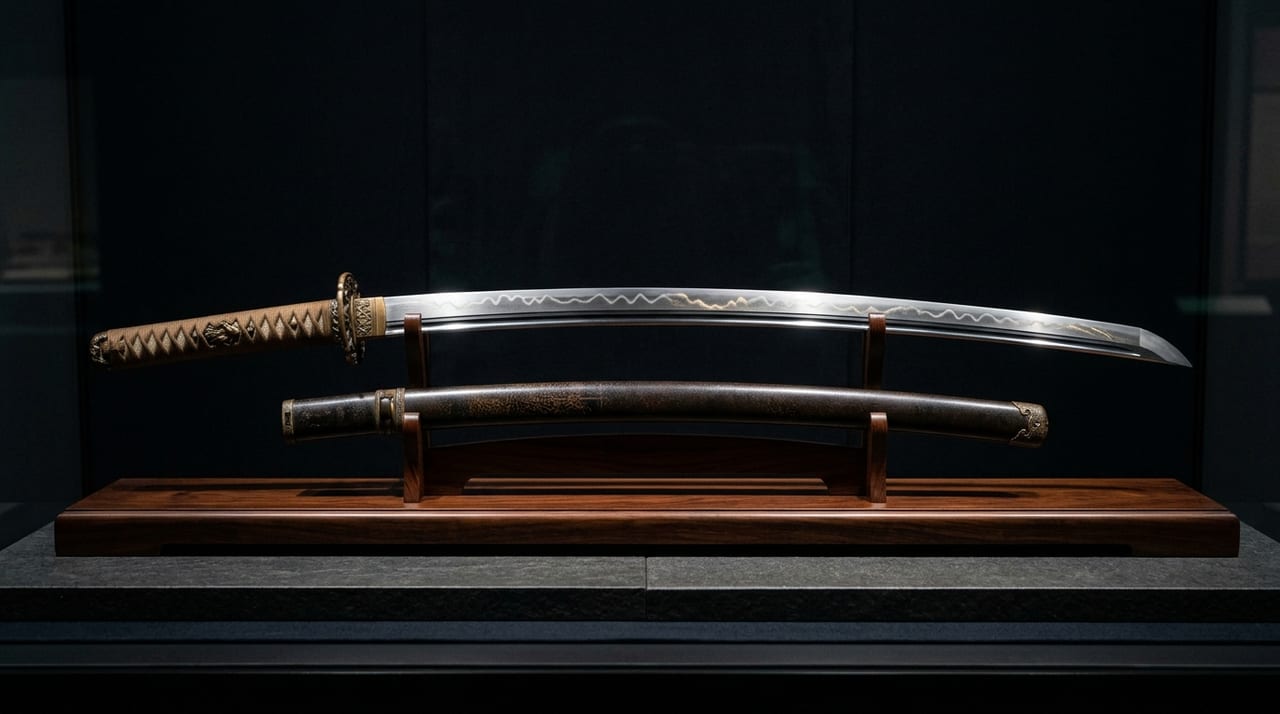
 * Image is for illustrative purposes only.
Yamanbagiri Chōgi
山姥切長義
Also known as: True Yamanbagiri
Description
Yamanbagiri Chōgi is the original 'Yamanbagiri' — the sword credited with slaying a mountain witch (yamanba) in Japanese legend — forged by the brilliant Nanboku-chō smith Chōgi of Bizen Province. While the name 'Yamanbagiri' is also associated with a later copy by Kunihiro (the so-called Yamanbagiri Kunihiro), Chōgi's blade is the authentic original, explicitly identified in the sword's long nakago inscription. Chōgi was a distinctive smith who blended Bizen and Sōshū traditions in a uniquely powerful style, and this sword is considered his greatest work. Designated an Important Cultural Property, it is held in a private collection on loan to the Tokyo National Museum, where it attracts enormous attention partly through its association with the popular game Touken Ranbu.
Legends & Stories
The Sword That Cut the Mountain Witch
The legend that gave rise to the name Yamanbagiri concerns a battle with a yamanba—a female demon dwelling in remote mountains. The yamanba is a supernatural being transmitted in the legends of mountainous regions throughout Japan, said to mislead travelers and woodcutters and sometimes to devour them—a terrifying existence. A certain warlord carrying this sword ventured deep into the mountains, encountered a yamanba, and struck her down. To honor this martial deed, the sword was bestowed the name "Yamanbagiri"—"The Sword That Cut the Mountain Witch."
An inscription on the nakago of the blade records that this sword is the "honka"—the original Yamanbagiri. The existence of this inscription is more than mere legend; it represents a rare instance in Japanese sword history wherein the blade itself testifies to its own legend. The inscription guarantees the sword's narrative, and the sword's narrative substantiates the inscription's meaning—this mutually complementary structure embodies the distinctive mode of existence possessed by the sword as a cultural artifact.
The Relationship Between Original and Copy
In the 18th year of Tenshō (1590), a swordsmith named Kunihiro, who served Nagao Akichiyo, an Ashikaga domain lord, forged a copy (utsushimono) of Yamanbagiri Chōgi. This "Yamanbagiri Kunihiro" is now designated an Important Cultural Property and is held in the collection of the Ashikaga Citizens Cultural Foundation. Making a copy was an honorable undertaking in the Japanese sword tradition and was regarded as a cultural practice of preserving the form and forging style of a celebrated blade for future generations. Yet the existence of the copy simultaneously proves the outstanding renown of the original Yamanbagiri Chōgi. The paradoxical judgment that "it was precisely because it was such a celebrated blade that a copy came to be made" further elevates the historical standing of Yamanbagiri Chōgi.
Touken Ranbu and Yamanbagiri Chōgi
In recent years, Yamanbagiri Chōgi appears in the sword-personification game Touken Ranbu as "the original Yamanbagiri," and this character has won the affection of many fans through distinctive pride and solitary beauty. The character concept of Yamanbagiri Chōgi—"I am the genuine one"—translates the historical relationship between original and copy into a modern narrative, contributing greatly to the popularization of sword culture as a fortunate meeting of history and fiction. When the blade was displayed at the Tokyo National Museum, a scene unique to modern times came into being: character enthusiasts and traditional sword aficionados standing side by side before the same display case.