 * Image is for illustrative purposes only.
Sword of Yamamoto Kansuke
山本勘助の刀
Also known as: Sword of Yamamoto Haruyuki (Sword of the Strategist of Kawanakajima, Military Advisor to Takeda Shingen)
Description
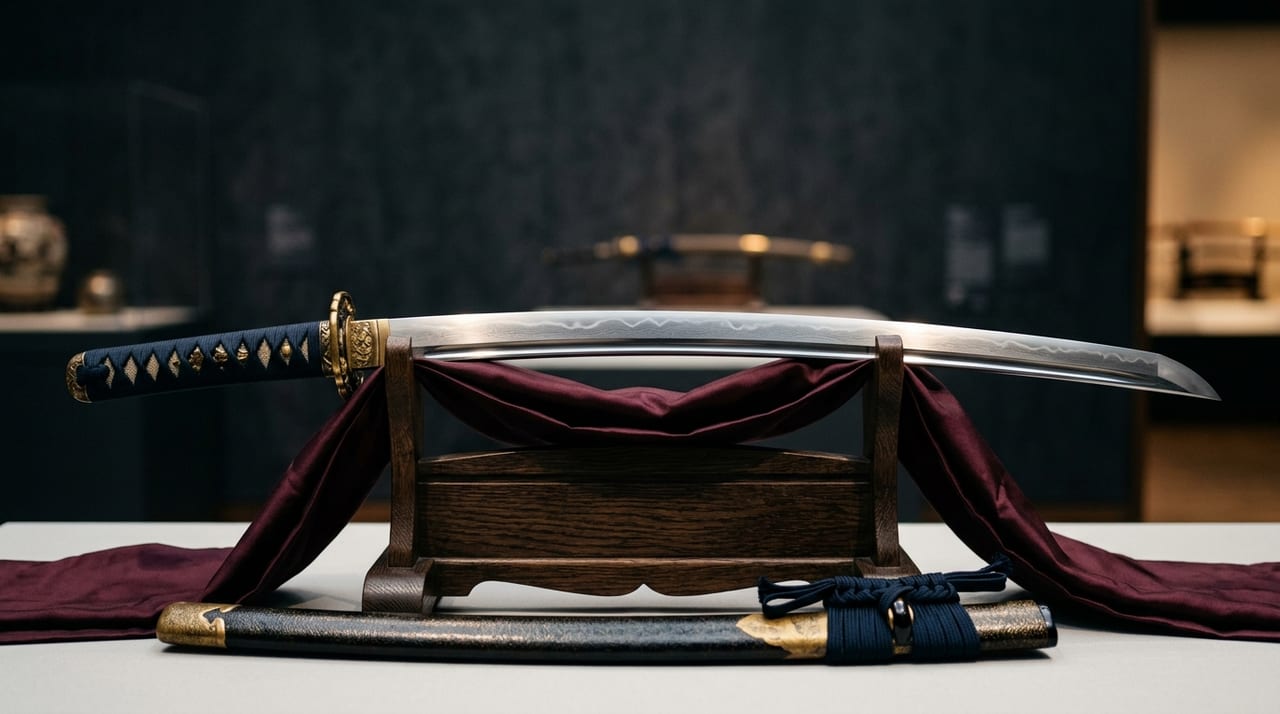
Yamamoto Kansuke (c. 1501–1561) — real name Yamamoto Haruyuki — was a Sengoku-period warrior and military strategist, renowned as the trusted advisor of Takeda Shingen. While the image of Kansuke in the Kōyō Gunkan military chronicle was greatly embellished in later ages, recent historical research has confirmed documentary evidence of his existence, and his role in the greatest battle of the Sengoku era, the Battles of Kawanakajima (1553–1564), continues to draw the attention of historians. Said to have originated in Mikawa or Tōtōmi Province, he wandered the country as a roving military strategist before being discovered by Takeda Shingen and elevated to a senior position. Under Shingen, he displayed talent in espionage, diplomacy, and castle construction, contributing to the expansion of the Takeda domain. The stratagem known as the "Woodpecker Tactic" is attributed to him at the Fourth Battle of Kawanakajima (1561); when it was reportedly seen through by Uesugi Kenshin and failed, Kansuke is said to have charged into the enemy ranks and fallen, taking responsibility for the defeat. Confirmed attributions of his sword are rare; multiple blades at shrines and temples in Shinshu are transmitted as "Kansuke's heirloom," though historical verification is difficult. His blade is described in tradition as a plain, practical uchigatana of about 2 shaku 2–3 sun, with a calm suguha or ko-midare hamon — a sword befitting a strategist who prized utility over display. Its very plainness has been passed down as the hallmark of "Kansuke's character," and the sword continues to be venerated as a blade in which the strategist's wisdom resides.
Legends & Stories
A legend holds that Yamamoto Kansuke received his sword as a gift from Takeda Shingen himself. When Shingen offered him his own blade in recognition of Kansuke's service, Kansuke at first refused, saying "Such a thing is far beyond what I deserve," but Shingen insisted, saying "The spirit of the sword dwells in one who carries wisdom" — and pressed it upon him. Another tradition tells that when the Woodpecker Tactic failed and Kansuke drew his blade to charge into the enemy ranks, he saw Shingen's face reflected in the steel — a moment passed down as his final oath of loyalty to his lord. In parts of Shinshu, a custom survives in which Kansuke's sword (or a copy) is used in agricultural divination ceremonies, a remarkable instance of a military strategist's wisdom being absorbed into folk religion as a deity of harvest. Among elders near the Kawanakajima battlefield, the saying lives on: "When a silhouette in armor appears in the autumn mist, that is Kansuke, sword in hand, still guarding Kawanakajima."