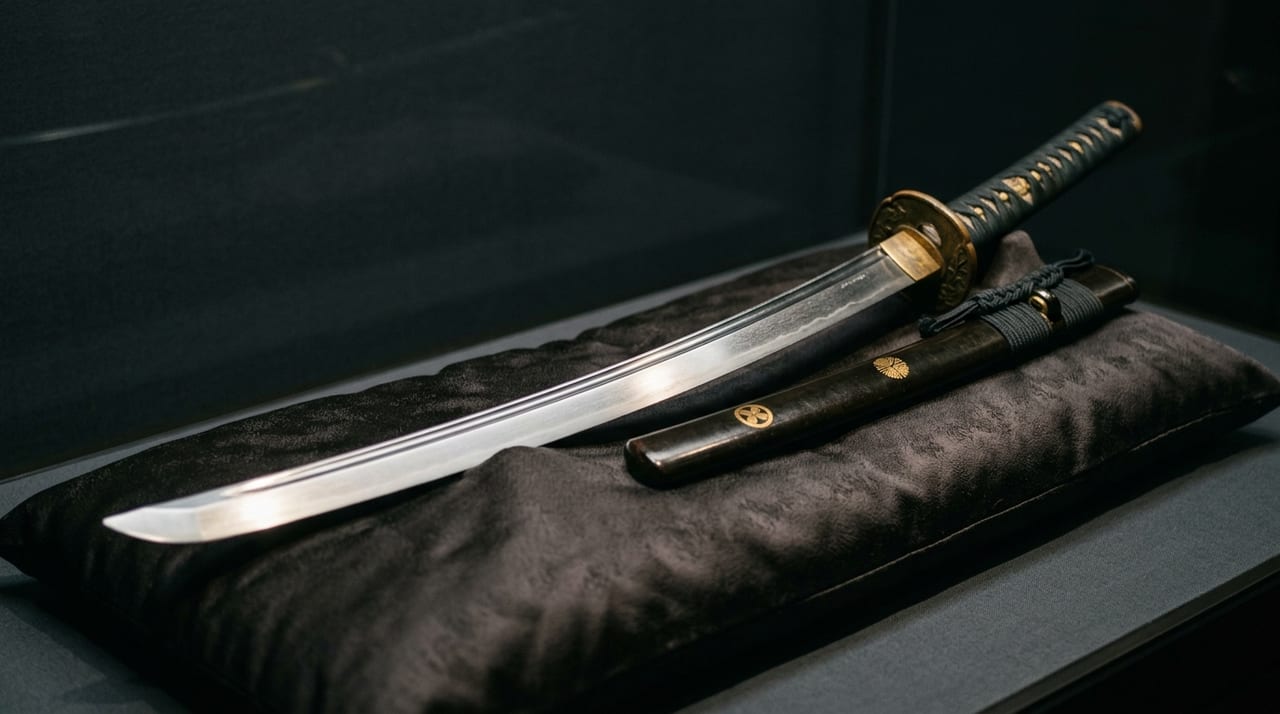
 * Image is for illustrative purposes only.
Uda Kunifusa
宇多国房
Also known as: Uda Kunifusa: The Finest Work of the Etchu Uda School, a Legendary Blade Transmitted through the Maeda Clan of Kaga
Description
Overview of the Blade
Uda Kunifusa is a tachi forged by Uda Kunifusa, a master swordsmith of the Uda school who was active in Etchu Province (present-day Toyama Prefecture) from the Nanboku-chō through the early Muromachi period. It is designated as an Important Cultural Property and is housed in the Ishikawa Prefectural Museum of Art (Kanazawa City). The Uda school derives its name from Uda in Yamato Province (present-day Uda District, Nara Prefecture). It was a group of swordsmiths who migrated to Etchu Province in the late Kamakura period and became the founders of the Etchu Uda school, sustaining Etchu's sword culture from the late Kamakura period through the Nanboku-chō and Muromachi eras. Uda Kunifusa is one of the supreme works of this tradition and is a celebrated blade with the distinguished provenance of having been transmitted through the Maeda clan, lords of Kaga Province.
The Distinctive Characteristics of the Uda School and Etchu's Sword Culture
The Uda school was a group of swordsmiths based in Etchu Province (present-day Toyama Prefecture) with distinctive characteristics in their swordcraft. The most remarkable feature of the Uda school is the appearance of a unique reflection called "shiraike-utsuri" (white-mist reflection), which emerges against a soft, flowing itame (wood-grain) jitetsu (blade steel). This shiraike-utsuri is a phenomenon unique to Etchu, distinct from both the chōji-utsuri (clove-bud reflection) of the Bizen school and the jikei (landscape effect) of the Sōshū school, making it the most distinctive signature that sets Uda school blades apart from other schools. The hamon exhibits a notare pattern based on the gunome (fish-scale) motif, with a somewhat deep nioi-kuchi (scent-mouth) and scattered nie, displaying an overall composition that is calm yet dignified. Etchu, located at the foot of the Tateyama mountain range, is a land blessed with abundant water and high-quality satetsu (iron sand), and it is believed that this region's natural environment shaped the unique texture and character of Uda school blades.
Uda Kunifusa's Skill and Artistic Style
Uda Kunifusa is especially highly regarded among Uda school smiths, and his tachi exemplifies the highest standards of the Uda school in both jitetsu and hamon. The jitetsu displays itame mixed with mokume (wood-grain variations), with the shiraike-utsuri clearly evident, emanating the soft, distinctive lustre characteristic of the Uda school. The hamon is a notare pattern intermingled with gunome and small chōji elements, displaying deep nioi-kuchi with scattered nie, exhibiting a distinctive beauty that might be called serene grandeur. Both the sori (curvature) and blade length reflect the stylistic traits of the late Nanboku-chō through early Muromachi periods, fully embodying the aesthetic demands of Etchu's warrior culture of that era. The nakago clearly bears a two-character mei (signature) reading "Kunifusa," making this a securely attributed extant work and earning it high evaluation as an authenticated Uda school blade.
The Maeda Clan of Kaga and Etchu-Kaga Sword Culture
The precise history of how Uda Kunifusa came into the possession of the Maeda clan, lords of Kaga, is not entirely clear, but the Maeda family was renowned as a cultured and refined daimyo household, maintaining deep sophistication in the arts and culture even after establishing themselves as lords of the million-koku Kaga domain following the Bunroku-Keichō Campaign and the Battle of Sekigahara. In particular, the fifth Kaga lord Maeda Tsunanori (1643–1724) was renowned as a great cultural figure, known as one of the "Three Walls of Kaga," and amassed an enormous collection of artworks and cultural properties. Given the Maeda family's rule of Kaga, which bordered Etchu, it was a natural development for a supreme work of the Etchu Uda school to be included in their collection.
The Ishikawa Prefectural Museum of Art and the Present Day
Today, Uda Kunifusa is housed in the Ishikawa Prefectural Museum of Art (Kanazawa City), where it is properly conserved and publicly displayed as an Important Cultural Property. Kanazawa has been a center of culture since the Edo period as the castle town of the Kaga domain, and the Ishikawa Prefectural Museum of Art, which houses numerous artworks and crafts associated with the Kaga clan, is recognized as one of Japan's finest regional museums. As one of the museum's important holdings, Uda Kunifusa continues to be treasured today as a bridge connecting Etchu's sword culture with Kaga's cultural traditions.
Rarity and Authentication of Signed Works
Securely authenticated signed works of the Uda school are few in number, and tachi bearing the Kunifusa signature are particularly rare. As a securely attributed work with the two-character signature "Kunifusa," this blade is positioned as one of the most important reference materials in Uda school authentication and research. During the Edo period, the Honjō family's sword authentication functioned as the authoritative standard, and Uda Kunifusa was highly valued as a celebrated blade bearing a Honjō authentication certificate (oroshi). As one of the Etchu lineage's works most clearly demonstrating the Uda school's distinctive character, this tachi maintains an important place in contemporary academic and artistic scholarship. Frequently cited as a representative work of the Uda school in sword museums and academic publications, Uda Kunifusa stands as one of the most important blades for conveying Etchu's sword culture to the world.
The Technical Lineage of the Etchū Tradition
The Etchu tradition (Etchu-den) is classified as a "regional school" rather than one of the Five Great Traditions of Japanese swordcraft (Yamato, Yamashiro, Sōshū, Bizen, and Mino), yet it possesses distinctive characteristics and technical refinement equal to those of the major schools. Etchu tradition blades are characterized by the soft ductility of the jitetsu and the beauty of the shiraike-utsuri, and Edo-period sword experts held the Etchu tradition in high regard. Uda Kunifusa stands at the apex of the Etchu tradition and is positioned as the most important representative of the special category of "the highest achievement of a regional school" in Japanese swordcraft. The fact that the distinctive sword culture nurtured by the Etchu region continues to be preserved and displayed in the form of the Ishikawa Prefectural Museum of Art demonstrates the achievement of Japan's cultural heritage protection administration and represents a precious legacy for future generations. The value of Uda Kunifusa lies not merely in its rarity but in its role as a testament to the historical existence of the Uda school's distinctive sword culture, making it indispensable in any account of Japanese sword history. Through this single blade, the history, culture, and natural environment of the Etchu region speak to us today across more than seven hundred years. The true appreciation of Japanese swords lies in admiring the blade's beauty while imagining the stories of the era, region, and people behind it. Uda Kunifusa offers this rich experience in full measure, possessing universal appeal that draws both novices to sword culture and expert connoisseurs alike.
Legends & Stories
The Mystery of Shiraike-Utsuri
The "shiraike-utsuri" (white-mist reflection), the defining characteristic of Uda school blades, is one of the most ethereal and mysterious among all types of utsuri (reflection) in Japanese swords. Utsuri is a light reflection that appears within the jitetsu above the hamon, corresponding to the hamon's form, and stands alongside the "chōji-utsuri" of the Bizen school and the "jikei" of the Sōshū school as an important point of appreciation. The Uda school's "shiraike-utsuri" differs from other utsuri, displaying a distinctive appearance in which a misty, soft white light gently envelops the entire blade. According to researchers, this phenomenon is believed to result from subtle differences in the composition of satetsu from the Uda region, forging techniques, and the precise temperature control of the quenching process, yet even today it remains incompletely understood. When one stands before Uda Kunifusa's tachi with its beautifully manifested shiraike-utsuri, a poetic, mist-shrouded beauty that transcends technical assessment of the hamon and jitetsu envelops the viewer—this is a unique world that only the Uda school could create, distinct from the celebrated blades of other schools.
The Cultural Legacy of the Maeda Clan—The Aesthetics of the Million-Koku Kaga Domain
The Maeda clan, lords of the Kaga domain with a revenue of a million koku second only to the Tokugawa shogunate, made exceptional investments in culture and the arts throughout the Edo period. To avoid being perceived as a threat to the shogunate, the Maeda family is said to have deliberately invested in culture rather than military might, and as a result, Kanazawa came to be known as "Kyoto in miniature" for its cultural abundance. Under Maeda patronage, noh theater, tea ceremony, Kaga yūzen dyeing, Wajima lacquerware, and Kaga makie (gold-inlaid decoration) flourished, and by collecting the finest sword masterpieces, the Maeda lords demonstrated their cultural authority. The fact that Uda Kunifusa was part of this collection demonstrates that this tachi functioned not merely as a weapon but as a symbol of cultural authority.
The Sword-Making Character of the Land of Etchu
Etchu (Toyama Prefecture) is blessed with both agricultural and industrial prosperity, backed by the Tateyama mountain range, one of Japan's most impressive alpine regions, with abundant snowmelt waters. Known since ancient times as a producer of high-quality satetsu (iron sand), this ore is believed to have shaped the distinctive iron characteristics of the Uda school. The unique environment where the maritime climate of Toyama Bay intersects with the alpine climate of Tateyama can be poetically interpreted as having created the meteorologically evocative phenomenon of the "shiraike-utsuri" displayed in Uda school blades, embodying the profound depth of Japanese sword culture where the blade's character and the land's natural environment resonate deeply with one another.
The Reevaluation of the Uda School in the Modern Era
While the Uda school is somewhat less well-known than the Five Great Traditions (Bizen, Sōshū, Yamashiro, Yamato, and Mino), recent Japanese sword scholarship has renewed attention to its distinctive character and high technical standard. In particular, the unique phenomenon of shiraike-utsuri has become a fascinating research subject for modern scholars from metallurgical and engineering perspectives, with high-quality authenticated works such as Uda Kunifusa serving as central research materials. Uda Kunifusa, which demonstrates that regional swordsmith groups possessed the capacity to produce art of world-class caliber, stands as one of the most compelling witnesses to the diversity and richness of Japanese sword culture. The reevaluation of the Uda school is progressing not only within Japan but among international Japanese sword researchers, with the shiraike-utsuri phenomenon gaining international attention as "the pinnacle of beauty found only in Japanese swords." The opportunity to view this tachi at the Ishikawa Prefectural Museum of Art will be a rare experience of touching the essence of sword culture nurtured by the Etchu and Kaga regions.
Uda Kunifusa as an Embodiment of "Regional Pride"
While celebrated Japanese sword masterpieces are often thought to originate from central or major production centers such as Kyoto, Nara, Kamakura, and Bizen, Uda Kunifusa embodies "regional pride" as a supreme masterpiece born from the local tradition of Etchu. The Etchu Uda school possessed an independent technical system distinct from the major central schools, and the shiraike-utsuri phenomenon it produced is a unique beauty that no central school could emulate, enriching the diversity of Japanese sword culture. The history of Uda Kunifusa joining the Maeda collection and being transmitted to the Ishikawa Prefectural Museum of Art embodies the ideal form of a region's greatest cultural treasure being transmitted within its own cultural context, serving as a model for Japan's approach to cultural heritage protection. Through the single blade of Uda Kunifusa, the nature of Etchu, the techniques of the Uda school, the culture of the Maeda family, and present-day Kanazawa are bound together in a continuous narrative, exemplifying the richness of Japanese culture to the world. Japanese blades are microcosms in which history, geography, culture, and art are concentrated, and Uda Kunifusa is a singular existence that encompasses a particularly rich array of stories within that microcosm. Uda Kunifusa, transmitted across the centuries from Etchu to Kaga and from the Nanboku-chō period through the Edo, Meiji, and modern eras, embodies the fact that the Japanese sword has maintained its place of value in society and culture for more than seven hundred years, making it one of the finest symbols of the continuity and depth of Japanese culture. For those studying sword culture, an encounter with Uda Kunifusa is an inexhaustible experience that always brings new discoveries and profound emotion. This tachi, bearing the shiraike-utsuri, continues to convey across nearly a thousand years to the present the memories of Etchu's mist, snow, and iron.