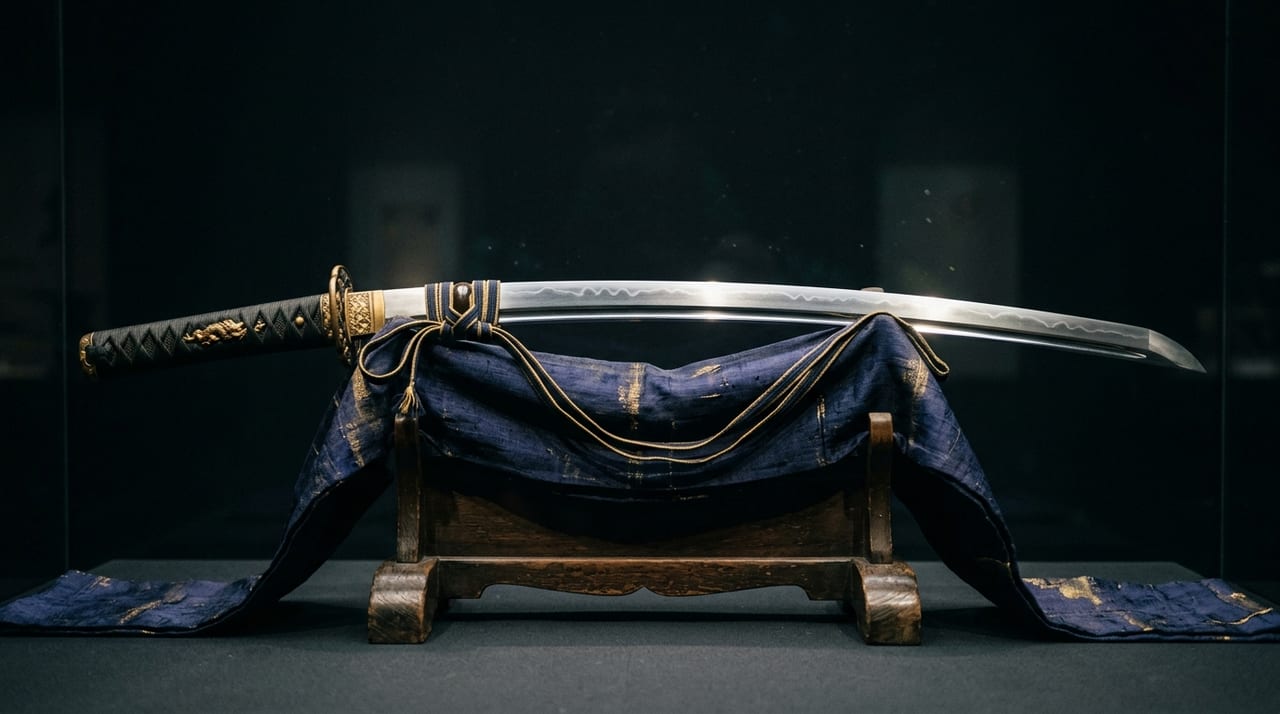
 * Image is for illustrative purposes only.
Tomokirimaru
友切丸
Also known as: Tomokirimaru; Former Name of Higekiri, the Genji Clan's Spirit-Blade
Description
Overview of the Blade
Tomokirimaru is known as the former name of the sacred tachi Higekiri, transmitted through the legitimate lineage of the Minamoto clan and a treasured sword of the Minamoto clan forged in the late Heian period. It is enshrined and preserved at Kitano Tenmangu Shrine (Kamigyo Ward, Kyoto) and is designated an Important Cultural Property. The name "Tomokirimaru" derives from an inauspicious legend in which the sword's owner accidentally cut down a companion (a fellow prisoner) imprisoned in the same cell, and it is said that the blade was subsequently renamed "Higekiri." This very circumstance of renaming constitutes an important cultural-historical fact demonstrating the spiritual nature of blades and naming practices in the Heian period.
Relationship with Higekiri and the Mystery of Naming
The prevailing scholarly view holds that Tomokirimaru and Higekiri are multiple names given to the same tachi. The tachi transmitted among the Minamoto clan has a history of being called by multiple names depending on its owner, period, and legendary accounts. In Heian-period culture of blade naming, a sword's spiritual nature was believed to be controlled and directed through its name, and there existed a practice of renewing a blade's spiritual essence through renaming a sword that had brought inauspicious experiences. The renaming from Tomokirimaru to Higekiri exemplifies this practice.
Transmission as a Spiritual Sword of the Minamoto
Minamoto no Mitsunaka (912–997) was a warrior who laid the foundation for the Seiwa Genji and established his base in Tada, Settsu Province. It is said that Mitsunaka had a pair of great swords forged, naming one "Higekiri" (or Tomokirimaru) and the other "Hizamaru." This pair of blades was passed down through generations as symbolic treasured swords of the Seiwa Genji and was inherited by Minamoto no Yorimitsu, Yorinobu, and Yoshiie.
Preservation at Kitano Tenmangu Shrine
At present, Tomokirimaru (Higekiri) is enshrined and preserved at Kitano Tenmangu Shrine. The enshrinement of this spiritual sword associated with the Minamoto at Kitano Tenmangu Shrine reflects complex historical circumstances at the intersection of court culture, warrior culture, and shrine culture of the Heian period, demonstrating that this tachi has been positioned as a cultural and religious entity transcending mere weaponry.
Legends & Stories
From Tomokirimaru to Hizakiri—Why the Sword's Name Changed
In the Heian period, bestowing a name upon a sword was not merely a means of identification, but an act of controlling and directing—through language—the spiritual nature that dwelt within the blade. The name "Tomokirimaru" indicated that this large sword possessed the inauspicious property of "cutting a friend"; that is, of mistakenly wounding the owner's companion. Such dangerous swords were believed capable of renewing their spiritual nature through renaming. The new name "Hizakiri" is said to derive from a legend of cutting the beard of a prison inmate, representing a shift in the sword's nomenclature from the direction of "cutting a friend" to "cutting criminals and demons"—a transformation of the blade's spiritual orientation. This tradition of renaming vividly demonstrates the cultural worldview of Heian-period Japanese people, who regarded swords as spiritual beings and sought to manage their spiritual power through the bestowal of names.
Minamoto no Raiko and the Defeat of the Demon
Minamoto no Raiko (948–1021) was the eldest son of Minamoto no Mitsunaka and a great general who established the martial prowess of the Minamoto clan. He is said to have commanded the Four Heavenly Kings of Raiko and subjugated thieves and evil demons across the realm. The most celebrated legend associated with the demon-slaying of Hizakiri (Tomokirimaru) is the account of Watanabe no Tsuna, one of the Four Heavenly Kings of Raiko, severing a demon's arm at the Ichijo Modorihashi bridge (or at the Rashomon gate). Through this deed, the sword came to be known as "Onigiri" or "Onigiri-maru." As an emblem of the Minamoto clan's martial might, Tomokirimaru (Hizakiri) has been venerated for a thousand years.
Kitano Tenmangu as Sacred Ground and the Sanctity of the Blade
Kitano Tenmangu is a shrine dedicated to Sugawara no Michizane (845–903), revered as the deity of learning and the arts, and was established for the appeasement of his vengeful spirit. The enshrinement of a spiritual sword of the Minamoto clan at this sacred precinct dedicated to the pacification of a vengeful spirit is understood to stem from the Japanese religious principle that "by concentrating potent spiritual forces in a single location, they mutually amplify one another's spiritual power." The pairing of Tomokirimaru—a "sword bearing the cursed history of cutting a friend"—with a "shrine that pacifies a vengeful spirit" embodies a profound theme within Japanese religious culture: the management and harmonization of spiritual power.