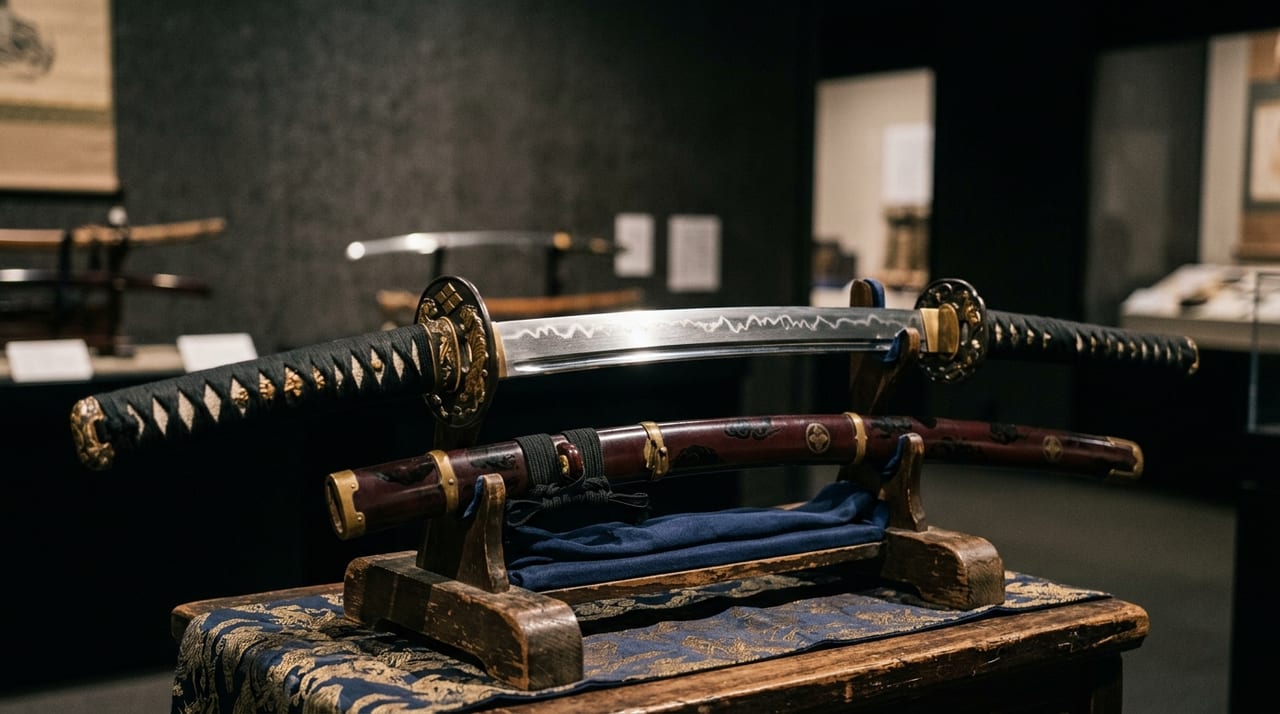
 * Image is for illustrative purposes only.
Beloved Swords of Takeda Shingen
武田信玄の愛刀
Also known as: Record of Shingen's Swords (Tatanashi, Nezukiri-maru, Swords of the Tiger of Kai)
Description
Takeda Shingen (1521–1573) was an outstanding general of the mid-to-late Sengoku period, based in Kai Province (present-day Yamanashi Prefecture). He is revered in Japanese history as the "Tiger of Kai" and the "military sage who bore the banner of 'Fū-Rin-Ka-Zan' (Wind-Forest-Fire-Mountain)." His beloved swords, which displayed his genius for military strategy in countless battles including the Battles of Kawanakajima against Uesugi Kenshin (1553–1564), continue to attract great interest today as embodiments of the martial power and cultural refinement of the Takeda clan.
Tatanashi—The National Treasure Great Armor and Its Companion Sword
The most sacred treasures of the Takeda clan are the great lamellar armor called "Tatanashi" (a National Treasure) and the tachi transmitted alongside it, likewise known as "Tatanashi no Tachi." Tatanashi means "sturdy enough that a shield is unnecessary," and served as the spiritual pillar of the Takeda clan—a "sacred artifact endowed with divine efficacy" believed to repel enemy attacks through the protection of the gods. This tachi, said to date from the late Heian or Kamakura period, carries serene dignity in its antique form. Shingen is said to have offered prayers before this tachi before every major battle. The National Treasure "Tatanashi Armor" (small cherry-blossom leather-laced great armor with helmet and large pauldrons), a family treasure of the Takeda, is currently enshrined in the Sugata Tenjinja shrine in Kōshu City, Yamanashi. Treasures associated with Shingen are preserved at temples and shrines linked to the Takeda throughout the region, drawing many pilgrims and researchers.
Nezukiri-maru—Shingen's Legendary Sword That Vanquished a Demon
Nezukiri-maru is a tachi or katana said to have been owned by Shingen, taking its name from a legend in which it slew a supernatural creature called "nene"—a giant rat demon. When this enormous rat monster called nene, which had appeared in Kai Province, was terrorizing the villagers, either a retainer to whom Shingen had granted this sword is said to have defeated it, or Shingen himself is said to have cut it down. Such "demon-vanquishing legends" are a characteristic form of lore accompanying famous swords, and this account of Shingen's sword's spiritual power has been passed down throughout Kai as testimony to its sacred efficacy. Several swords preserved at Takeda Shrine and various temples throughout Kōfu are proposed as candidates for the actual blade identified as "Lord Shingen's legacy sword," but definitive provenance remains difficult to confirm.
Kiku-ichimonji Norizane—Swords of Supreme Quality
Among the swords attributed to Shingen are works said to be by Kiku-ichimonji Norizane, a master smith of the Kamakura period. Kiku-ichimonji Norizane is known as the court swordsmith (goban-kaji) to Emperor Go-Toba and recognized as the supreme smith of his era—his works are extraordinarily rare and highly coveted in sword-collecting circles. While there is limited historical evidence that Shingen possessed such a blade, this account has become widely known in the context of "a warlord contending for dominion sought only the finest swords," and serves as an anecdote attesting to Shingen's refined eye for swordsmanship.
Shingen's Philosophy of the Sword—Embodying "Fū-Rin-Ka-Zan"
Takeda Shingen's military banner "Fū-Rin-Ka-Zan" (Wind-Forest-Fire-Mountain) embodies the spirit drawn from Sun Tzu's Art of War: "swift as wind, silent as forest, fierce as fire, immovable as mountain." Shingen's beloved swords were likewise positioned as embodiments of this spirit. Swift as the wind in their cutting stroke, silent as a forest as the blade rests in its scabbard, brilliant as fire in the blade pattern, steadfast as a mountain in the will of their steel—Shingen's philosophy of the sword, a distillation of the very essence of the bushidō code, has continued to exert profound influence on warriors, martial artists, and sword enthusiasts from the Edo period to the present day.
Much of the Takeda sword collection was scattered following the great defeat at the Battle of Nagashino (1575) and the fall of the Takeda clan in 1582, but many relics associated with Shingen remain preserved at Takeda Shrine and throughout Kai, transmitting the finest expressions of Sengoku-period samurai culture to the present day.
Legends & Stories
The greatest legend surrounding Takeda Shingen's beloved swords concerns the "protection of Tatanashi." When Shingen first donned the Tatanashi armor, a priest of Kandatenjinja is said to have received a divine oracle in a dream: "The one who holds these arms shall rule all under heaven." Shingen took this as proof that the Takeda clan would assert hegemony over Japan, and his faith in the armor and sword became a cornerstone of his military campaigns. Nenekiri-maru, a great tachi housed at Nikko Futarasan Shrine, is surrounded by a ghostly legend: it is said to have single-handedly vanquished the yokai Nene dwelling in the Nikko mountains. At the height of the fierce battles at Kawanakajima, when Uesugi Kenshin is said to have struck directly at Shingen, tradition holds that Shingen wielded his beloved sword as a shield and escaped the peril—giving rise throughout Kai Province to the saying "Shingen's sword saved his lord's life." After Shingen's death, portions of his beloved swords were distributed to his retainers, and the belief persisted for generations that "a warrior bearing the Takeda diamond crest who carries one of these swords shall be called to victory"—a faith quietly preserved in the households of former Takeda retainers long after the clan itself had fallen.