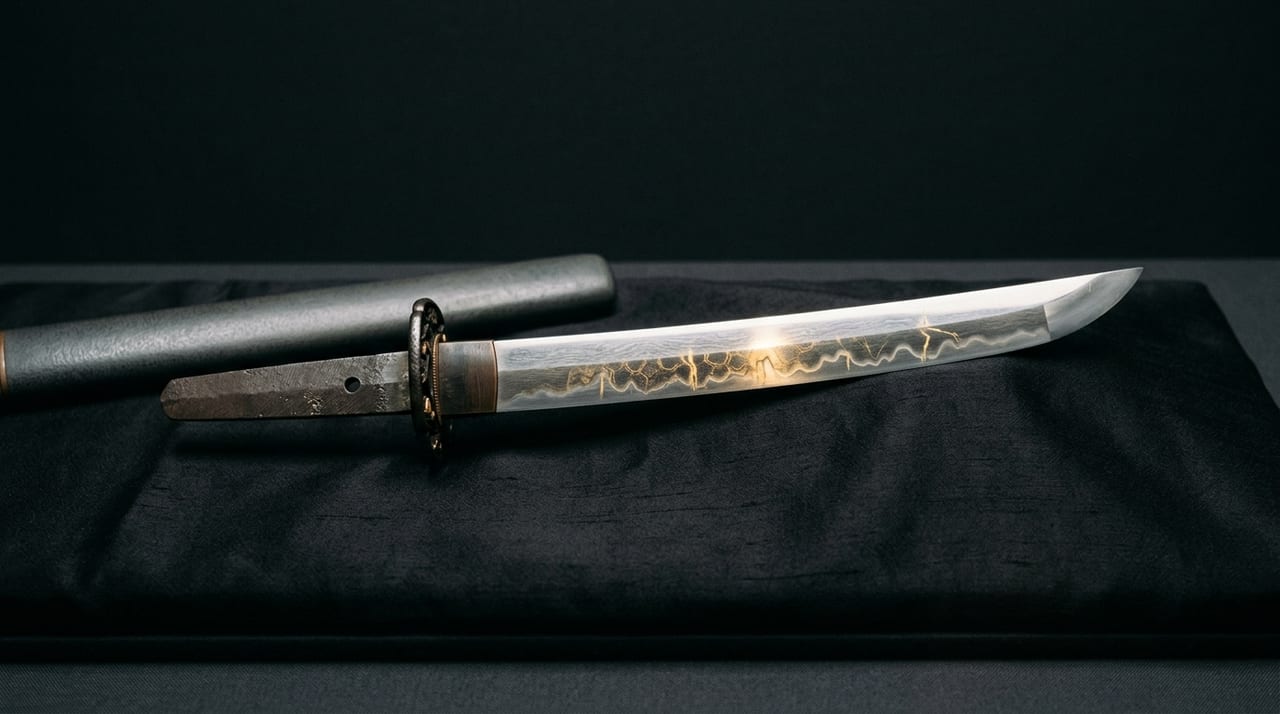
 * Image is for illustrative purposes only.
Suijingiri Kanemitsu
水神切兼光
Also known as: Suijingiri Kanemitsu — Water-Deity Cutter, Date Clan Heirloom, Bizen Osafune Kanemitsu
Description
Suijingiri Kanemitsu is a tachi forged by Osafune Kanemitsu, a master craftsman of the Osafune school in Bizen Province (present-day Setouchi City, Okayama Prefecture), during the Nanbokuchō period. The blade is renowned as a celebrated treasure owned by Naoe Kanetsugu, senior retainer (karo) of Uesugi Kagekatsu, and is designated as an Important Cultural Property. Kanemitsu, the son of Kagekuni, was an Osafune smith who flourished from the late Kamakura period through the Nanbokuchō era. His forging style inherited the orthodox Bizen tradition from his master while embracing the grand and robust proportions characteristic of the Nanbokuchō period, demonstrating excellence in both hamon and jigane. The name "Suijingiri" (literally "Water-Deity Cutter") derives from a legend associated with Naoe Kanetsugu: when a river threatened to overflow and flood the domain under his governance, Kanetsugu went to the riverbank and struck the water with this blade, whereupon the waters receded and the flood subsided. Since then, the sword has been revered as a sacred talisman capable of averting water disasters. The blade displays the stately and elongated form characteristic of the Nanbokuchō period, with a blade length exceeding two shaku seven sun (approximately 82 centimeters). Its hamon is a bold composition of ō-gunome interspersed with choji, while the jigane shows ko-itame grain mixed with larger patterns, displaying bright nie and utsuri throughout. The tang retains the signature "Kanemitsu" and is recognized as a benchmark work in the study of the Osafune school. It is currently housed in the collection of Breastrive Corporation.
Legends & Stories
The legend behind the name Suijingiri Kanemitsu relates to Naoe Kanetsugu, a senior retainer of the Uesugi clan. When a great flood struck the domain, Kanetsugu stood at the riverbank where the flood threatened to overflow, and legend holds that when he cut the water deity in the flooded waters with this sword, the water immediately receded and the flood subsided. From this event, the sword received the epithet "Water-Deity Cutter." This sword is also counted among the "Thirty-Five Blades Hand-Selected by the Uesugi," chosen by Uesugi Kagekatsu, who was skilled in sword appreciation, and was transmitted as a celebrated blade associated with the Uesugi clan. It is a work by Bizen Osafune Kanemitsu from the Nanboku-chō period and is designated as an Important Art Object. Currently it is preserved with a collector in Ibaraki, Osaka Prefecture.