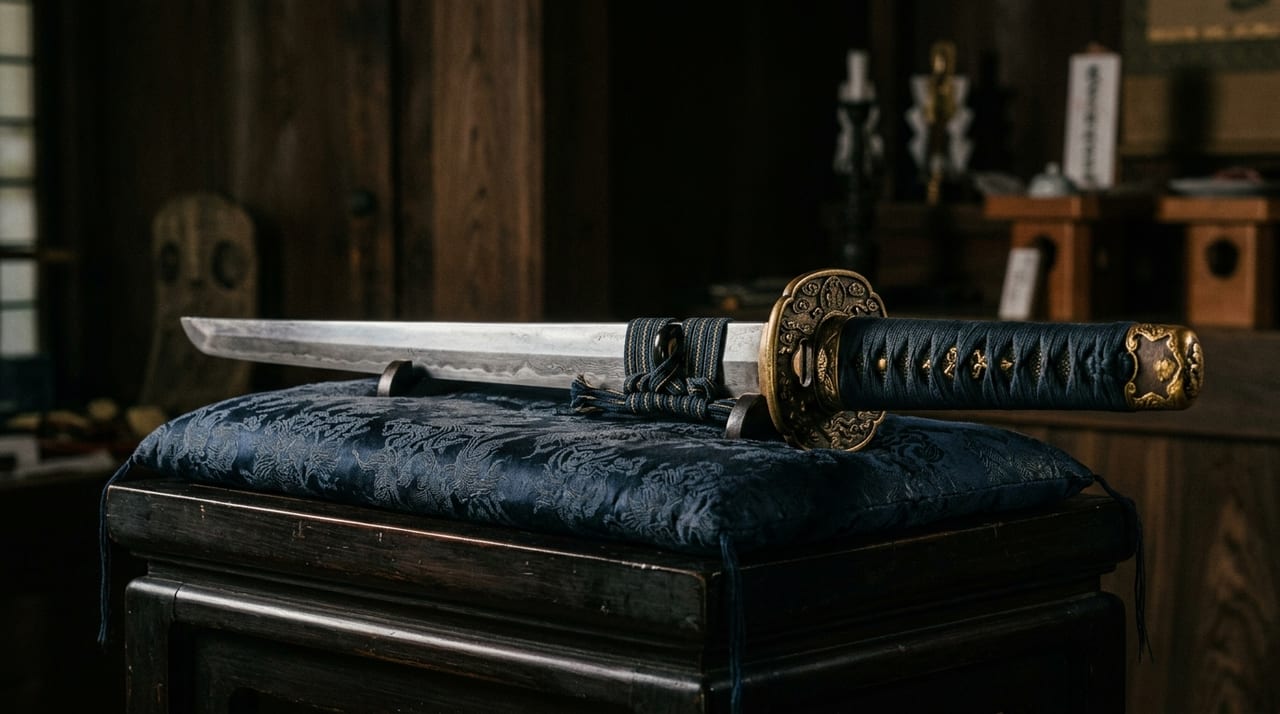
 * Image is for illustrative purposes only.
Sohaya no Tsuruki
ソハヤノツルキ
Also known as: The Miike Sword · a copy of Sakanoue no Tamuramaro's sword · Tokugawa Ieyasu's deathbed blade
Description
Overview of the Sword
Sohaya no Tsuruki is a tachi whose tang bears the kiritsuke-mei 'Myōjun Denji Sohaya no Tsuruki Utsusu Nari.' It was made as a copy of the 'Sohaya no Tsuruki' said to have been carried by the Heian-period warrior Sakanoue no Tamuramaro, and it is traditionally attributed to Miike Tenta Mitsuyo, a renowned smith of Chikugo active from the late Heian to early Kamakura periods. It is known as the blade Tokugawa Ieyasu kept close to him until the end of his life. It is still held by Kunōzan Tōshōgū as a relic of Ieyasu, and as 'Ieyasu's protective blade' it is the most important such sword. 'Sohaya' is interpreted either as an archaic word meaning 'swift' or as deriving from a specific place or personal name, but the true etymology is debated and has not been settled. The name 'Sohaya no Tsuruki' may also be seen as praise for the sharpness of this blade and the swiftness of its miraculous efficacy.
The Legend of Sakanoue no Tamuramaro
Sakanoue no Tamuramaro (758–811) was the greatest warrior of the Heian period, commanding campaigns against the Emishi (indigenous peoples of the Tōhoku region) in the Enryaku and Daidō eras. Through two campaigns (794 and 801), he forced Aterui, leader of the Emishi, to surrender, and established the court's rule over the Tōhoku region. Tamuramaro was believed to be an incarnation of Bishamonten, and his martial prowess and strategy became an ideal for warriors of later generations. The name Sohaya no Tsuruki derives from the fact that it is a copy of Tamuramaro's sword, and it has been passed down in later times as a blade that shares in the power of the sacred sword that defeated the Emishi. That the Tōhoku land Tamuramaro conquered was later ruled by Date Masamune as dominant lord of Ōshū, and that Sendai was then built on that same ground, shows that Tōhoku has remained an important stage of history from ancient through medieval and early modern times.
Deep Ties with Tokugawa Ieyasu
According to the treasure register of Kunōzan Tōshōgū, Sohaya no Tsuruki was presented to Ieyasu by Oda Nobukatsu around 1584 (Tenshō 12). According to shrine tradition, Ieyasu favored this blade above all, wore it constantly, and even used it as a makura-gatana (pillow sword) at night. As a warlord who survived the chaos of the Sengoku period, Ieyasu had a deep understanding of and faith in swords. Sohaya no Tsuruki, which carries the tradition of being 'Sakanoue no Tamuramaro's sword,' was for Ieyasu not merely an old blade; it is thought to have been a Dharma-protecting sword bearing the spirit of a hero who accomplished the feat of the Tōhoku campaign. Ieyasu died at Sunpu Castle on June 1, 1616 (Genna 2/4/17), at the age of seventy-five. Just before his death, Ieyasu is said to have ordered his retainers to test-cut criminals with this sword, and left a testament that it be enshrined on Kunōzan with its point facing west, so that the lords of the western provinces would not rise in rebellion. This testament was faithfully observed, and Sohaya no Tsuruki is still preserved at Kunōzan Tōshōgū as one of Ieyasu's relics.
Features of the Blade
Sohaya no Tsuruki has a broad, imposing form, with a blade length of about 67.9 cm and a curvature of about 2.5 cm, and its point is an ikubi-kissaki. It is said to be the work of Miike Tenta Mitsuyo and shows the archaic elegance of the late Heian to early Kamakura periods. The tang (nakago) is inscribed with the kiritsuke-mei 'Myōjun Denji,' 'Sohaya no Tsuruki,' and 'Utsusu Nari,' though their meaning has not yet been clarified. That the blade has maintained high regard as an Important Cultural Property after being transmitted since the Kamakura period is the result of both the quality of the sword and the efforts of later generations to preserve it.
Kunōzan Tōshōgū
Kunōzan Tōshōgū is a shrine founded as the mausoleum of Tokugawa Ieyasu on Kunōzan, where his remains were interred in accordance with his dying wish. It stands on the summit of Kunōzan at an elevation of 200 meters, overlooking Suruga Bay, and as a key point on the Tōkaidō it received the patronage of the shogun's house throughout the Edo period. It holds many of Ieyasu's relics, and among them Sohaya no Tsuruki occupies a special place as the most important sword. As 'a sword in which Ieyasu's spirit resides,' Sohaya no Tsuruki symbolizes the spiritual legacy of the man who laid the foundations for three centuries of Tokugawa peace.
Legends & Stories
Sakanoue no Tamuramaro and the Emishi Campaigns
Sakanoue no Tamuramaro's campaign into the Tōhoku region against the Emishi took place in the late eighth century, early in the Heian period. The Emishi were peoples living in the Tōhoku region who continued to resist the authority of the Yamato court. Tamuramaro's eastern campaign was not merely a military conquest; it was a historic undertaking that fixed the territory of the Japanese state and laid the foundations for later Tōhoku culture.
It is said that when Tamuramaro went into battle wearing Sohaya no Tsuruki, the mysterious power the blade emitted broke the enemy's fighting spirit and drew victory to him. Some hold that the name 'Sohaya' (swift) refers not only to the speed of the blade but to the sword's swift display of miraculous efficacy in response to prayers. Just as Tamuramaro himself was believed to be an incarnation of Bishamonten, Sohaya no Tsuruki was also regarded as a sacred sword that carried the divine power of Bishamonten.
Ieyasu's Death and Final Testament
Tokugawa Ieyasu died at Sunpu Castle on June 1, 1616 (Genna 2/4/17), at the age of seventy-five. According to the Tōshōgū Gojikki and other accounts, just before his death Ieyasu ordered his retainers to test-cut criminals with this sword, and left a testament that it be enshrined on Kunōzan with its point facing west, so that the lords of the western provinces would never rise in rebellion.
Why did Ieyasu leave this particular sword behind? It is suggestive that the blade he, a deep lover of swords, ordered placed on Kunōzan at his death was not a masterpiece by Masamune but a tachi said to be a copy of Sakanoue no Tamuramaro's sacred sword. Just as Tamuramaro pacified the Tōhoku region, Ieyasu pacified all of Japan and established an age of peace. By keeping Tamuramaro's sacred sword close, Ieyasu may have expressed his self-understanding as the heir to a mission to 'unify and protect the realm.'
Tamuramaro's Land: Tōhoku and Date Masamune
The Tōhoku land that Tamuramaro conquered became, several centuries later, the land of the golden culture of the Ōshū Fujiwara, and after that the Sendai region where Date Masamune asserted his dominance. That Sohaya no Tsuruki links two great historical achievements, Tamuramaro's campaign in Tōhoku and Ieyasu's unification of the realm, reminds us once more of the great historical significance of this sword.