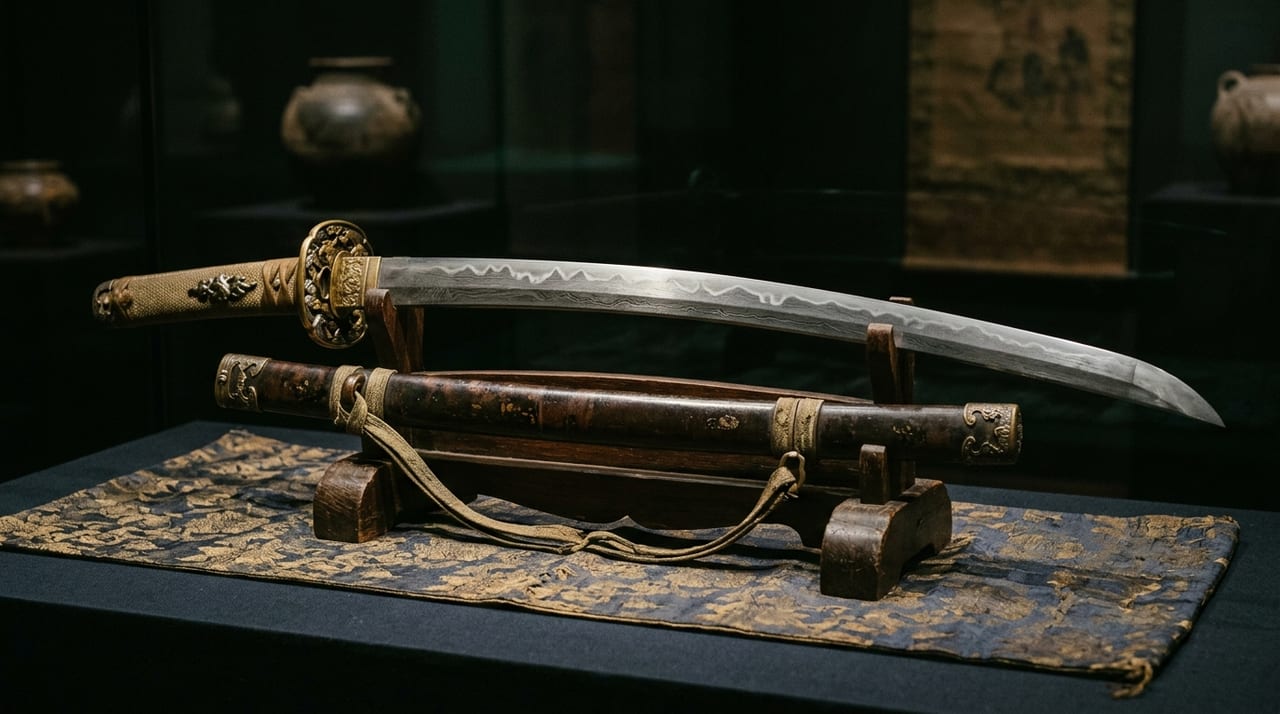
 * Image is for illustrative purposes only.
Tachi by Shizu Kaneuji
志津兼氏の太刀
Also known as: Shizu; Mino Kaneuji; Shizu Saburō Kaneuji
Description
Shizu Saburō Kaneuji — Foremost of the Ten Great Disciples of Masamune and Founder of the Mino Tradition
Shizu Saburō Kaneuji (志津三郎兼氏) was a swordsmith active in the Nanbokuchō period (first half of the 14th century), who occupies a special place in sword history as one of the "Ten Great Disciples of Masamune (Masamune Jittetsu)" — ten master craftsmen who left their mark on Japanese sword history as high disciples of Sōshū Masamune (相州正宗). A native of Yamato Province (Nara), Kaneuji deeply mastered the techniques of the Sōshū tradition under Masamune, then relocated to Mino Province (modern-day Gifu Prefecture), where he settled in an area called Shizu (志津) and established the Shizu school (志津派) — a sword-forging tradition that would become the foundation of what later became known as the Mino tradition (美濃伝). The "Mino tradition" is the origin of the sword-making tradition that characterizes Mino, the production center that from the later Muromachi through the Warring States period would circulate vast quantities of practical military swords throughout the nation under the name "Seki swords (関の刀)"; positioned at the very source of this tradition, Kaneuji stands as the "founder of Mino sword history" — an essential figure for understanding the regional diversity of Japanese swords. Multiple important cultural properties are among Kaneuji's surviving works, which are housed in major museums and art museums, including the Tokyo National Museum.
The Style of Shizu Saburō Kaneuji — Fusion of the Sōshū and Yamato Traditions
The defining characteristic of Shizu Saburō Kaneuji's works lies in a unique aesthetic in which "the bold and powerful ji-tetsu and blade-pattern expressiveness of the Sōshū tradition" fuses with "the elegant refinement of the Yamato tradition's pure and upright bearing." While mastering the "Sōshū tradition (相州伝)" — the Kamakura technique renowned for its fierce boiling activity (nie) and rough, dramatic blade patterns — under Masamune, Kaneuji never abandoned the aesthetic sensibility of his native Yamato: its "correct and pure bearing," instead establishing a unique style that unified both. The blade patterns of Shizu Saburō Kaneuji are characterized by what are called "large interlocking diamonds (大互の目)" or "large disorder (大乱れ)" — undulating patterns of great amplitude — displaying beauty with dignity amid fierce energy. In the ji-tetsu as well, while possessing "the large wood-grain texture (大肌) of the Sōshū tradition," it exhibits a complex character that evokes "the clarity of the Yamato tradition" — a feature that positions Kaneuji's works in a particularly unique place among the Ten Great Disciples of Masamune. This "unified style of two traditions" serves as the origin of the historical process whereby later Mino smiths would "inherit both the Sōshū and Yamato traditions while establishing a unique Mino tradition," and carries significant meaning in sword history.
Relocation to Mino Province — Establishing the Swordsmith's Craft in a New Land
The background of Shizu Saburō Kaneuji's relocation from Yamato to Shizu in Mino Province is explained by various theories, including "Masamune's direction," "supply of high-quality sand iron and fuel," and "demand from local warriors of Mino." Mino Province from the Kamakura period through the Nanbokuchō period was "a strategic junction connecting eastern and western Japan" and was economically and politically important, possessing favorable conditions for swordsmiths: "high demand for swords and easy access to high-quality iron resources." By settling in the Shizu area of Mino and establishing the Shizu school, Kaneuji expanded Japanese sword production — which had previously concentrated in the "four major production centers of Yamato, Yamashiro, Bizen, and Sōshū" — to Mino as a new production center, laying the foundation for the historical phenomenon of the "spread of Mino swords" in the later Muromachi and Warring States periods. The pattern in sword history of "a high disciple of Masamune establishing a unique school in a new land" exemplifies most typically the process by which the techniques of the Sōshū tradition, with Masamune at its apex, were disseminated throughout Japan, and Shizu Saburō Kaneuji is recorded in sword history as the leading figure in this development.
Important Cultural Property Works of Shizu Saburō Kaneuji — Surviving Masterpieces
Among the surviving works of Shizu Saburō Kaneuji, highly valued is an Important Cultural Property tachi (long sword) held in the Tokyo National Museum (unsigned but attributed to Shizu), which is positioned as one of the most important reference works in sword research for its masterwork status: the blade pattern of "large interlocking diamonds in disorder (大互の目乱れ)" harmonizes with the rich ji-tetsu inherited from the Sōshū tradition. The tachi of Kaneuji exhibits in all respects — edge length, curvature, and form — the typical characteristics of "the great-style (大様) tachi of the Nanbokuchō period"; the combination of "the thick, large, and powerful tachi form of the turbulent Nanbokuchō period" with "Shizu's distinctively fierce yet dignified blade pattern" embodies most directly "the aesthetic of the Nanbokuchō age of upheaval and warfare" and is held in high esteem for this reason. Multiple works by Kaneuji designated as Important Cultural Properties are also housed in renowned museums and art museums throughout the country, comprehensively supporting the evaluation of "Kaneuji as the swordsmith with the most distinctive and individual style among the Ten Great Disciples of Masamune."
The Genealogy of the Ten Great Disciples of Masamune — The Dissemination and Regional Diversification of Japanese Swords
The "Ten Great Disciples of Masamune" to which Shizu Saburō Kaneuji belonged form one of the most important master-disciple networks in sword history. The ten sword craftsmen recognized as high disciples of Masamune each established unique schools, becoming agents in the historical process of "the dissemination of Sōshū tradition techniques throughout Japan." While Kaneuji established the Shizu school in Mino, simultaneously Goō Yoshihiro (郷義弘), likewise one of the Ten Great Disciples of Masamune, established a distinctive style in Etchu, and Samōnji (左文字) established the Samōnji school in Chikuzen; thus the "radiating dissemination of Sōshū tradition" by which Masamune's high disciples scattered throughout the regions and formed unique schools produced the regional diversification of Japanese swords in the Nanbokuchō period. When Shizu Saburō Kaneuji is positioned within this grand historical context, he emerges as "founder of Mino, a new sword-producing region," bearing the special significance of being "one of the most important agents in the historical process of regionalization of Japanese swords."
Legends & Stories
## The Ten Great Disciples of Masamune——"The Seed Sowers of the Sōshū Tradition" The concept of the "Ten Great Disciples of Masamune" (Masamune Jittetsu) is a framework retrospectively attributed by later scholars to describe "the most influential master-disciple network in Japanese sword history," though Masamune himself never claimed to have had exactly ten disciples. Nevertheless, the historical fact remains undeniable: the swordsmiths said to have studied under Masamune established independent schools across different regions during the Nanbokuchō period and produced works of the highest caliber in their respective areas. Kaneuji of Shizu (Mino), Goō Yoshihiro (Echū), Samongiji (Chikuzen), Hasebe Kunishige (Yamashiro), Kanejū (Mino), and presumably several others——these swordsmiths, as "flowers blooming from Masamune's seed," enriched the sword culture of each region and carried forward the historical process by which "the supreme techniques of the Sōshū tradition spread across the Japanese archipelago." This pattern of Japanese sword transmission——where a single master's many disciples scatter across different regions and establish their own schools——manifests not merely the dissemination of sword-forging technique but a fundamental characteristic of Japanese technical culture: the way the bonds of master-disciple relationship, forged through the acquisition of skill, take root and flourish in each locality. ## The Nanbokuchō Wars and the Great-Style Tachi——The Age of Kaneuji The Nanbokuchō period (1336–1392), during which Kaneuji of Shizu rose to prominence, was an era of fifty-six years of internal conflict between the rival Southern and Northern courts——a division that began with the collapse of Emperor Go-Daigo's Kemmu Restoration and is regarded as one of the "most fierce and longest civil wars in Japanese history." In this age of warfare, swordsmiths were called upon to forge blades that were "not merely beautiful but large and imposing enough to be wielded effectively in actual combat." The "great-style tachi" (ōyō no tachi)——characterized by elongated blades and broad widths——distinctive to the Nanbokuchō period, reflected these practical demands of the era. The "large, commanding form and intensely turbulent ō-gunome hamon" exhibited by Kaneuji's Important Cultural Property tachi embodies the concrete aesthetic impact that this war-torn Nanbokuchō age exerted upon Japanese sword aesthetics and stands as one of the most eloquent demonstrations of the historical truth that "warfare reshapes the form of the blade." Kaneuji's tachi, uniting both beauty and practical utility, is inscribed in sword history as a masterwork that directly answered the era's demand: "the swordsmiths of the Nanbokuchō age sought from the greatest masters the greatest blades." ## The Birth of the Mino Tradition——One Swordsmith Who Remade the Map of Japanese Swords The "Mino Tradition" (Mino-den) originated with Kaneuji's relocation to Mino and subsequently gave rise to numerous swordsmiths bearing signatures that include the character "kane" (兼)——such as Kanemoto and Kanesada——forming a major production center that generated vast quantities of practical blades distributed throughout the national market under the name "Seki Blades" (Seki no katana). In this sense, Kaneuji's move to Mino represents a momentous historical event: "a single swordsmith's personal decision fundamentally transformed the geography of Japanese sword production." The interpretation follows logically: "the emergence of Mino as a new production center was no accident, but the inevitable consequence of a migration by a high disciple of Masamune——a swordsmith possessing the most advanced techniques." That the city of Seki in present-day Gifu Prefecture is globally recognized as "the town of blades" (hadamono no machi) and continues to produce a wide spectrum of implements——from traditional Japanese swords to modern kitchen knives and Western tableware——is nothing other than the image of a mighty tree that has grown for eight hundred years, nourished by the seed of the Sōshū tradition that Kaneuji brought to Mino in the fourteenth century.