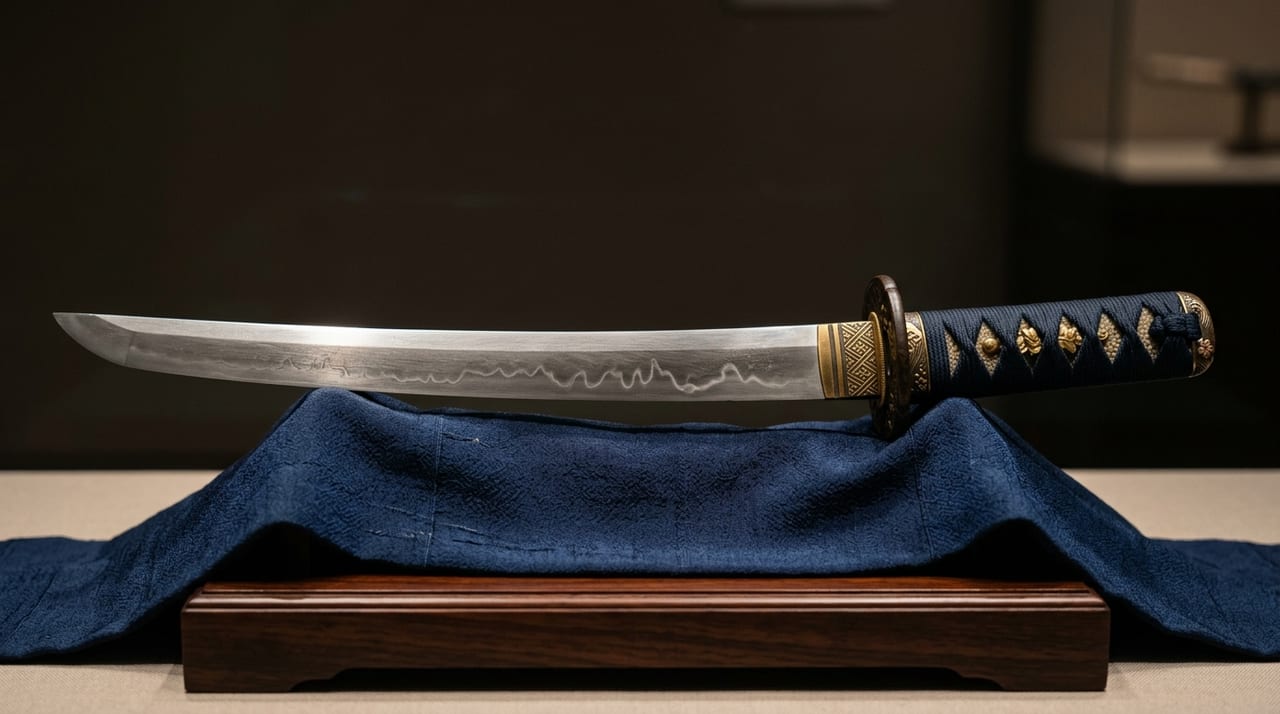
 * Image is for illustrative purposes only.
Sayo Samonji
小夜左文字
Also known as: Sayo Samonji — The Revenge Short Sword
Description
Overview of the Sword
Sayo Samonji is a tantō forged by the renowned Nanbokuchō-period smith Samonji (Sa) of Chikuzen Province (present-day Fukuoka Prefecture). This celebrated blade is intimately linked to the legendary tale of vendetta set at Sayo no Nakayama, a pass in Tōtōmi Province (present-day Shizuoka) on the Tōkaidō road. Having been passed down through the Hosokawa clan—one of the great daimyo families of the Muromachi period—Sayo Samonji is designated an Important Cultural Property and remains a masterwork of Japanese sword craft.
The Smith: Samonji
Samonji (Sa) stands among the greatest smiths of the Nanbokuchō period, with his personal name said to have been Sano Yasuyoshi. A native of Chikuzen Province, Samonji studied the techniques of the Awatagyoji and Raigō schools in Kyoto, and deliberately incorporated the advanced methods of Sōshū Masamune, thereby establishing his distinctive style. His steel exhibits finely packed small-scale forging patterns of refined beauty, and his temper pattern—influenced by the Sōshū tradition—combines formidable strength with graceful restraint. His tantō in particular are sometimes praised as "the most beautiful short swords in Japan," so sophisticated is their execution. Samonji signed his blades with the single character 'Sa'—a concise signature that became the source of his name. His surviving dated works number only several tens, and their extreme rarity combined with their superb quality has made Samonji works the highest-valued treasures in the sword market, prized as masterpieces of the realm.
Sayo no Nakayama and the Revenge Legend
Sayo no Nakayama is a mountain pass in what is now the border region between Kakegawa and Iwata in Shizuoka Prefecture (formerly Iwata District, Tōtōmi Province). Long known as a dangerous stretch of the Tōkaidō road, the pass has given rise to various tales and legends, including the famous "child-rearing ghost" story. Among these, the legend associated with Sayo Samonji is particularly dramatic. According to tradition, a wife set out to sell this short sword, a keepsake of her late husband, but was ambushed and killed by a bandit at Sayo no Nakayama, who also stole the blade. Years later, as their orphaned child had grown and apprenticed with a sword polisher, that very bandit brought the tantō in for polishing—whereupon the child, recognizing the blade and knowing the bandit to be the murderer of his parent, struck him down. Though details vary across different accounts, the legend that this short sword was used to avenge a parent's death became the origin of the name "Sayo Samonji." The Sayo no Nakayama pass, with its reputation as a treacherous section of the Tōkaidō and its associations with travel dangers and death, became intimately bound with this tale of vendetta, conferring upon Sayo Samonji a distinctive aura of dread and narrative power.
Provenance through the Hosokawa Clan
Sayo Samonji is renowned as a celebrated blade that passed into the hands of the Hosokawa clan, a great family of the Muromachi period. The Hosokawa were among the most powerful guardian daimyo supporting the Ashikaga shoguns and possessed cultural refinement unmatched by their peers. The successive lords of the clan, beginning with Hosokawa Yoriyuki, possessed deep erudition in culture and the arts, and were accomplished collectors of fine swords. The fact that the Hosokawa possessed Sayo Samonji proves that this blade was far more than a legendary object—it was a masterpiece of sword craft in its own right. Thereafter, the blade passed through various hands while receiving designation as an Important Cultural Property and continuing to the present day. The association with the Hosokawa clan imbued Sayo Samonji with the pride of the warrior clan and the authority of culture, and when combined with the popular, legendary narrative of vendetta, it became one of the most multifaceted treasures among Samonji's finest works.
The Beauty of Samonji's Tantō
The beauty of Sayo Samonji is concentrated in the balanced proportions of the blade as a Nanbokuchō-period tantō and the refined steel and temper pattern characteristic of Samonji's work. The cutting edge spans roughly one shaku in length, the standard dimensions of a short sword, with excellent balance between the thickness at the tang and at the point, and possesses the dignified form of a flatly forged blade. The temper pattern exhibits the characteristic roiro-hazuki (boiling emergence) technique of Samonji, in which quiet undulation conceals underlying power. The small-scale forging pattern of the steel is intricately packed with a luminous quality; the subtle grain marks and golden striations appear in measured abundance, creating a composition of considerable visual interest. The simplicity of the single-character signature 'Sa' harmonizes beautifully with the refined elegance of the blade itself, embodying the mastery of a smith who "became renowned throughout the realm with but one character." The contrast between the tempestuous legacy of vendetta and the quiet, austere beauty that stands in opposition to that turbulence—this very tension makes Sayo Samonji an unforgettable masterwork.
Legends & Stories
The Sayo no Nakayama pass on the old Tōkaidō highway was notorious for bandits and danger. According to legend, a traveling warrior was murdered near the pass, leaving behind a wife and young child. The child, given the father's Samonji tantō as a keepsake, grew up training in swordsmanship with a single purpose: to find and kill the father's murderer. Eventually returning to the very pass where his father fell, he avenged his father's death with this blade. The story of filial revenge — one of the most sacred obligations in samurai culture — became inseparable from the sword itself, earning it the name 'Sayo Samonji.' The pass is also immortalized in a famous poem by the monk Saigyō: 'Did I ever think I would cross you again, growing old — yet here I am, still alive, at Sayo no Nakayama.' This poem's meditation on mortality and the passage of time resonates deeply with the sword's own story of death, memory, and justice. The Hosokawa clan's possession of this blade conferred upon it the ultimate cultural prestige of one of medieval Japan's greatest ruling families — a fitting home for a blade that combines poetic legend with supreme smithing artistry.