 * Image is for illustrative purposes only.
Tachi by Sanjō Munechika
三条宗近の太刀
Also known as: Munechika Tachi
Description
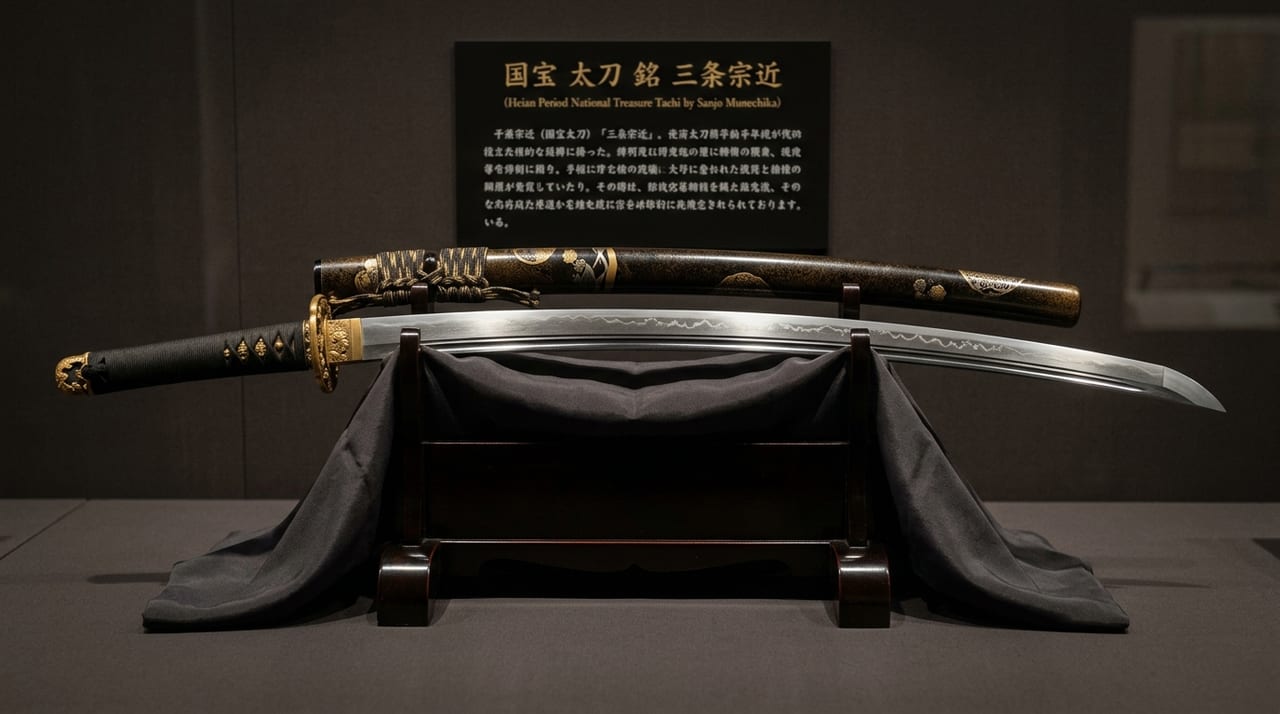
Mikazuki Munechika is a tachi (long sword) attributed to Sanjō Munechika, a swordsmith active in the Sanjō district of Kyoto in the mid-Heian period, and is designated a National Treasure. Signed simply "Sanjō," it takes its name from a series of crescent-moon-shaped uchinoke that appear within the temper line. Counted among the "Five Greatest Swords under Heaven" (Tenka Goken) chosen in the Muromachi period, it is often called the most beautiful of the five. The blade handed down as "Sanjō Munechika's tachi" is this famous Mikazuki Munechika.
The smith and the blade's workmanship
Sanjō Munechika is said to have lived in Sanjō around the Eien era (987–989); known as the "Sanjō Kokaji" and celebrated in the Noh play Kokaji, he is among the earliest masters in the history of Japanese swords. Mikazuki Munechika is about 80.0 cm long with a curvature of roughly 2.7 cm, showing the graceful koshizori (deep curvature near the hip, shallower toward the tip) typical of Heian tachi. The steel is a finely forged ko-itame with mokume and thick ji-nie; the temper line is a ko-midare base along which crescent-shaped uchinoke appear abundantly—the very feature that gives the blade its name.
The name and the Five Greatest Swords
The name derives from the crescent-moon forms seen among the activity of the hamon. From the Muromachi period, five especially celebrated blades came to be called the Tenka Goken: Mikazuki Munechika, Dōjigiri Yasutsuna, Ōtenta Mitsuyo, Onimaru Kunitsuna, and Juzumaru Tsunetsugu. Among them Mikazuki Munechika is praised as the most beautiful and is frequently placed first.
Provenance
Mikazuki Munechika is said to have been owned in the Sengoku period by Kōdai-in (Kita-no-mandokoro, "Nene"), principal consort of Toyotomi Hideyoshi. After her death it was presented as a memento to the second Tokugawa shogun, Tokugawa Hidetada, and thereafter descended as a treasure of the Tokugawa shogunal house.
Designation and present location
Mikazuki Munechika was designated a National Treasure on 9 June 1951, accompanied by an itomaki-no-tachi mounting scabbard as an attachment. It is today preserved at the Tokyo National Museum in Tokyo, one of that museum's representative sword treasures, shown to the public on the occasion of special exhibitions.
Legends & Stories
When Munechika was forging Kokaji, he lamented that a masterwork could not be completed without an excellent ai-zuchi (hammer partner). According to legend, Inari Daimyōjin appeared in the form of a white fox and served as his hammer partner. This mythic tale was incorporated into the Noh play 'Kokaji,' and has been widely transmitted down to this day. Munechika performed sacred ritual with each forging, and has been revered in later generations as a sword smith who embodied Japan's unique spiritual culture of viewing swords as sacred objects.