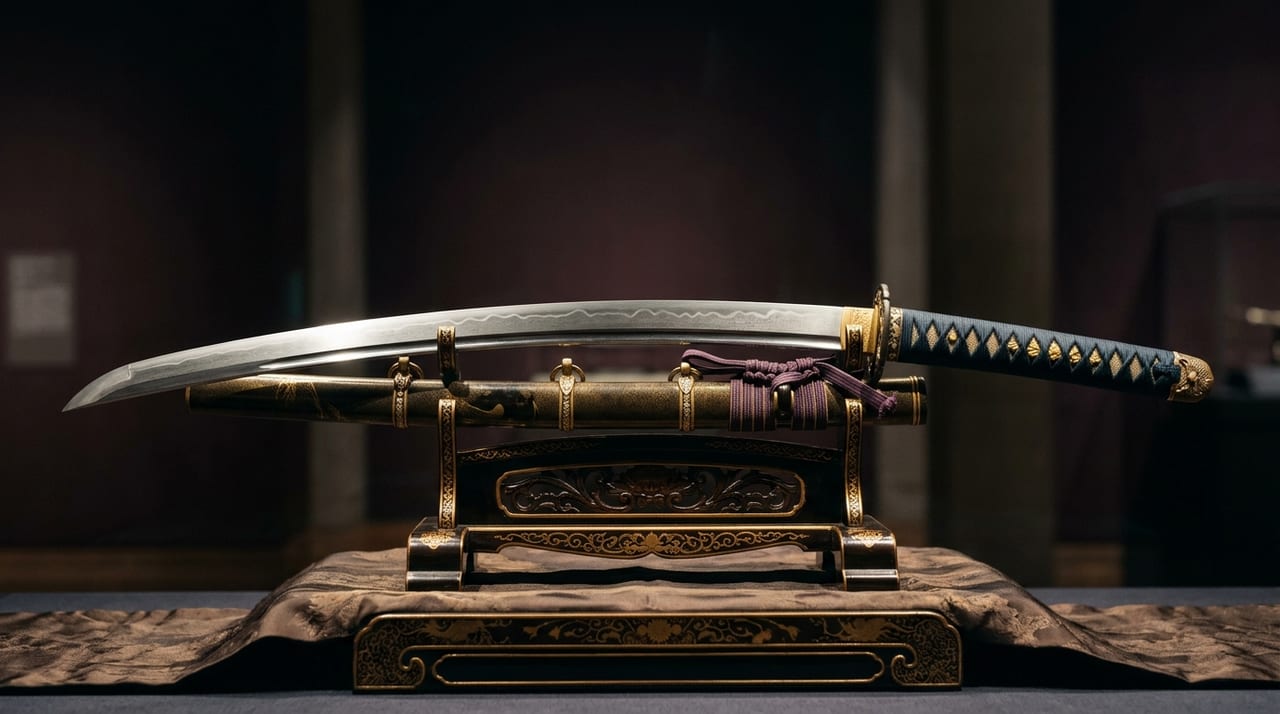
 * Image is for illustrative purposes only.
Rai Kunitsugu Tachi
来国次の太刀
Also known as: Rai Kunitsugu; one of the supreme works of the Rai school
Description
The Rai School: The Prestigious Yamashiro Tradition of Kyoto
The Rai school (Rai-ha) was a lineage of swordsmiths that flourished in Yamashiro Province (present-day Kyoto Prefecture) from the Kamakura period through the Nanboku-chō period. It is the collective name for the group of smiths who bore the signature "Rai." The founder of the Rai school is said to be Kuniyoshi, but no certain works by him survive, so Rai Kuniyuki is regarded as the de facto founder. Thereafter, smiths whose signatures included the character "kuni" carried on the line across generations, including Rai Kunitoshi, Rai Kunimitsu, Rai Kunitsugu and Rai Kuninaga. The Rai school is a representative lineage of the Yamashiro tradition, which together with the Bizen tradition, the Yamato tradition, the Sōshū tradition and the Mino tradition forms the Five Traditions (Gokaden). The Rai school is highly regarded as the group of smiths that most purely embodies the defining qualities of the Yamashiro tradition: a fine, clear jigane and a hamon of dignified and gentle character. Swords of the Rai school have been favored by people of particularly high refinement and dignity, including the imperial court, court nobles and the Ashikaga shogunal family. The dignity of "swords of the capital" and "swords of the court" gives Rai works a special distinction.
Rai Kunitsugu's Style and Craft: The Rai Within the Rai
Rai Kunitsugu was a swordsmith of the Rai school who was active from the late Kamakura period through the Nanboku-chō period. He is traditionally said to have been a son or disciple of Rai Kunimitsu. In Edo-period sword literature he is also listed among the Ten Disciples of Masamune (Masamune Juttetsu). Kunitsugu's work displays two modes: the traditional straight hamon (suguha), and a midare-ba rich in nie. The latter is thought to reflect the influence of Masamune of Sōshū. Within the Rai school, he displays the unusual style of quenching a midare-ba with strong nie. Both the jigane and the hamon carry strong nie, the jigane shows some raised grain (hada-datsu), and the pronounced chikei is also a Sōshū trait. Kunitsugu's tantō receive particularly high acclaim. He has a tantō designated as a National Treasure (privately owned) as well as tachi and wakizashi designated as Important Cultural Property. As a smith of the highest standard representing the Rai school, he occupies an important place in present-day sword research.
The Rai School's Swords and Court Culture: The Aesthetics of the Capital
Yamashiro Province, where the Rai school was active, was the seat of the Japanese imperial court. From the Heian period through the Muromachi period it was the center of Japanese politics, culture and religion. Rai swords, raised in this setting, embody the "refinement and dignity of court culture," which differs from the "rugged practical beauty of the warrior house." They express an "aesthetics of the capital" in which three elements harmonize: the gentleness of the hamon, the clarity of the jigane and the elegance of the form. The imperial court and court nobles' appreciation of Rai swords was not merely a matter of taste. It rested on a deep cultural affinity, in which "the aesthetic worldview of Rai swords resonated with the aesthetic values of court culture." Kunitsugu's placement within this current as "a smith of particularly varied expression within the Rai school" gives him the special standing of "a smith who understood both the refinement of court culture and the strength of warrior culture." This is one of the grounds for the high regard in which later ages held him.
Rai Kunitsugu's National Treasure and Important Cultural Properties
Extant works by Rai Kunitsugu include one tantō designated as a National Treasure and four swords designated as Important Cultural Property, most of which are privately owned. Kunitsugu is highly regarded especially for his tantō. Some of his tachi were handed down to the Tokugawa shogunal family and the Maeda family. His group of works influenced by the Sōshū tradition shows the range of the Rai style, which makes it important for research as well. Overall, Kunitsugu, together with Rai Kunitoshi and Rai Kunimitsu, is one of the representative smiths of the Rai school. He is among the most important smiths conveying the essence of the Yamashiro tradition to the present day, and he has built a firm place in sword history.
Succession of the Rai School and Its Present-Day Reputation
The tradition of the Rai school continued to exert influence on Japanese sword history after the Muromachi period. Smiths appeared who positioned themselves as "successors of the Rai school." Among present-day sword enthusiasts, works of the Rai school, particularly those of Rai Kunitoshi, Rai Kunitsugu and Rai Kunimitsu, are spoken of with special reverence as "the works that display the noblest and most dignified beauty among Japanese swords." Exhibitions of Rai works at the Tokyo National Museum and the Kyoto National Museum have always enjoyed great popularity.
Legends & Stories
The Beauty of Rai — The Dignity Nurtured by the Heian Capital
The distinctive aesthetic world of Rai school swords is deeply bound up with the spiritual climate of the place known as "the Heian capital, Kyoto." Kyoto, which flourished for a thousand years as the capital from the Heian period through the Muromachi period, was the place where the most profound aesthetic concepts of Japanese culture were nurtured: "mono no aware," "yūgen," and "wabi." Within this cultural soil, the Rai smiths embodied in their sword making a distinctive aesthetic of "a beauty of dignity free of ostentation" and "profound expression that suggests movement within stillness." The beauty of hamon rich in variation with strong nie that Rai Kunitsugu's works possess can be understood as the meeting of the Kyoto aesthetic with the vigor of the Sōshū tradition, and it has affinities with the Zen sense that "there is a fierce current beneath a calm water surface." As "the crystallization of the aesthetics of the capital," Rai swords grant the Japanese sword a beauty of another dimension, apart from "grandeur" and "intensity": "a beauty of dignity and depth." Rai Kunitsugu's works, as the richest expression of this beauty, continue to stir a quiet emotion in viewers' hearts to this day.
Rai Kunitsugu and the World of Sword Appraisal — "Highlights of Rai"
In the appraisal of Japanese swords, the highlights of Rai Kunitsugu's works are two styles: works in the suguha style that inherit the Rai school tradition, and works with strong nie and turbulent midare-ba influenced by the Sōshū tradition. Also notable is the chikei that stands out in jigane with prominent hada. The breadth of Kunitsugu's works, which present diverse expressions while never losing the qualities of the Rai school, makes them an excellent teaching material for learning the many possibilities of Rai beauty.