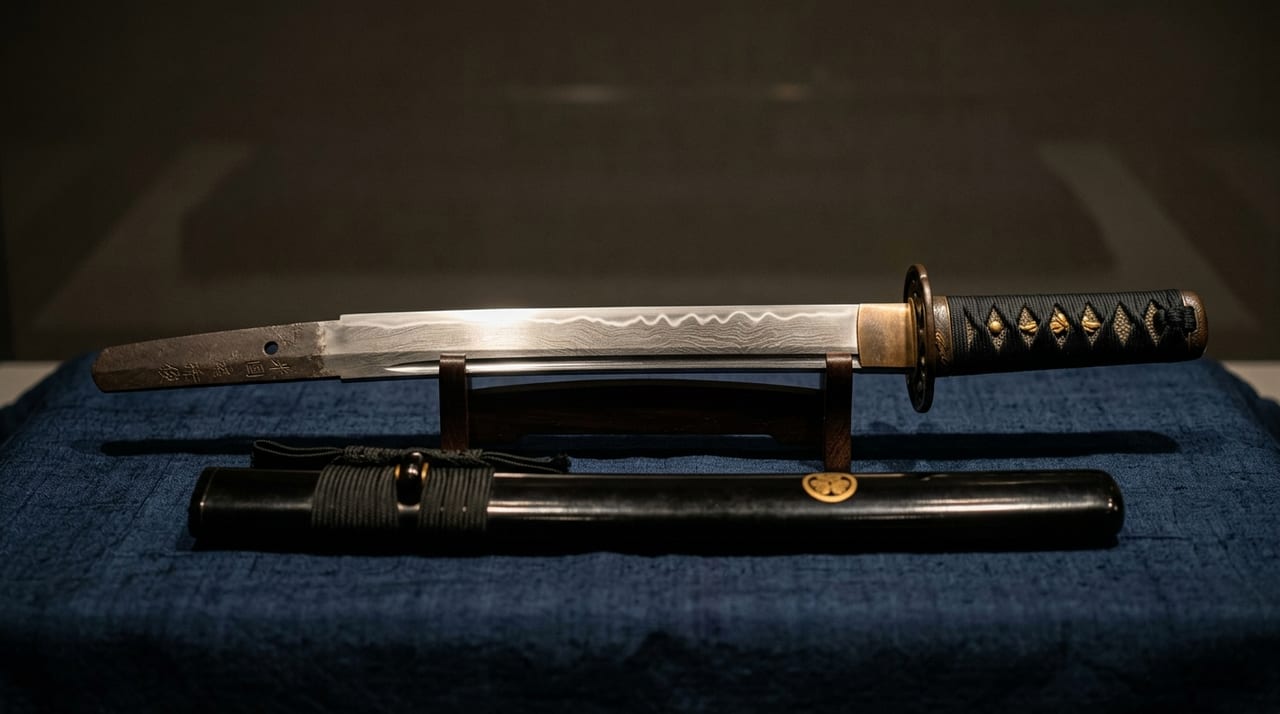
 * Image is for illustrative purposes only.
Tantō by Rai Kunitoshi
来国俊の短刀
Also known as: Kunitoshi Tantō
Description
Rai Kunitoshi was one of the most highly regarded swordsmiths of the late Kamakura period in Kyoto and a representative master of the Rai school. Born as the son of Rai Kuniyuki, he left numerous works that embody the finest achievements of Kamakura sword art. He distinguished himself especially in tantō production, and works exemplifying the perfected form of flat-ground (hira-zukuri) tantō are still regarded as the supreme expression in the sword world today. This tantō, with a blade length of approximately 24 centimeters, fashioned in the hira-zukuri style with iori-mune ridge, perfectly exemplifies the refined late Kamakura tantō form. The hamon is a composed suguha with gentle ko-midare accents, and the tempered zone is quietly filled with moist ko-nie throughout. The jigane displays the characteristic flowing grain (nagare-itame) of the Rai school in refined precision, pervaded with fine, uniformly distributed ji-nie, exhibiting a dignified and refined finish. The tang is signed 'Rai Kunitoshi.' This tantō is equally celebrated by scholars and collectors as one of the supreme expressions of late Kamakura sword art. Furthermore, the Nezu Museum houses an Important Cultural Property, a "Tachi signed Rai Kunitoshi."
Legends & Stories
Rai Kunitoshi's tantō were treasured by Kamakura-period warriors as 'guardian talismans,' and several anecdotes record them protecting their owners from surprise attacks in the dark of night. One tradition tells of a court noble who kept a Kunitoshi tantō at his pillow; on a night when an intruder crept into the room, the blade reportedly fell free from its scabbard and glowed, startling the assailant into flight. Kunitoshi is also said to have been a devotee of Buddhism, and it was believed that his faith was somehow transferred into the steel of his swords.
Related Famous Swords
同田貫正国
Multiple official designationsDōtanuki Masakuni
Dōda-tsuruba Masakuni (Higo Dōda-tsuruba School)
肥前忠吉
Important Cultural Property • Important Sword (multiple works)Hizen Tadayoshi
First Hizen Kuni Tadayoshi
一期一振
Gomotsu (Imperial Collection)Ichigo Hitofuri
Awataguchi Yoshimitsu
織田信長の愛刀
National Treasures and Important Cultural Properties (multiple)Oda Nobunaga's Beloved Sword
Awataguchi Tōshirō, Samonji, Yukimitsu, Hasebe (respective smiths)