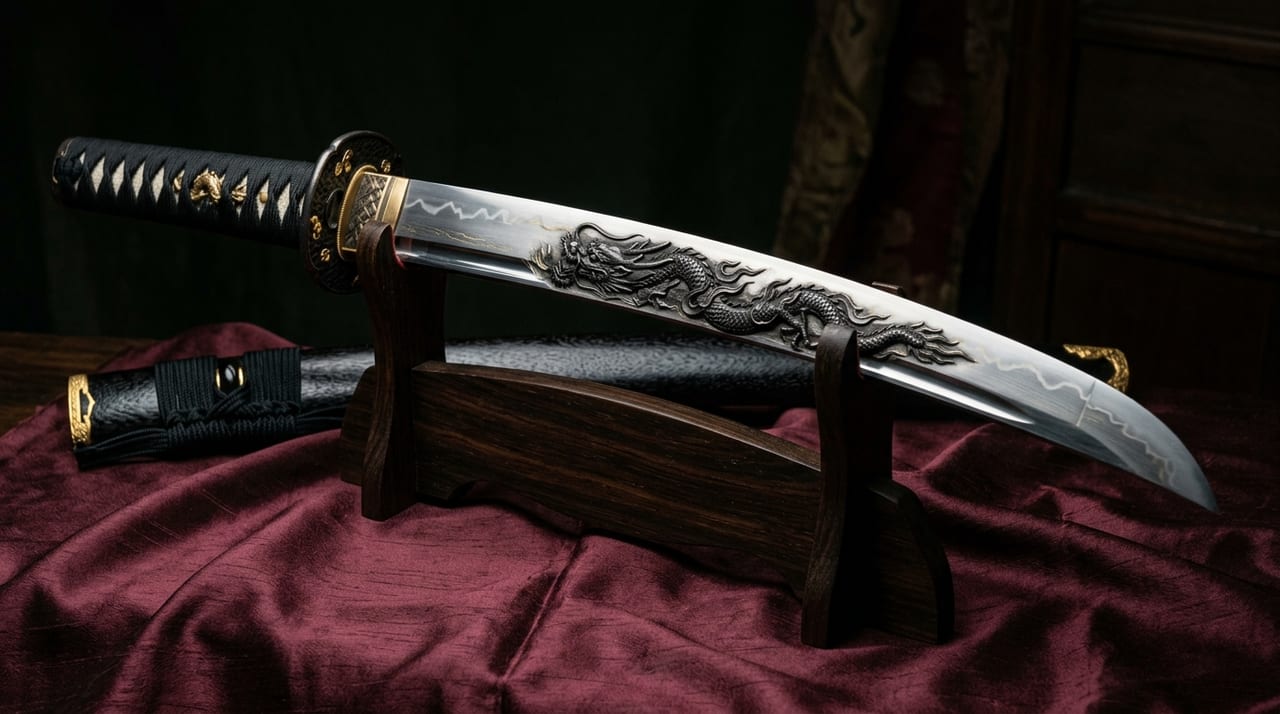
 * Image is for illustrative purposes only.
Ōkurikara
大倶利伽羅
Also known as: Ōkurikara Hiromitsu; handed down in the Date family; carved dragon embodying Fudō Myōō
- Smith
- Hiromitsu
- Era
- Nanbokuchō period (14th century)
- Type
- Uchigatana
- Designation
- Important Art Object (private collection)
- Location
- Private collection
Description
Overview of the Sword
A celebrated uchigatana by Hiromitsu, a master of the Sōshū-den tradition, whose most distinctive feature is the kurikara dragon carved on the blade. “Kurikara” refers to an iconographic motif in which a dragon, regarded as a manifestation of Fudō Myōō, coils around a sharp sword (a treasure sword) while wreathed in flames. It is one of the most powerful expressions in esoteric Buddhist art. The name “Ōkurikara” derives from the kurikara dragon carved on this blade.
The Swordsmith
Hiromitsu was a smith active in Kamakura, Sagami Province, during the Nanboku-chō period. He is said to have been either a disciple of Masamune, or his biological or adopted son.
Forging Method and Characteristics
Ōkurikara is forged in ō-itame, and its hamon is ko-midare based on suguha, with vigorous hotsure along the habuchi (hamon edge). The Nanboku-chō period was the era in which Japanese swords reached their most imposing style, and Hiromitsu's work reflects that era in its powerful proportions. The sword was originally a tachi of just over three shaku (about 90 cm). Through ō-suriage it has been shortened to 2 shaku 2 sun 3 bu (about 67.6 cm). Ōkurikara is said to have been presented by the shogunal house to Date Masamune (1567–1636) as a reward for stone-wall construction work at Edo Castle, and it remained with the Date family from then on. Date Masamune is among the most celebrated heroes of the Sengoku period, known by the epithet “One-Eyed Dragon.” He became the overlord of Ōshū while still young. He overcame the hardship of losing his right eye to smallpox in childhood, and when he became head of the Date family at eighteen, he quickly brought the daimyō of Ōshū under his command. Based on analysis of the rust within the carving, the kurikara dragon on the blade is considered to have been carved at the same time as the blade was made. Fudō Myōō is a manifestation of Dainichi Nyorai. He is said to cut through worldly desires with the sharp sword in his right hand and save sentient beings with the kensaku (noose) in his left. For Sengoku warlords, Fudō Myōō was one of the familiar protective deities. The sword is currently held in a private collection, and opportunities for public viewing are limited.
Legends & Stories
Legends and Anecdotes
Ōkurikara is often discussed in connection with Date Masamune, as a sword that was handed down in the Date family. Date Masamune was born in Eiroku 10 (1567) in Dewa Province, Yonezawa (present-day Yonezawa, Yamagata Prefecture), as the eldest son of Date Terumune. At the age of five he contracted smallpox and lost his right eye. The handicap of having only one eye is said to have caused the young Masamune deep anguish, but under the care of his mother, Yoshihime, and the education of the Zen master Kotai Sōitsu, he received a comprehensive training in both letters and the martial arts and developed a strong mental fortitude. In Tenshō 12 (1584), at the age of eighteen, Masamune became the 17th head of the Date family and, with the momentum of a bamboo stalk splitting, conquered the daimyō of Ōshū. Through the Battle of Hitotoribashi, the Battle of Suriagahara, and the capture of Kurokawa Castle (Aizu), he established his position as the dominant power of Ōshū in a short period. The epithet “One-Eyed Dragon” is modeled on Li Keyong, a hero of the Tang dynasty in China, and carries the connotation of a hero who, though having one eye, looks toward control of the realm. Fudō Myōō symbolizes an unshakable heart that no difficulty can disturb, as the name “the Immovable Myōō” indicates. The kurikara dragon carved on the blade of Ōkurikara is the manifestation of this Fudō Myōō. A dragon coiling around a sharp sword, wrapped in flames and gazing up at the sky, is said to symbolize the power to burn away the flames of worldly desire and cut off delusion. Date Masamune is also known as the person from whom the word “datemono” originated, and he was fond of flamboyance and had an original sense of aesthetics. When Toyotomi Hideyoshi summoned him on suspicion of inciting an uprising, he is said to have travelled to Kyoto carrying a gilded crucifixion post on his back. His actions were always grand and original, including the dispatch of the Keichō Embassy to Europe, which sent Hasekura Tsunenaga to Europe. In the game “Touken Ranbu”, he is portrayed as a lone uchigatana that dislikes banding together with others, and his character, who walks his own path like Masamune, resonates with many fans.