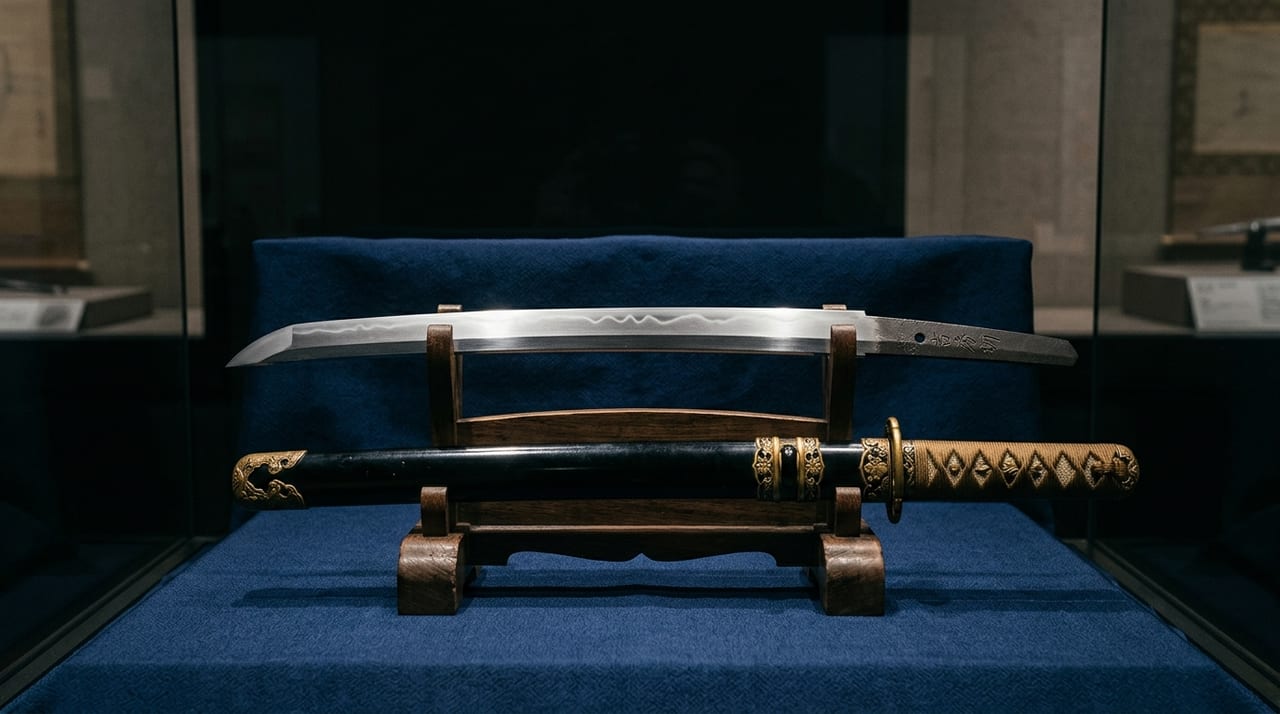
 * Image is for illustrative purposes only.
Okadagiri Yoshifusa
岡田切吉房
Also known as: Okadagiri; the Tantō of Awataguchi Yoshifusa
Description
Okadagiri Yoshifusa — A Tachi by Yoshifusa of the Fukuoka Ichimonji School
Okadagiri Yoshifusa (岡田切吉房) is a tachi forged by the master smith Yoshifusa (吉房) of the Fukuoka Ichimonji school in Bizen Province (present-day Okayama Prefecture) during the mid-Kamakura period. It is designated a National Treasure and is housed at the Tokyo National Museum. The Fukuoka Ichimonji school was a group of sword smiths based in Fukuoka, Bizen Province, characterized by magnificent choji-midare hamon, and Yoshifusa was the leading master among them, leaving behind numerous superior works. Okadagiri Yoshifusa is a noble tachi with a moderately high curve and broad blade width, bearing the characteristic brilliant choji-midare of Yoshifusa's hand, and is renowned as one of Yoshifusa's representative masterpieces.
The Etymology of "Okadagiri"
The name "Okadagiri" (岡田切, "Okada Cutter") derives from a historical anecdote: during the Komaki-Nagakute War in the 12th year of Tensho (1584), Oda Nobukatsu (織田信雄), suspecting disloyalty to Toyotomi Hideyoshi, executed his retainer Okada Sukesakuro Shigeataka (岡田助三郎重孝) with this very tachi. Many of Japan's famous named swords bear designations like "◯◯ Cutter" (◯◯切) derived from historical accounts of actual cutting exploits, and Okadagiri Yoshifusa is one such example. It is known as a celebrated blade with a keen cutting edge and a history that conveys the vivid realities of the Sengoku period to the present day.
The Fukuoka Ichimonji School and Yoshifusa's Style
The mid-Kamakura period when the Fukuoka Ichimonji school was active represented the golden age of Bizen swords, marked by their brilliant choji-midare hamon. Yoshifusa was the representative smith of this Ichimonji school, ranked alongside his contemporaries Sukesane (助真) and Norihusa (則房). Yoshifusa's tachi display a jigane with tightly packed itame that casts a vivid sugata-utsuri, and a hamon featuring large-scale choji-midare and kawazu-choji (frog choji) that unfolds with spectacular brilliance. The magnificent and ornate appearance—where the jigane's utsuri and the hamon's choji mutually enhance one another—is highly valued as the epitome of the Ichimonji school's aesthetic.
Provenance and Preservation
Okadagiri Yoshifusa passed through the collection of Masuda Takayoshi (益田孝, known as "Donō"), a prominent Meiji-era industrialist and pillar of the Mitsui zaibatsu, and was subsequently presented to the Crown Prince (later Emperor Taishō). In 1947 (Showa 22), it was transferred from the Imperial Household Ministry to the National Museum (now the Tokyo National Museum), where it remains today. Preserved with the utmost care as a National Treasure, whenever it is displayed at special exhibitions, many sword enthusiasts visit to admire the brilliant beauty of mid-Kamakura Bizen blades.
The Technical Legacy of the Ichimonji School
The brilliant choji-midare style established by the Fukuoka Ichimonji school became one of the highest evaluation standards in later sword appreciation as "the great choji-midare of Ichimonji," and the phrase "choji work like Ichimonji" continues to be used today as the supreme expression of praise. Okadagiri Yoshifusa, bearing both the beauty of the Ichimonji school and a storied provenance colored by Sengoku anecdotes, is inscribed in the annals of Japanese sword history as a celebrated masterpiece.
Legends & Stories
The Named Blade: Okadagiri—The Origin and History of Its Name
The Okadagiri Yoshifusa is a tachi forged during the Kamakura period by Yoshifusa, a master smith of the Fukuoka Ichimonji school of Bizen Province (present-day Okayama Prefecture), and is designated a National Treasure. The name "Okadagiri" originates from an incident during the Battle of Komaki-Nagakute in the 12th year of Tenshō (1584), when Oda Nobutada, suspecting his senior retainer Okada Sukesaburo Shige-Takashige of communication with Toyotomi Hideyoshi, cut him down. The name "Okadagiri"—the Okada Cutter—thus inscribes into the sword's very identity the historical moment when this tachi actually severed Okada Shige-Takashige. The Fukuoka Ichimonji school is renowned for its brilliant togashi-midare patterning, and Yoshifusa was its preeminent master; this blade is highly esteemed as his masterwork, displaying the most resplendent style among his creations. It is currently housed in the Tokyo National Museum, bearing a transmission history that includes presentation to the Meiji Emperor following the Meiji Restoration.
The Meaning of "Giri" (Cutting)—Battle Memory and the Naming of Celebrated Blades
The name "Okadagiri," which denotes the memory of cutting a person named Okada, exemplifies one of the most fundamental characteristics of Japanese naming traditions for celebrated blades. Japanese sword nomenclature encompasses styles such as "◯◯-giri" (the memory of cutting someone), "◯◯-maru" (the bestowal of mythical or personified character), and "◯◯-Kunitsu" (the merger of smith-name and specific legend); these patterns reveal the essential Japanese understanding of the sword—not as mere tool, but as an entity possessing its own inherent history and memory. The Yoshifusa tachi bearing the name "Okadagiri" is an entity that eternally encases within its name "the memory of having actually severed something through the sharpness it possessed"; and as a cultural artifact embodying the narrative "a blade forged with supreme technique was employed at a historic moment," it transcends the status of pure artwork to function as "a witness to history." The fusion of Bizen Ichimonji Yoshifusa's precise and distinguished craftsmanship with the raw historical memory embedded in the word "giri" (cutting) most directly symbolizes the multifaceted cultural significance of the Japanese sword—beauty and power, art and utility, technique and history.