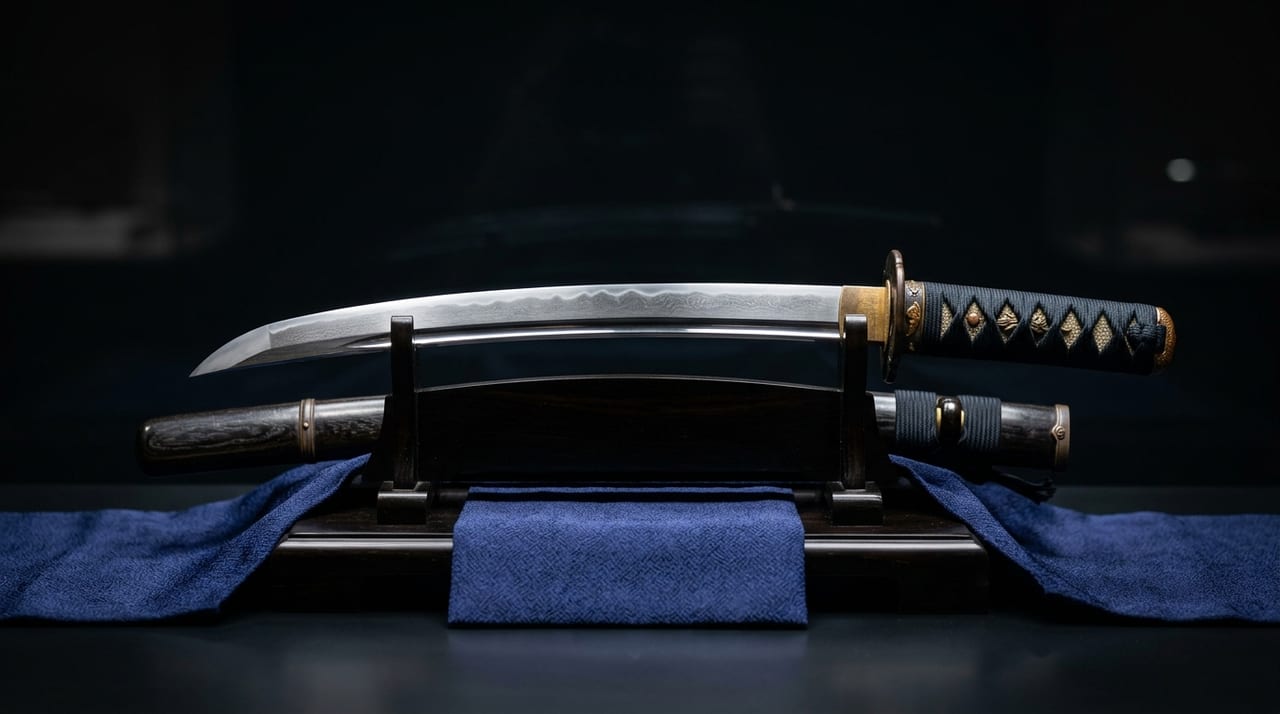
 * Image is for illustrative purposes only.
Okada Tōshirō
岡田藤四郎
Description
Okada Tōshirō is a tantō forged by the Kamakura-period master Awataguchi Yoshimitsu (commonly known as "Tōshirō"), currently held at the Tokyo National Museum and designated an Important Cultural Property. Awataguchi Yoshimitsu is highly esteemed as one of the first master smiths to establish the tantō as a distinct sword form, and the group of tantō bearing his by-name "Tōshirō" (藤四郎) form one of the most celebrated clusters of meibutsu (famous named swords) in the sword world. Awataguchi Yoshimitsu's tantō are generally called "Tōshirō," and many celebrated named examples are known — "Gotō Tōshirō," "Akita Tōshirō," "Yagen Tōshirō," and others — and the present "Okada Tōshirō" is one of this group, transmitted in the Okada family (or a warrior or merchant house associated with the Okada name). The blade of Okada Tōshirō displays the typical style of a Yoshimitsu tantō. The mihaba is somewhat wide, the construction is hira-zukuri (flat-ridge construction), the kasane is thin, and the curvature is the refined uchi-zori (inward curvature) or mu-zori (no curvature) characteristic of Yoshimitsu's tantō form. The hamon is centered on suguha (straight temper line), characteristic of Yoshimitsu, with a softly nie-deki edge running uniformly — nie of refined, fine quality, deep nioi, and a clear, serene ha-edge. The jigane presents densely packed ko-itame-hada with fine, even ji-nie rising throughout, lending the steel surface a deep, luminous beauty. The circumstances of the blade's accession to the Tokyo National Museum are understood to reflect the post-Meiji process of Important Cultural Property recognition and the collection and donation from former daimyō and warrior households. It is currently available for public viewing in the museum's permanent and special sword exhibitions, providing a precious opportunity to appreciate directly the supreme beauty of a Yoshimitsu tantō.
Legends & Stories
The most widely told legends associated with Okada Tōshirō belong both to the shared mythology common to all of Awataguchi Yoshimitsu's tantō — the "protector sword" tradition — and to the personal provenance stories of individual named pieces. Since ancient times, Yoshimitsu's tantō have been accorded absolute trust as "swords that protect their owner's life," and a recurring type of legend — in which the sword vibrates of its own accord within its scabbard in warning, saving its master from an assassination attempt — is shared across multiple "Tōshirō" meibutsu. For Okada Tōshirō specifically, the tradition holds that when the head of the Okada household was once targeted by an intruder in the night, this tantō, placed at his bedside, suddenly sprang from its scabbard (saya-bashiri) and fell to the floor. The sound woke the lord, who escaped unharmed; afterward, he was moved to deep gratitude toward Yoshimitsu's memory, declaring that "this sword moved of its own will to protect its master." Another oral tradition holds that after forging his last blade, Yoshimitsu said: "There is no need to forge any more. My tantō have already protected enough people in this world" — and retired from smithing. It is said that "the resolve of that retirement, and the mature spiritual energy of his final work, lives on in Yoshimitsu's tantō." Whether Okada Tōshirō was or was not that "last blade" is unknown, but this one blade — transmitted with such special care among the Yoshimitsu tantō — carries to this day the mysterious story of a swordsmith's soul made resident in steel.