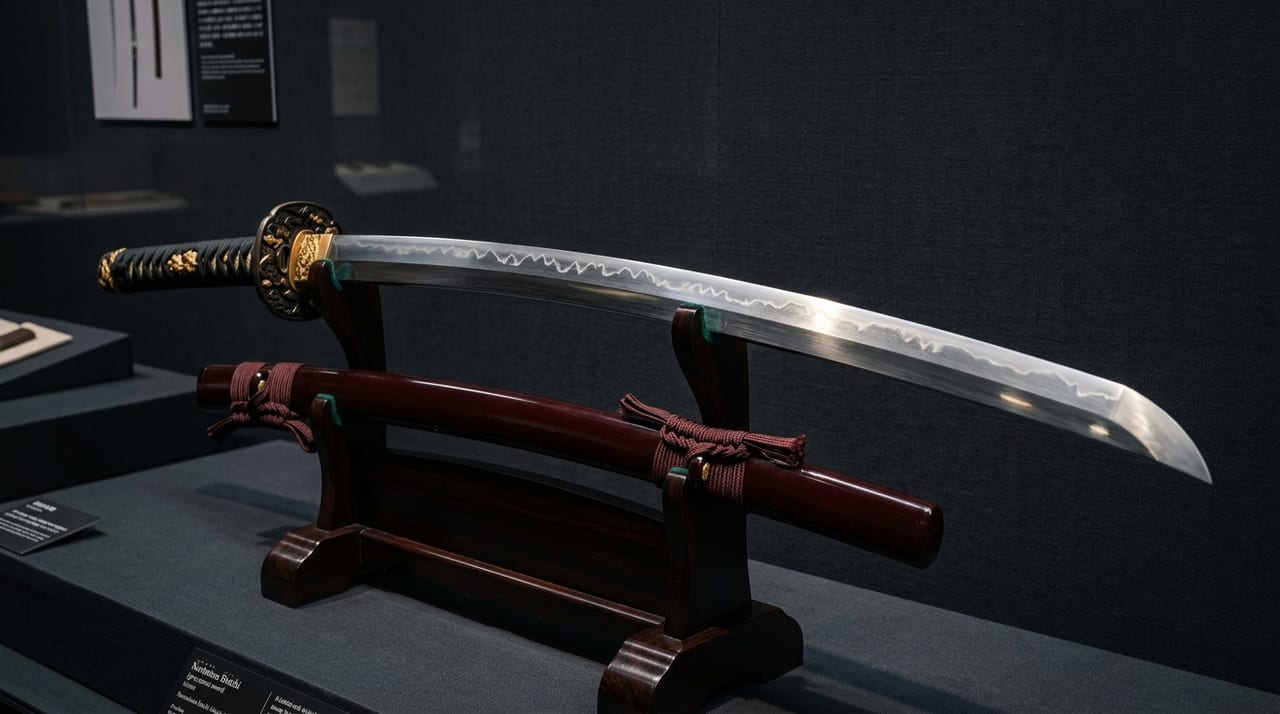
 * Image is for illustrative purposes only.
Norimitsu Ōdachi
則光大太刀
Also known as: Great Sword of Norimitsu; Kibitsu Shrine Great Sword; the Giant Sword
Description
The Hōmitsu Ōdachi—The Largest Surviving Japanese Sword
The "Hōmitsu Ōdachi" enshrined at Kibitsu Jinja is one of the largest surviving works among Japanese swords, boasting a total length of 377 centimeters, a blade length of 226.7 centimeters, and a weight of approximately 13 kilograms, and is internationally known as a "super-giant sword" that fundamentally questions the very concept of the Japanese sword. This great sword is believed to have been forged in the middle Muromachi period in Bunan 3 (1446) by the swordsmith "Hōmitsu" (signatory: Bishū Osafune Hōmitsu) of Bizen Osafune in the province of Bizen (present-day Osafune-chō in Setouchi City, Okayama Prefecture), and occupies a special position in sword history as an exceptionally giant existence among ōdachi ("great swords") or nodachi ("field swords") of extra-large dimensions. Considering that the total length of ordinary katana or tachi is approximately 70–100 centimeters, one can understand how extraordinarily outsized the 377-centimeter length of the Hōmitsu Ōdachi is. This sword, far too large for ordinary human hands, is believed to have been offered to the shrine as a ritual and votive object, and is understood to have functioned not as "a weapon for actual human use" but as "an offering to the gods and a symbol of divine authority."
Bizen Osafune School and Hōmitsu—Japan's Preeminent Swordmaking Center
Bizen Osafune (present-day Osafune-chō in Setouchi City, Okayama Prefecture) was one of the most important production centers in the history of the Japanese sword, earning the reputation "Bizen blades neither break nor bend and cut well"—a major sword-producing center. The Osafune school produced renowned smiths such as "Mitsutada," "Nagamitsu," "Kagemitsu," "Kanemitsu," "Shigimitsu," and "Hōmitsu" from the late Heian period through the Sengoku period, received commissions widely from emperors, shoguns, and feudal lords, and prospered for approximately 500 years as the center of Japan's sword culture. Hōmitsu was a swordsmith of the Osafune school in the middle Muromachi period of Bunan 3 (1446), known as a smith engaged in vigorous production activity during the middle Muromachi period. During this era, the Osafune school responded to the sharp increase in demand for blades due to warfare by engaging in mass-production-style manufacturing, resulting in variable quality among individual works, though many superior pieces by master smiths also survive. The Hōmitsu Ōdachi holds special significance in sword history not for technical perfection but for its "unprecedented challenge of creating in reality a sword of scale beyond human imagination," making it an extraordinary work.
The Dimensions and Technical Challenges of Ōdachi Manufacturing
The scale of the Hōmitsu Ōdachi—377 centimeters in total length and 13 kilograms in weight—challenged the technical limits of Japanese sword manufacture. In ordinary Japanese sword manufacture, the swordsmith uses high-quality steel called "tamahagane" (jewel steel) and, through repeated folding and forging (orikaeshi tanren), removes impurities from within the steel while creating a uniform, high-hardness blade. However, to manufacture a sword of such immense size, all ordinary furnaces, anvils, whetstones, and tools must be enlarged, multiple smiths must cooperate in forging work, and moreover, in the most delicate processes of heat treatment and tempering (yakiire), an entirely different approach from the ordinary becomes necessary. The weight of 13 kilograms far exceeds what a person could swing in one or both hands, demonstrating that this ōdachi was designed from the outset not as a "practical combat weapon" but as "an offering to a shrine and a ritual symbolic object." In the context of an offering to the gods at Kibitsu Jinja, the act of "presenting to the gods a giant sword that challenges the limits of human craft technique" can be understood as a concrete expression of the logic of religious devotion: "presenting to the gods the highest possible expression of human technical skill."
Kibitsu Jinja—An Ancient Sacred Site of the Province of Kibi
Kibitsu Jinja is an ancient shrine situated in Kibitsu, Kita Ward, Okayama City, Okayama Prefecture, and is the First Shrine (ichinomiya) of Bitchū Province with Ōkibitsu Hiko no Mikoto as its principal enshrined deity. Ōkibitsu Hiko no Mikoto is transmitted in Japanese mythology as a heroic god who pacified the province of Kibi (present-day Okayama Prefecture and the eastern part of Hiroshima Prefecture), and is the legendary heroic deity who became the prototype of the "Momotarō Legend" through the tale of vanquishing the demon-god "Ura." Kibitsu Jinja has its main hall and worship hall designated as National Treasures and is renowned as an ancient shrine famous for its extensive corridor extending some 360 meters, making it one of Okayama's representative sacred sites. The fact that the Hōmitsu Ōdachi is enshrined at this illustrious shrine demonstrates that it was positioned as the supreme offering to the Great God of Kibi in terms of significance as "a giant votive blade demonstrating the supreme skill of Bizen, a sword-producing region."
The Position of Ōdachi in Sword History
The "ōdachi" or "nodachi" is a category of sword that developed as an extra-large tachi manufactured from the Northern and Southern Courts period (1336–1392) through the Muromachi period for use in battlefield combat, and is understood to have functioned as a "striking weapon" (uchimono) used by mounted warriors to sweep aside enemy spears and naginata from horseback. In the military narratives of the Northern and Southern Courts period, numerous accounts of prowess record "wielding an ōdachi to cut an enemy in two with a single stroke," indicating that "ōdachi wielding" was a specialized martial technique respected in samurai society. However, from the late Muromachi period onward, as warfare styles shifted toward group formations, practical ōdachi became obsolete, and instead ōdachi began to be manufactured for "offering to shrines," "symbols of authority," and "ritual existence." The Hōmitsu Ōdachi is precisely a typical example of such "ritual and symbolic ōdachi," and represents one culmination of late-Muromachi sword culture in which "the pursuit of beauty and scale in sword-craft became bound with religious devotion."
The Contemporary Significance and Viewing of the Hōmitsu Ōdachi
The Hōmitsu Ōdachi is currently preserved at the Kibitsu Jinja treasure hall as a work designated as Okayama Prefecture Important Cultural Property (on deposit at the Okayama Prefectural Museum), and its overwhelming size continues to make a striking impression on domestic and international visitors. Particularly in recent years, with the surge in young Japanese sword enthusiasts due to the influence of sword-themed games and anime such as "Touken Ranbu," attention to the Hōmitsu Ōdachi as the "world's largest-class Japanese sword" has risen markedly. The total length of 377 centimeters corresponds to more than twice the average height of an adult male, and standing before it in person becomes an experience of being overwhelmed anew by "the technical skill and depth of faith of the swordsmith who forged it." As the largest work produced by Bizen Osafune, Japan's preeminent sword-producing center, the Hōmitsu Ōdachi is one of the most dramatic examples demonstrating "what emerges when the technique and spirituality of the Japanese sword are pursued to their limits," and continues to be enshrined today before the Great God of Kibi as an incomparable presence that demonstrates to the world the grandeur of Japan's sword culture.
Legends & Stories
The Kibi God and Ura — Mythological Background of the Norimitsu Ōdachi
The presiding deity of Kibitsu Jinja, where the Norimitsu Ōdachi is enshrined, is Ōkibitsu Hiko no Mikoto, who is transmitted in Japanese mythology as one of the most magnificent heroic gods, and the legend of this deity imbues the act of enshrining the Norimitsu Ōdachi with profound significance. Ōkibitsu Hiko no Mikoto is transmitted to have been dispatched as one of the Four Road Generals during the reign of Emperor Sujin, the tenth emperor, to the Western Road, where he subjugated Ura, a demonic deity of fearsome form who dominated the Kibi region. Ura was a powerful immigrant chieftain possessed of iron-working technology, said to have tormented the people with demonic countenance. Ōkibitsu Hiko no Mikoto, after a fierce battle with Ura, slew him, and the shrine is said to have originated from a sanctuary erected at the place where Ura's head was buried. The head of Ura, buried there, is said to remain alive even now within Kibitsu Jinja's 'ringing cauldron' ritual (naru-kama shinji), transmitted to the present day as a mysterious sacred rite through which fortune is divined by the manner of the cauldron's ringing. The act of a Bizen swordsmith offering 'the greatest sword, which challenges the ultimate limits of human technique' to this 'sacred ground where a heroic god vanquished a demon' can be understood as the most intense expression of religious dedication in which the sword serves the power of the heroic deity.
Prototype of the Momotarō Legend — The Kibi Hero and Japan's Greatest Sword
The legend of the battle between Ōkibitsu Hiko no Mikoto and Ura is regarded as one of the most prominent prototypes for the Momotarō (Peach Boy) tale, one of Japan's most cherished folktales. The story of Momotarō—the boy born from a peach who, accompanied by a dog, monkey, and pheasant, defeats the demons of Demon Island—is deeply rooted in the land of Kibi as a transformation of the legend of Ōkibitsu Hiko no Mikoto's vanquishment of Ura, and Okayama Prefecture is even today strongly regarded as the 'homeland of Momotarō.' In this context, the Norimitsu Ōdachi enshrined at Kibitsu Jinja carries special narrative significance as a sacred blade that embodies the spiritual essence of Momotarō's demon-slaying, Japan's most celebrated folktale. The fact that 'Japan's greatest sword' is enshrined at the shrine constituting the very stage of 'Japan's most famous demon-slaying legend' is one of the most dramatic demonstrations of the multilayered richness of Japanese culture, wherein swords, myth, folklore, and religion are intricately interwoven. Within the magnificent mythological cosmos that surrounds the Japanese sword, the Norimitsu Ōdachi is profoundly positioned with the overwhelming presence of 'greatest.'
The Ōdachi and Samurai Spirit of the Northern and Southern Courts Period — Yearning for Giant Blades
In the Taiheiki, the military chronicle literature of the Northern and Southern Courts Period (1336–1392), numerous vivid depictions appear of warlords wielding great ōdachi with bold sweeping strokes and rushing about the battlefield, revealing the spiritual tendency within samurai society of that age toward 'longing for the ōdachi' and 'veneration of giant blades.' Giant blades functioned beyond mere weapons as 'symbols of the wielder's martial valor and spiritual greatness,' and the narrative archetype of 'a hero who masters a giant blade that ordinary mortals cannot wield' became one of the profoundly rooted heroic ideals within Japanese martial culture. Extending this spirit of the age, the Hōmitsu Ōdachi, forged in Bunan 3 (1446) in the mid-Muromachi period, can be understood as the product of a faith-based practice: 'though it cannot actually be wielded, by offering it to the gods one receives its symbolic power as divine protection.' The act of 'offering to the gods a sword too immense for any warrior to bear' most succinctly exemplifies the spiritual profundity of Japanese sword culture as a peculiar synthesis of faithful humility—'returning the highest expression of martial virtue to the gods'—and proud defiance of 'the limits of human technical achievement.'
Modern Sword Enthusiasts and the Rediscovery of the Norimitsu Ōdachi
In recent years, with the explosive surge in popularity of sword-themed games, anime, and novels, beginning with 'Touken Ranbu' (Sword Dance), the Norimitsu Ōdachi, once known only to sword connoisseurs and historical scholars, has become widely recognized by the general public as 'the world's greatest Japanese sword.' Particularly, a new generation of sword enthusiasts—chiefly young women—called 'sword girls' has emerged, sparking a 'Japanese sword boom' with rapidly surging numbers of visitors to sword museums, shrines, and art museums across the nation. Visitors drawn specifically to see the Hōmitsu Ōdachi have increased markedly, and the impact of the '377-centimeter colossal Japanese sword' has been disseminated globally through social media via photographs and video. Within this 'sword renaissance,' the Norimitsu Ōdachi has acquired fresh cultural significance as a symbol embodying 'the physical extremity of the Japanese sword' and is drawing international attention as the most visually dramatic exemplar showcasing 'the superhuman technical mastery of Japanese traditional craftsmanship' to the world.
The Legacy of Bizen Osafune — Pride of a Sword-Forging District and the Norimitsu Ōdachi
Bizen Osafune, the region where the Hōmitsu Ōdachi was born (now Osafune-chō, Setouchi City, Okayama Prefecture), today maintains institutions dedicated to inheriting the traditional craft of the Japanese sword as the 'Bizen Osafune Sword Village,' where contemporary Bizen swordsmiths continue to safeguard the sword-forging tradition in this historic place. Osafune is known throughout Japan to sword devotees as 'the sword-forging region that has produced the most renowned blades,' and even now an annual 'Bizen Osafune Sword Festival' is held. As a work exemplifying the highest mastery of this region's craft, the Norimitsu Ōdachi serves as the most dramatic testimony to 'what stands at the apex of Bizen swordsmith technique.' The Norimitsu Ōdachi—'humanity's largest sword,' born from Bizen Osafune, 'the pinnacle of humanity's sword-forging'—embodies these twin 'supremes,' eternally witnessing the grandeur of Japanese sword culture and humanity's perpetual striving against the boundaries of technical achievement.