 * Image is for illustrative purposes only.
Nikkō Ichimonji
日光一文字
Also known as: Nikkō Ichimonji
Description
Overview
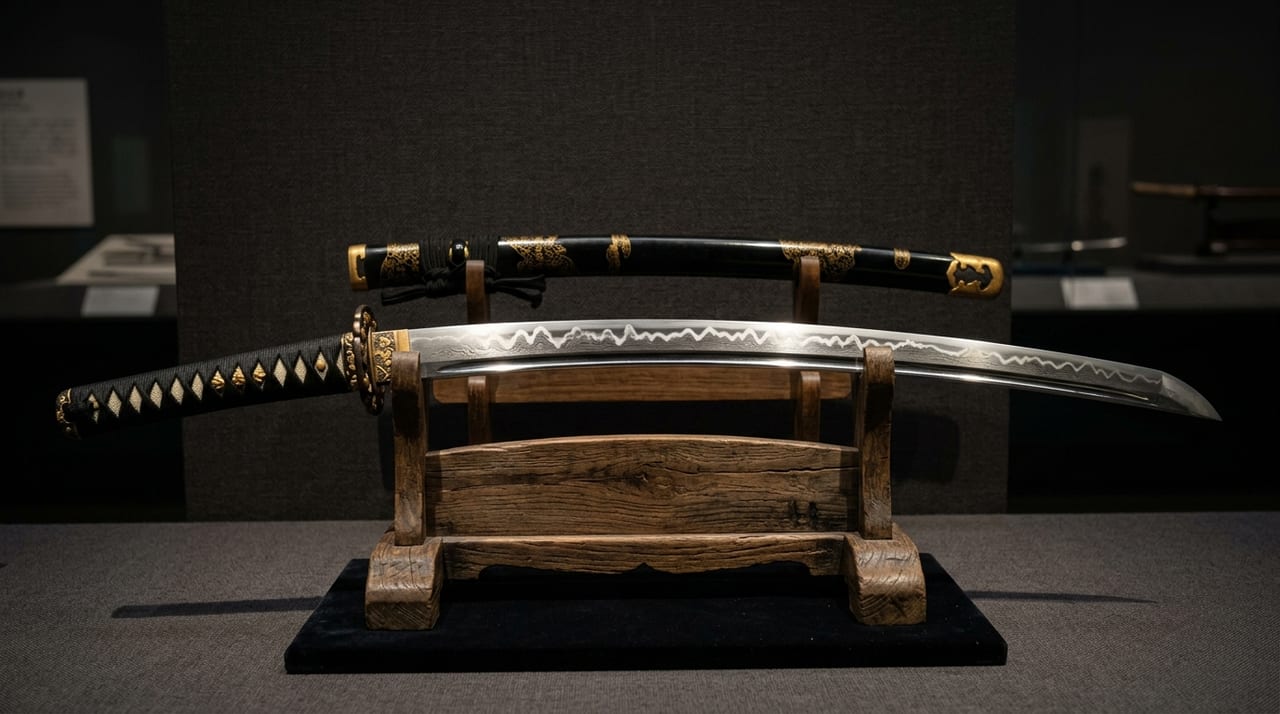
A National Treasure tachi hailed as the supreme masterpiece of the Fukuoka Ichimonji school, garnering the highest praise among Japanese sword enthusiasts. With a blade length of approximately 67.8 cm and a curve (sori) of approximately 2.4 cm, it exemplifies the characteristic form of mid-Kamakura period tachi while displaying a slightly broader blade width and robust thickness, imbuing it with formidable presence and strength.
Manufacturing and Features
The jigane (steel surface) exhibits tightly-packed itame (wood-grain) skin with vivid utsuri (reflected pattern), displaying the characteristic warm, lustrous iron color distinctive of the Bizen tradition. The hamon (blade pattern) represents this tachi's greatest appeal—massive shigeka-chōji (densely-layered chōji) patterns overlap repeatedly to create an exceptionally opulent and magnificent spectacle. This is precisely why it is celebrated as the most resplendent chōji hamon among all Ichimonji school works, heralded by the phrase "the Ichimonji chōji achieves perfection here."
The Fukuoka Ichimonji school was a group of swordsmiths based in Fukuoka, Bizen Province (present-day Fukuoka, Osafune-chō, Setouchi City, Okayama Prefecture), flourishing in the mid-Kamakura period. The school takes its name from their practice of inscribing the character '一' (one) as their mei (signature). It produced celebrated masters including Norimuneᵃ, Sukemaᵇ, Yoshifusaᶜ, and Yoshihiraᵈ, establishing the golden age of Bizen swordsmithing.
The title "Nikkō Ichimonji" derives from this tachi's former enshrinement at Nikkō Gongen Shrine (Nikkō Futarasan Shrine) in Shimotsuke Province (Tochigi Prefecture). Since Hōjō Sōun, founder of the Later Hōjō clan, received this sword, it has been transmitted as a treasured heirloom of the Odawara Hōjō family. During the Siege of Odawara (Tenshō 18 / 1590) launched by Toyotomi Hideyoshi, it is recorded that it was presented to Kuroda Kanetsugu (known as Kuroda Josui), who played a crucial role in achieving the peace settlement, as a reward from Hōjō Ujinao, the fifth-generation head of the Hōjō clan. Thereafter, it has been carefully preserved and transmitted as a treasured heirloom of the Kuroda clan of Chikuzen for over four centuries. It was designated a National Treasure in 1951 and is currently housed in the Fukuoka City Museum. Together with Nihongo, it serves as one of the museum's two signature treasures and remains a source of pride for Fukuoka.
Legends & Stories
Legend and Tales
The name Nikkō Ichimonji derives from a tradition that a tachi dedicated to Nikkō Gongen Shrine (now in Tochigi Prefecture, Nikkō City) was received by Hōjō Sōun, the founder of the Later Hōjō clan. Thereafter, this tachi became a treasured heirloom of the Later Hōjō family, and during the Siege of Odawara by Toyotomi Hideyoshi in Tenshō 18 (1590), it is said that as a token of gratitude for Kuroda Jōsui (Takao)'s efforts in bringing about peace between the Toyotomi and Hōjō families, it was presented to the Kuroda family by Hōjō Ujinao, the fifth-generation head of the Later Hōjō. After entering the Kuroda family, the Nikkō Ichimonji was preserved and transmitted as the most precious heirloom of the Chikuzen Kuroda clan for more than four hundred years. In the Kuroda household, successive lords designated this tachi as "the family's supreme treasure" and strictly forbade its removal from the domain. It was brought out from the storehouse only on occasions of major celebrations and important domain events, and the lord himself would personally verify its condition—such was the rigorous care maintained. The jūka-chōji hamon changes in appearance depending on the angle of viewing and the quality of light, giving the impression that living flowers are blooming within the blade. Among sword researchers, the evaluation that "among the chōji patterns of the Ichimonji school, nothing surpasses the Nikkō Ichimonji" has become established, and it occupies an extremely important position academically as the pinnacle of the Bizen-den chōji hamon. Its display at the Fukuoka City Museum is a matter of pride for Fukuoka residents, and the joint exhibition with the Nippon-go is an extraordinary experience that can never be seen at any other museum—a unique experience available only in Fukuoka.