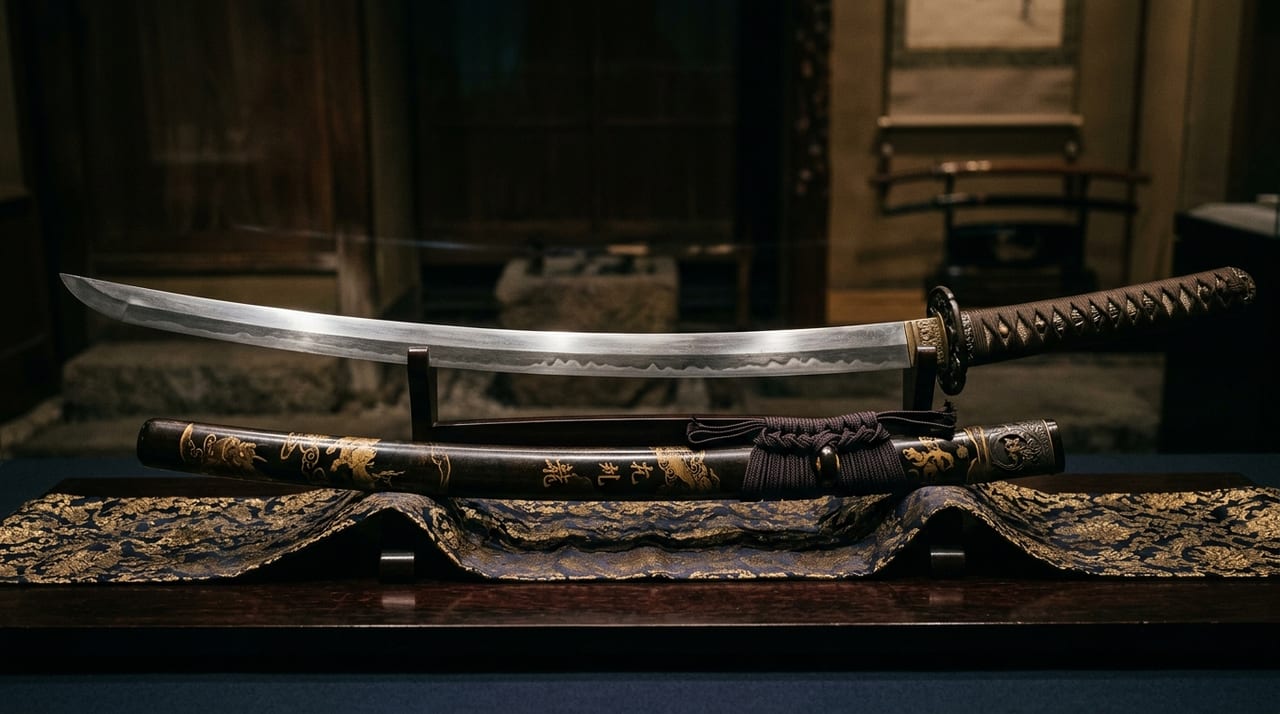
 * Image is for illustrative purposes only.
Nene-Kirimaru
祢々切丸
Also known as: Nene-Kirimaru, Nue-Slayer, Sacred Blade of Nikko Futarasan Shrine
Description
Overview of the Blade
Nene-Kirimaru is a large tachi (ōdachi) enshrined at Nikko Futarasan Shrine in Nikko City, Tochigi Prefecture, and is a sacred blade that derives its name from the legend of slaying a yokai called "Nene" that dwelt in the Nenezawa valley in the Nikko mountains and cried with a sound like "nee-nee." Designated as an Important Cultural Property, it has been transmitted as a treasure of Nikko Futarasan Shrine to the present day. The most distinctive feature of this blade is its overwhelming size: with a blade length of approximately 216.7 cm and total length of approximately 324.1 cm, this giant ōdachi is so large that it would be difficult for an ordinary person to use in actual combat.
The Yokai Nene—A Legend Unique to Nikko
"Nene," which appears in the name Nene-Kirimaru, was a yokai unique to Nikko that dwelt in the Nenezawa valley in the Nikko mountains and was said to cry out "nee-nee" and trouble people. This is a legend unique to Nikko, entirely separate from the slaying of the Nue by Minamoto no Yoritomo as told in the Tale of the Heike, and Nene-Kirimaru occupies a special position as a sacred blade said to have slain this yokai indigenous to this region.
Characteristics of the Blade
Nene-Kirimaru's blade exhibits the imposing appearance befitting a large tachi, displaying a powerful form matching its great length. The ji-tetsu (base steel) possesses the dignity characteristic of old swords, and while detailed records of the hamon (temper line) are scarce, it is carefully preserved as a work of ancient provenance. The ōdachi and ō-nagamono forms are often custom-made blades dedicated to shrines, functioning more as an offering to the kami and symbol of divine power rather than for actual combat. Nene-Kirimaru, too, has existed as a quasi-divine entity enshrined at Nikko Futarasan Shrine for many years.
Nikko Futarasan Shrine and Sword Faith
Nikko Futarasan Shrine is an ancient shrine with the Nikko mountains (Nantai, Nyotai, and Tarō mountains) as its shintai (kami-body), and as the primary shrine of Shimotsuke Province, it ranks among the greatest shrines of the Kanto region. Since Tokugawa Ieyasu was enshrined at Nikko Tōshōgū, Nikko became the spiritual pillar of the Edo bakufu, and Futarasan Shrine gained special status through this connection. The dedication of blades to shrines is an ancient tradition, and Futarasan Shrine has received many renowned swords beyond Nene-Kirimaru. Among them, Nene-Kirimaru demonstrates exceptional presence through its unique legend as a "sacred blade that slew a yokai."
Cultural Significance as a Sacred Blade
The combination of the ōdachi form and the legend of yokai-slaying positions Nene-Kirimaru as a "spiritual protective object" transcending mere weaponry. A blade enshrined at a shrine becomes a proxy for divine power; a sword that slew the yokai "Nene" that troubled people was believed to possess the power to purify all evil dwelling within the shrine. Such faith was passed down through generations and has been carefully preserved to the present day, demonstrating the depth and persistence of Japan's sword faith.
The Ōdachi Form—A Blade Offered to the Sacred Realm
That Nene-Kirimaru possesses the form of an "ōdachi" (large tachi) suggests it was originally crafted for dedication to the kami rather than for combat. Blades dedicated to Japanese shrines, serving as offerings and symbols of divine power, are often made at dimensions far too large for humans to actually wield. Nene-Kirimaru's total length requires considerable strength for a human to swing, even with both hands, carrying symbolic meaning as "a blade that only one possessed of divine power can handle." Such large dedication blades are stored in the shrine's treasury, serving as guardians of the shintai, and at important rituals they are displayed before the kami to manifest divine authority. Nikko Futarasan Shrine has been revered since ancient times as a military and martial kami shrine, and is known as a highly efficacious shrine where warriors prayed for long military fortune. Among the shrine's treasures, Nene-Kirimaru is the most important ōdachi and has occupied a special place in the shrine's long history. Today it is designated as an Important Cultural Property and carefully preserved in the shrine's treasure house.
Nikko Futarasan Shrine and the Sacred Grove of Martial Kami
Nikko Futarasan Shrine, where Nene-Kirimaru is enshrined, is an Engishiki-listed shrine seated at the base of Nikko mountain, the sacred peak revered as the tutelary kami of Nikko mountain since ancient times. Futarasan is the ancient name of Nantai mountain (Nantai-san), and the shrine stands at its base. Nikko mountain developed especially during the medieval period as a sacred site where Buddhism and Shinto merged in syncretic practice, and as one of the Nikko sansha (three shrines of Nikko) alongside Rinnō-ji Temple and Tōshōgū (which enshrines Tokugawa Ieyasu), it is registered as a UNESCO World Cultural Heritage site. Futarasan Shrine is revered as a martial kami and protector of the nation, and has collected the faith of warriors since the Heian period. Historical rulers including Minamoto no Yoritomo and Tokugawa Ieyasu showed deep reverence for Futarasan Shrine, and many weapons and blades were dedicated to it. Nene-Kirimaru is one of the most important dedicatory offerings among these, and has been guarded and transmitted as a symbolic treasure of the shrine for centuries. This ōdachi, bearing the legendary provenance of having slain the yokai "Nene," is venerated in the shrine's treasure house as a sacred entity embodying the shrine's spiritual efficacy and continues to be revered to this day.
The Forging Technique of Ōdachi and the "Unknown Master Smith"
As for the maker of Nene-Kirimaru, no clear record remains at present. Blades enshrined as shrine treasures sometimes preserve the name of the dedicator, but the name of the swordsmith who forged them often does not survive clearly. In the case of Nene-Kirimaru, while the shrine's transmitted accounts relate the legendary provenance that it "slew Nene," it remains unclear who, when, or where forged this ōdachi. Based on the style and workmanship of the blade, it is estimated to have been forged in the late Heian to early Kamakura period, but the smith remains unidentified. Forging an ōdachi requires techniques more advanced than ordinary blades, and achieving uniform curvature across a long blade while applying consistent hamon (temper pattern) throughout requires considerable skill. Judging from the size and preservation state of Nene-Kirimaru, it is clear that its maker possessed the highest technical standards of the time—there is no doubt it is a master craftsman's work—yet his name has vanished into history's mist. The very fact that this ōdachi, forged with full devotion by an unnamed swordsmith for dedication to the kami, has been transmitted to the shrine even after nearly a thousand years is itself a miracle.
Legends & Stories
The Nue—A Terror that Shook the Heian Night
Heian Kyoto was a world where, even as the aristocratic culture flourished in brilliant splendor, people lived in proximity to the fear of strange phenomena lurking in the darkness of night. The tale of the Nue told within the Tale of the Heike exemplifies this terror. During the reign of Emperor Konoe (early 12th century), strange clouds drifted nightly over the imperial palace, and the Emperor fell gravely ill with an ailment of unknown cause. Through divination by onmyōji (yin-yang masters), it was revealed that this cloud was the work of the Nue. It was a fearsome composite beast: head of a monkey, torso of a badger (or tiger), tail of a snake, and limbs of a tiger, and its cry echoed through the night sky, freezing the blood of all who heard it. The Emperor issued an imperial command for a Nue-slaying expedition, and Minamoto no Yoritomo, the Third Rank, came before the palace armed with bow and arrows. In the dead of night, Yoritomo sensed something moving within the pitch-black cloud, and while chanting "Namu Hachiman Daibosatsu" (Homage to the Great Bodhisattva Hachiman), he released his arrow. The arrow struck true, hitting the Nue, and the creature fell to the palace grounds. Yoritomo had his retainer Ino Hayata deliver the final blow, and the slaying was accomplished.
The Legend of Nene-Kirimaru—The Power of Slaying Dwelling in the Shrine
The name and legend of Nene-Kirimaru derive from a separate yokai tradition from that of the Nue-slaying in the Tale of the Heike—the account of "Nene," a yokai passed down in the Nikko mountains. According to the tradition, a mysterious entity called "Nene" (which made sounds like insect cries, or was said to be a type of kappa-like creature) dwelt in "Nenezawa" valley in the Nikko mountains and was feared by people, but when this great blade drew itself from its sheath and slew the Nene, it was named "Nene-Kirimaru." It has been venerated as a sacred blade of Nikko Futarasan Shrine, symbolizing the power of the sacred mountain. The ōdachi form—a size so large as to be impractical for actual combat—suggests that this blade was designed from the outset as an offering to the kami. The kami of the shrine was understood to be larger, stronger, and more powerful than any human warrior, and the blade embodying divine protection was likewise believed to possess dimensions transcending the human scale.
Nikko's Sacred Mountain and Yokai-Slaying
Nikko has been known since ancient times as a "sacred mountain," a pilgrimage site of Shugendō (mountain ascetic Buddhism) where many practitioners gathered. The power of the kami dwelling in the mountain was venerated as the power to purify yokai and malevolent spirits, and Nikko Futarasan Shrine was the center of this spiritual force. The dedication of Nene-Kirimaru to Futarasan Shrine can be understood to mean that this blade was intended to embody the shrine's "banishing of malevolent spirits" power. The blade protects the shrine, and the shrine grants spiritual power to the blade—this mutual relationship has transmitted Nene-Kirimaru as a spiritual entity transcending mere cultural property to the present day.
Nene-Kirimaru in the Modern Era
Nikko Futarasan Shrine continues to attract many pilgrims in the present day, and Nene-Kirimaru, housed in the shrine's treasure hall, is cherished as a symbol of the shrine's spiritual authority. The existence of the Nue continues to live on in modern fantasy culture, and Nene-Kirimaru, as the legendary blade that slew the Nue, is widely known among sword enthusiasts.
The Heroic Tale of Yoritomo and the Master Archer
Minamoto no Yoritomo, the protagonist of the Nue-slaying, was a warrior of the late Heian period and also renowned as a poet. Yoritomo lived as a member of the Minamoto clan during the height of the Taira clan's power, and in his later years he rose in response to a call from Prince Mochihito but was defeated, ultimately taking his own life at the Battle of the Uji River. At his end, he composed the death poem "Though the buried tree has bloomed no flower of beauty, the end of my life is what I deeply lament," and was remembered by posterity as a hero filled with pathos. In the tale of Nue-slaying, Yoritomo plays the role of an archery master who discerns the Nue's true form and shoots down the monster brilliantly from within the darkness of night. Such a role as "the hero who overcomes an unseen terror" became deeply inscribed in the ideals of the warrior in medieval samurai society. It should be noted, however, that Yoritomo's weapon in the Nue-slaying was a bow and arrows, whereas the Nene that Nene-Kirimaru of Nikko Futarasan Shrine is said to have slain was not the Nue of the Tale of the Heike, but a yokai called "Nene" in the Nikko mountains.
Yokai and Sacred Blades—The Spiritual Worldview of Japan
The tradition that Nene-Kirimaru, as a blade that slew the yokai "Nene" of the Nikko mountains, was dedicated to the shrine reflects the spiritual worldview of the Japanese people deeply. Since ancient times in Japan, certain weapons and blades have been believed to possess the power to battle yokai, malevolent spirits, and plague kami. Such weapons possessed of divine power became "protective implements" (gohō no gu) guarding the people of the region when dedicated to shrines and temples. The tradition that a blade which slew the yokai "Nene" of the Nikko mountains was enshrined in the region's shrine became a powerful message that this land was a sacred realm protected from malevolent spirits and anomalies. Nikko mountain has been regarded since ancient times as "the sacred mountain of Kanto," commanding both fear and reverence, and the sacred blade of yokai-slaying dedicated there was valued as an entity further elevating the spiritual power of the sacred mountain. Even in the modern era, Nene-Kirimaru continues as one of the most important treasures of Nikko Futarasan Shrine, symbolizing the kami's protection.
Relations with Nikko Tōshōgū and the Divine Protection of Martial Kami
Nikko Futarasan Shrine exists adjacent to Nikko Tōshōgū, built in the Edo period to enshrine Tokugawa Ieyasu, with the entirety of Nikko mountain regarded as a "sacred place" receiving the patronage of the Tokugawa shogunate. Tokugawa Ieyasu himself held deep reverence for Nikko mountain and chose it as the site of his own mausoleum at Tōshōgū. Within such religious and political contexts, Nene-Kirimaru became a sacred entity indirectly bound to the authority of the shogunate. At a time when Nikko mountain as a whole occupied the special position of "guardian sacred mountain of Kanto," Nene-Kirimaru, the most important treasure of its tutelary shrine, Futarasan Shrine, drew the faith of people throughout Kanto as a sacred blade offering protection from malevolent spirits and calamity. Even in the present day, visitors to Nikko pay their respects at Futarasan Shrine alongside Tōshōgū and Rinnō-ji Temple, and sword enthusiasts who know the legend of Nene-Kirimaru direct special interest toward its treasure hall. As "Nikko's Shrines and Temples," a UNESCO World Heritage site, gains international recognition, the story of Nene-Kirimaru serves as a medium transmitting Japan's spiritual culture to the world.