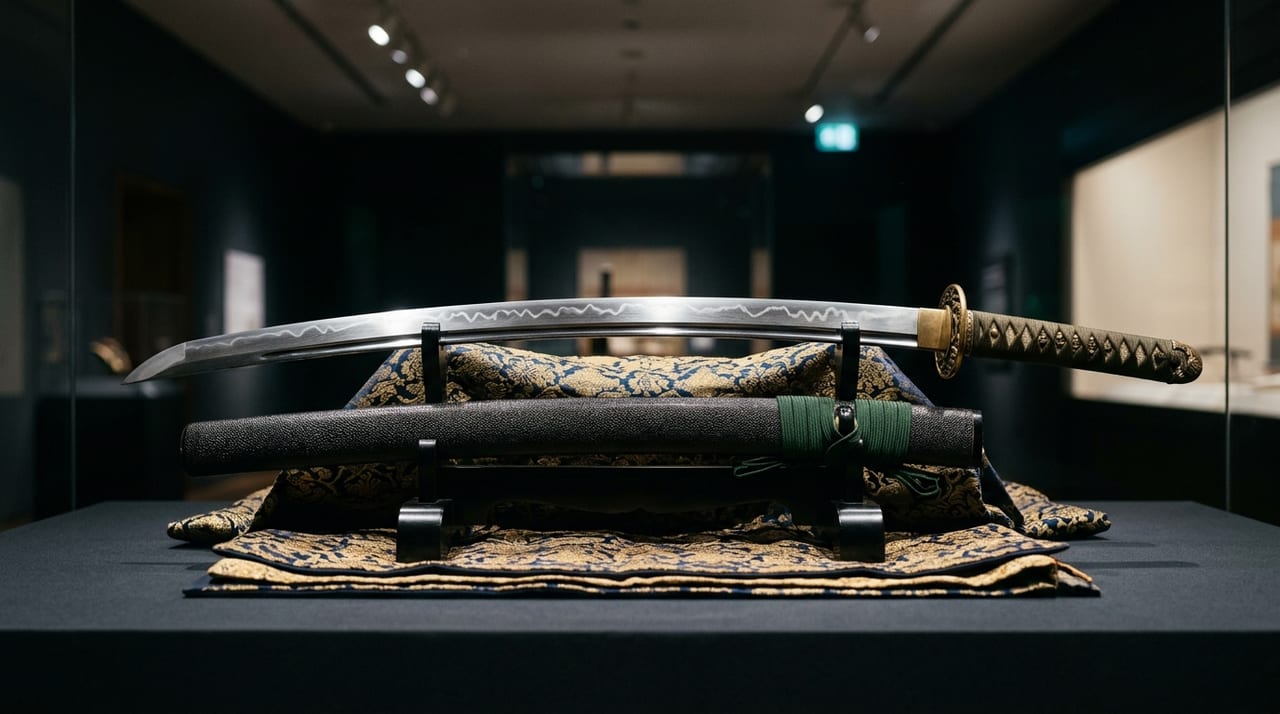
 * Image is for illustrative purposes only.
Nansen Ichimonji
南泉一文字
Also known as: Nansen's Ichimonji
Description
Overview of the Sword
Nansen Ichimonji is a tachi forged by the Bizen Ichimonji school during the Kamakura period, named after the Zen koan "Nansen slaying the cat" (nansen-zan-myō), a celebrated story in Zen Buddhism. The blade's name embodies a Zen anecdote in which Nanquan Puyuan (Nansen Fugan), a Tang dynasty Zen monk, tested the enlightenment of his practitioners by slaying a cat. The unique cultural backdrop of bearing a Zen koan in the sword's name elevates this tachi to an intellectual and spiritual dimension distinct from other celebrated blades.
About the Bizen Ichimonji School
The Ichimonji school was a group of swordsmiths active in Bizen Province (present-day Okayama Prefecture) during the Kamakura period, encompassing the Bizen tradition's master smiths, including subsidiary branches such as Fukuoka Ichimonji and Katayama Ichimonji. Blades from the Ichimonji school are characterized by rich and elegant chōji-midare hamon and finely detailed ko-itame jigane, representing the pinnacle of sword beauty in the Kamakura period. Nansen Ichimonji's hamon is a quintessential Ichimonji chōji-midare, with large and splendid chōji arranged in succession, presenting a rich and varied landscape that vividly embodies the beauty of the Bizen tradition. The jigane displays tightly packed ko-itame with fine jisui, presenting a bright steel color, and the balance with the resplendent hamon is exquisite.
Details of the Blade
Nansen Ichimonji possesses blade dimensions characteristic of a Kamakura-period tachi, with a blade length (nagasa) in the range of approximately 2 shaku 4 sun. The jigane displays finely packed ko-itame with thick jisui, producing beautiful standing reflection (utsuri). The hamon is a large chōji-midare with interspersed gunome and small midare between the chōji, abundant ashi and ha creating a rich and varied landscape. The nioiguchi is bright and crisp, with well-developed nie giving a refined finish. The boshi curves inward with deep return, maintaining the abundance of the hamon to the tip. The nakago (tang) shows heavy polishing and is unsigned; the designated name is "Sword—Unsigned Ichimonji (Famous Blade: Nansen Ichimonji)."
Provenance and the Owari Tokugawa Family
A crucial part of Nansen Ichimonji's provenance is its transmission as a designated treasure (shitai) of the Owari Tokugawa family, cherished by successive daimyo. This tachi was originally transmitted to the Ashikaga shogunal house, and then passed through the hands of Toyotomi Hideyoshi and Tokugawa Ieyasu before being inherited by the Owari Tokugawa family. The passage of this famous blade from military rulers to a daimyo house demonstrates its high rank and prestige. It is currently housed in the Tokugawa Museum (Nagoya) and designated as an Important Cultural Property.
Zen and the Samurai—Why a Zen Koan Dwells in This Sword
The adoption of a Zen koan for the name Nansen Ichimonji reflects the deep bond between Zen and samurai culture in medieval Japan. Zen Buddhism was formally transmitted to Japan during the Kamakura period and rapidly spread among the warrior class. This was because Zen practice had high affinity with the spiritual cultivation of the samurai; concepts such as "mushin" (no-mind), "ichigo ichie" (one time, one meeting), and "shikantaza" (just sitting) resonated profoundly with the spirit of swordsmanship and martial arts. The koan of "Nansen slaying the cat" describes immediate action beyond logic—the shocking act of cutting down a cat—as demonstrating truth, a narrative that resonated with the samurai's spiritual world, wherein a single flash of the sword revealed truth. To name a blade after a Zen koan was an act of elevating the sword from a mere tool of violence to a symbol of spiritual practice in the quest for enlightenment. The name Nansen Ichimonji stands as precious evidence that samurai of the Kamakura period found spiritual value in both the blade and Zen.
Samurai Aesthetics and the Prosperity of the Ichimonji School
The Ichimonji school's attainment of the highest esteem during the Kamakura period lay in the cultural maturity of the Kamakura bakufu. Since Minamoto no Yoritomo established the shogunate in Kamakura, samurai culture had developed its own refined aesthetic sensibility while competing with court culture. Swords lay at the heart of samurai identity, and possession of the finest blade was evidence of a samurai's rank and authority. The shoguns and regents of the Kamakura bakufu held blades of the Bizen Ichimonji school in special reverence, and records survive of Ichimonji tachi being used as shrine offerings and gifts bestowed upon military commanders. The chōji-midare of the Ichimonji school was described as possessing "the beauty of chrysanthemums blooming in profusion," and its sumptuous and meticulous hamon became testimony to the samurai's refined aesthetic sense. Nansen Ichimonji, forged at the height of this Kamakura samurai culture, is a tachi that embodies the aesthetic sensibility of its age.
Legends & Stories
Nanzen Kills the Cat — A Zen Koan and the Naming of a Sword
"Nanzen Kills the Cat" (Nanzen Zanmyō) is renowned as one of the ten great koans of Zen Buddhism. The Tang-dynasty Zen monk Nanquan Puyuan (748–834), witnessing monks from the east and west halls of the meditation hall quarreling over a cat, seized the moment. Nanquan held the cat aloft and declared: "If anyone here can speak a true word to save this cat, I will spare it. If not, I will cut it down." None of the monks could speak. Nanquan killed the cat. That evening, when Nanquan's disciple Zhaozhou returned from outside, Nanquan recounted the day's events. Zhaozhou, in silence, placed the straw sandal he was wearing on his head and walked out of the room. Upon seeing this, Nanquan sighed, "If Zhaozhou had been here, the cat would have been saved."
This koan contains the fundamental questions of Zen: "What is enlightenment?" and "How should a person respond when faced with the problem of life and death?" Zhaozhou's act of placing a sandal on his head is interpreted as an expression of "non-discriminating wisdom" that transcends language and logic. The name Nanzen Ichimonji concentrates this profound Zen inquiry into a single sword, and in this name, the sword's power to determine life and death resonates strangely with the realm of transcendence beyond life and death that Zen enlightenment seeks.
Warriors and Zen — The Spirit Dwelling in a Renowned Blade
From the Kamakura period onward, Zen penetrated deeply as a spiritual foundation for the samurai. Zen's teachings of non-attachment and non-discrimination resonated profoundly with the samurai's confrontation with life and death on the battlefield. The phrase "Sword and Zen are One" — kenzen ichinyo — succinctly expresses the fusion of warrior culture and Zen thought. The name Nanzen Ichimonji is the most direct embodiment of this spirit of sword-and-Zen-as-one, and the very act of naming a sword after a Zen koan demonstrates the depth and complexity of Japanese samurai culture.
From the Ashikaga Shoguns to the Owari Tokugawa House
The Nanzen Ichimonji originally came into the possession of the Ashikaga shogun family, and later passed to the Toyotomi. It is said that in Keicho 16 (1611), Toyotomi Hideyori presented it to Tokugawa Ieyasu at a meeting in Nijō Castle, and after Ieyasu's death, it passed through the division of his estate to Tokugawa Yoshinao, the first lord of the Owari Tokugawa house, where it has been treasured by successive generations. That it was preserved under the Owari Tokugawa house, which valued learning, testifies to the deep affinity between the Zen depth of the blade's name and a daimyo house that honored culture. The daimyo culture that combined the martial vigor of the warrior with aristocratic elegance was the most fitting cultural soil in which to appreciate the Nanzen Ichimonji.
Koan and Sword — A Masterwork That Embodies a Question
Each time a samurai who held Nanzen Ichimonji drew the blade, he was confronted with a Zen question: "Are you always prepared to cut? Can you refrain from cutting? Where does your mind dwell at the boundary of life and death?" Just as Nanquan cut the cat, so does the sword cross the boundary of life and death in an instant. As an object that enshrines both question and answer in its blade, the Nanzen Ichimonji represents the highest spiritual dimension that Japanese sword culture has achieved.
Zhaozhou's Dog and the System of Koans — The Spiritual World of Zen
Alongside "Nanzen Kills the Cat," another famous Zen koan is "Zhaozhou's Dog" (Zhaozhou Wuzi). When a disciple asked Zhaozhou whether a dog possesses Buddha-nature, the Zen master Zhaozhou answered simply: "No" (wu). The practice of gazing upon this single character "No" for years on end became a central practice in Zen training. In the "Nanzen Kills the Cat" koan, when Zhaozhou returned the next morning and Nanquan recounted the previous night's events, Zhaozhou lifted the straw sandal he was wearing, placed it upon his head, and walked out. Seeing this, Nanquan sighed, "Had that one been here last night, the cat could have been saved." The practice of the koan lies in continually contemplating the meaning of Zhaozhou's act — placing a sandal on his head — as an expression of enlightenment that transcends words. The name Nanzen Ichimonji can be called a masterwork of naming that is both intellectual and spiritual, encasing within a sword's name the profound spiritual world of Zen.
The Nanzen Ichimonji in the Modern Era
The Nanzen Ichimonji is currently designated as an Important Cultural Property and is housed in the Tokugawa Art Museum in Nagoya, a repository of treasures transmitted through the Owari Tokugawa house, where it undergoes ongoing preservation and scholarly research. Swords of the Ichimonji school are housed in museums and art galleries throughout Japan, and the Nanzen Ichimonji is known as one of their representative examples. Due to its unique cultural background — bearing a name derived from a Zen koan — it attracts interest not only from sword enthusiasts but also from Zen scholars and Buddhist scholars. The Nanzen Ichimonji, where the essence of two pillars of Japanese culture — the Japanese sword and Zen — converge in the name of a single blade, will continue to draw the attention of many as a symbol of Japanese cultural diversity and spiritual depth. The question posed by the koan embedded in the blade's name continues to ask the viewer, even more than seven hundred years later: "Why did Nanquan kill the cat?"
The Philosophical Meaning Inherent in a Sword's Name
The deepest meaning of the name Nanzen Ichimonji lies in the fact that the very question "Why was this sword given this name?" functions itself as a Zen koan. The sword of Nanquan who killed the cat — yet it is a precisely crafted blade of the Ichimonji school. There is no logical answer to "Why was Nanzen Kills the Cat chosen as the sword's name," and the answer dwells either in the ongoing questioning or beyond the question itself. This is the very spirit of Zen, and one senses the refined intellect and Zen sensibility of the person who named the sword by placing a Zen koan within its name. The Japanese sword exists to "cut" — it is a weapon — yet the name Nanzen Ichimonji places that blade within a philosophical context that deeply questions the meaning of the act of "cutting." "Nanquan killed the cat, and the sword carries that memory — but what then is the sword?" When this question quietly arises in the heart of one who beholds the Nanzen Ichimonji, it transcends mere artwork and becomes a Zen "vessel of questioning."