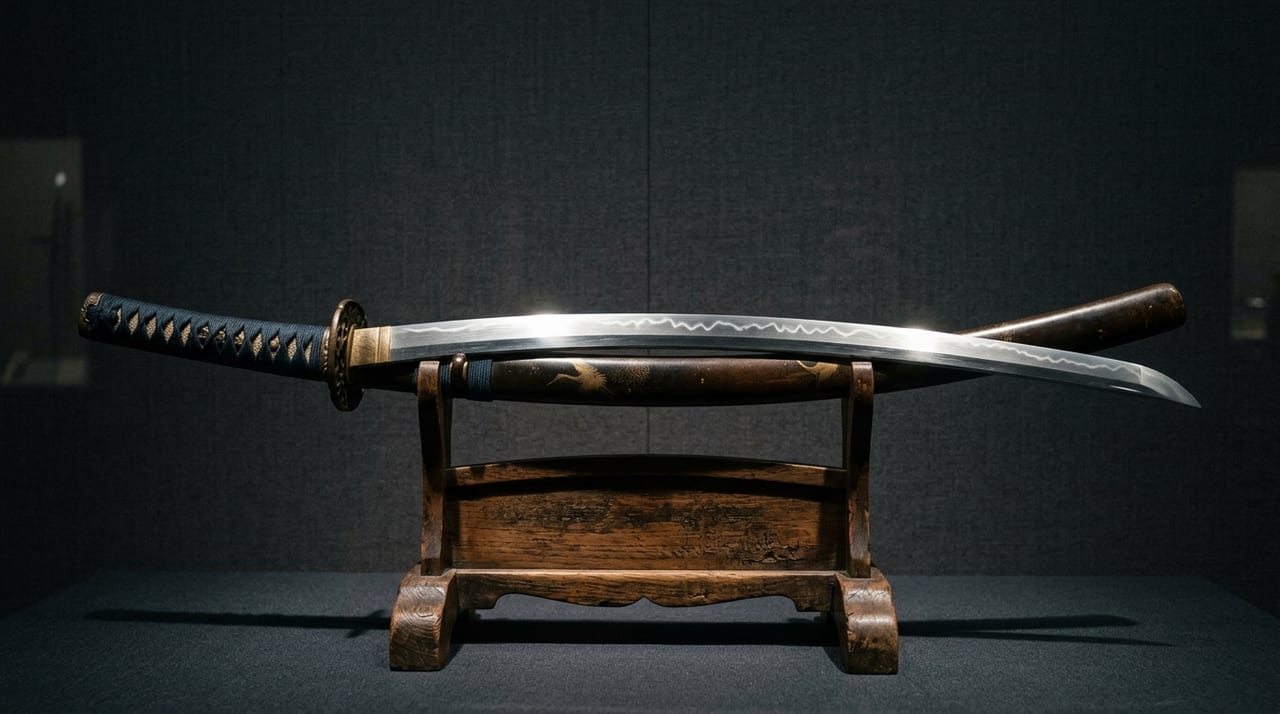
 * Image is for illustrative purposes only.
Nakimushi Chiyozuru
泣き虫千代鶴
Also known as: Chiyozuru's Weeping Blade
Description
Overview of Nakimushi Chiyozuru — The Weeping Blade of Echizen Province
Nakimushi Chiyozuru (Crying Chiyozuru) is a tachi attributed to Chiyozuru Kuniyasu, a master swordsmith active in Echizen Province (present-day Fukui Prefecture) during the late Nanboku-chō period through the early Muromachi era (latter half of the 14th century). This legendary blade, transmitted as an Echizen provincial treasure, earned its moniker "Nakimushi" (crybaby) from a peculiar tradition: the sword was said to weep dew-like droplets at night, as if shedding tears.
Chiyozuru Kuniyasu is revered as the founding figure of the Echizen school of bladesmithing. Active during the turbulent Nanboku-chō wars, Kuniyasu forged blades that combined the influences of the Yamato tradition with distinctive Echizen characteristics. His work is noted for refined jigane (steel surface) with bright nie and nioi activity, and hamon patterns featuring ko-midare (small irregular waves) interspersed with gunome (undulating clove shapes), balancing martial functionality with aesthetic refinement.
The blade of Nakimushi Chiyozuru measures approximately 70 centimeters (about 2 shaku 3 sun) in length, displaying the robust proportions typical of Nanboku-chō tachi: moderately wide mihaba (blade width), deep koshizori (waist curvature), and a commanding presence. The jigane exhibits finely packed ko-itame hada (small wood-grain pattern) with abundant ji-nie, creating a precise and luminous surface. The hamon is primarily ko-chōji midare (small clove irregularity) with ashi (legs) and (leaves) extending into the ji, and the nioiguchi (boundary line of the tempered edge) is bright and crisp. The bōshi (tempered point) forms a small round return, preserving a healthy overall configuration.
Kuniyasu is traditionally associated with service to the Asakura clan of Echizen, and the lineage of Echizen smiths continued into the Sengoku period. Edo-period sword appraisal texts such as Kotō Mei Tsukushi and Shokoku Kaji Enkaku record Chiyozuru Kuniyasu as a distinguished craftsman of Echizen. Though Nakimushi Chiyozuru has not received formal cultural property designation, it holds historical and folkloric significance as a regional heirloom. Currently held in private collection within Fukui Prefecture, its precise location remains undisclosed. The supernatural lore surrounding this blade exemplifies a facet of Japanese culture wherein swords transcended their martial function to embody spiritual agency and presence.
Legends & Stories
The Legend of the Weeping Blade
The moniker "Nakimushi" (crybaby) originated from the experience of an Echizen samurai during the Sengoku period. A retainer of the Asakura clan, this warrior received a tachi forged by Chiyozuru Kuniyasu as a reward for battlefield merit. The blade was exquisitely tempered and sharp, and the samurai proudly wore it at his side. Yet before long, strange occurrences began to unfold. On the night before an allied general fell in battle, dew-like droplets appeared on the sword resting in the tokonoma alcove, as though the blade itself were weeping. The samurai initially dismissed this as coincidence, but the phenomenon repeated itself before family tragedies and military defeats.
One night, the samurai drew the blade to examine it closely. Under moonlight, he saw tear-like streaks glistening along the steel surface, glowing with an eerie luminescence. Alarmed, he consulted swordsmiths and onmyōji (yin-yang diviners), all of whom declared: "This sword harbors a spiritual presence that forewarns its master of impending calamity." From that point forward, the samurai heeded the blade's "tears" as omens, and tradition holds that he thereby averted disaster on several occasions. Villagers and household retainers came to call the tachi "Nakimushi Chiyozuru," revering it as a sacred blade.
Even after the warring era ended and the samurai's family declined, the sword remained in Echizen, reportedly bestowing uncanny protection upon successive owners. Edo-period essays record "a tachi in Echizen that sheds tears," preserving the legend through generations. To this day, Nakimushi Chiyozuru stands as an emblem of the spiritual depth and craftsmanship of Echizen bladesmithing, a source of regional pride and cultural heritage.