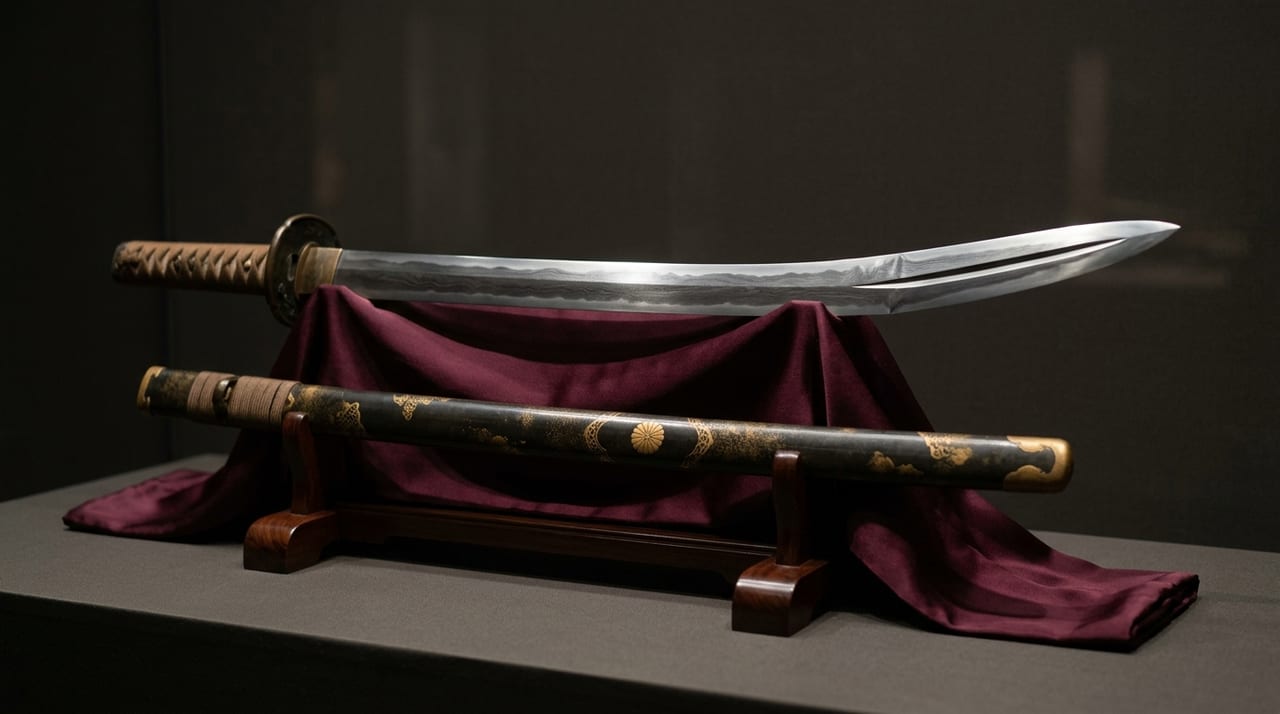
 * Image is for illustrative purposes only.
Nakahara Tōshirō
中原藤四郎
Description
Nakahara Tōshirō is a tantō forged by the Kamakura-period master Awataguchi Yoshimitsu (commonly known as "Tōshirō"), held at the Tokyo National Museum and designated an Important Cultural Property. The tantō of Awataguchi Yoshimitsu are collectively called "Tōshirō" after his by-name; numerous celebrated meibutsu (famous named swords) are known — Yagen Tōshirō, Gotō Tōshirō, Akita Tōshirō, Okada Tōshirō, and others — and Nakahara Tōshirō is one of this distinguished group, a named piece transmitted in a family connected to the Nakahara clan or the Nakahara district. Awataguchi Yoshimitsu is credited with perfecting a new sword form — the tantō — combining utility and beauty, as a departure from the traditional long swords of the Yamato tradition, and is considered one of the most important figures in establishing the tantō style of the Japanese sword. His tantō are characterized by their thin construction, the clear form of hira-zukuri, the refined suguha or ko-chōji hamon, and the densely textured, deep jigane — acclaimed to the present day as the ideal form of the tantō. The blade of Nakahara Tōshirō displays the typical Yoshimitsu tantō style: moderately wide mihaba, hira-zukuri construction, thin kasane, and a refined uchi-zori or mu-zori curvature. The hamon is centered on suguha with ko-midare mixed in; the fineness of the nie and the depth of the nioi directly embody Yoshimitsu's refined character. The jigane presents densely packed ko-itame-hada with fine, even ji-nie; the beauty of the jigane has been praised since ancient times with the saying "Yoshimitsu's skin is like a mirror." Its accession to the Tokyo National Museum is understood to reflect the Meiji-era process of collection and donation from former daimyō and warrior households, and it is now widely accessible to the public as one of the representative masterpieces of Yoshimitsu tantō in the museum's sword exhibitions.
Legends & Stories
The legends associated with Nakahara Tōshirō combine the theme of "guardian sword" that underlies all of Awataguchi Yoshimitsu's tantō with the individual provenance story pertaining to the Nakahara clan. Since ancient times, Yoshimitsu's tantō have been the object of absolute faith as "protective swords that guard human life," and an anecdote in which the blade itself issued a warning when a samurai bearing it faced a crisis is commonly transmitted among multiple "Tōshirō" meibutsu.
Regarding Nakahara Tōshirō, there is a tradition that when the head of the Nakahara clan who once held this blade was ambushed by an enemy commander during a campaign, the tantō worn at his waist vibrated, drawing forth his lord's instinctive response and allowing him to barely escape the crisis. The lord who returned alive is said to have written: "This blade protected its master with its own will," and to have inscribed gratitude and reverence for this tantō in the Nakahara clan's family precepts.
Among the legendary accounts concerning Yoshimitsu, there is a saying: "Yoshimitsu's final tantō becomes the finest blade unknown to anyone." The belief that tantō forged in Yoshimitsu's later years possessed increasingly elevated spiritual energy—the purest distillation of the master's technique and soul—is deeply rooted in sword culture. Whether Nakahara Tōshirō corresponds to that "late-career blade" remains unclear, but it continues to be preserved with the traditional evaluation of "a sword in which Yoshimitsu's soul resides."