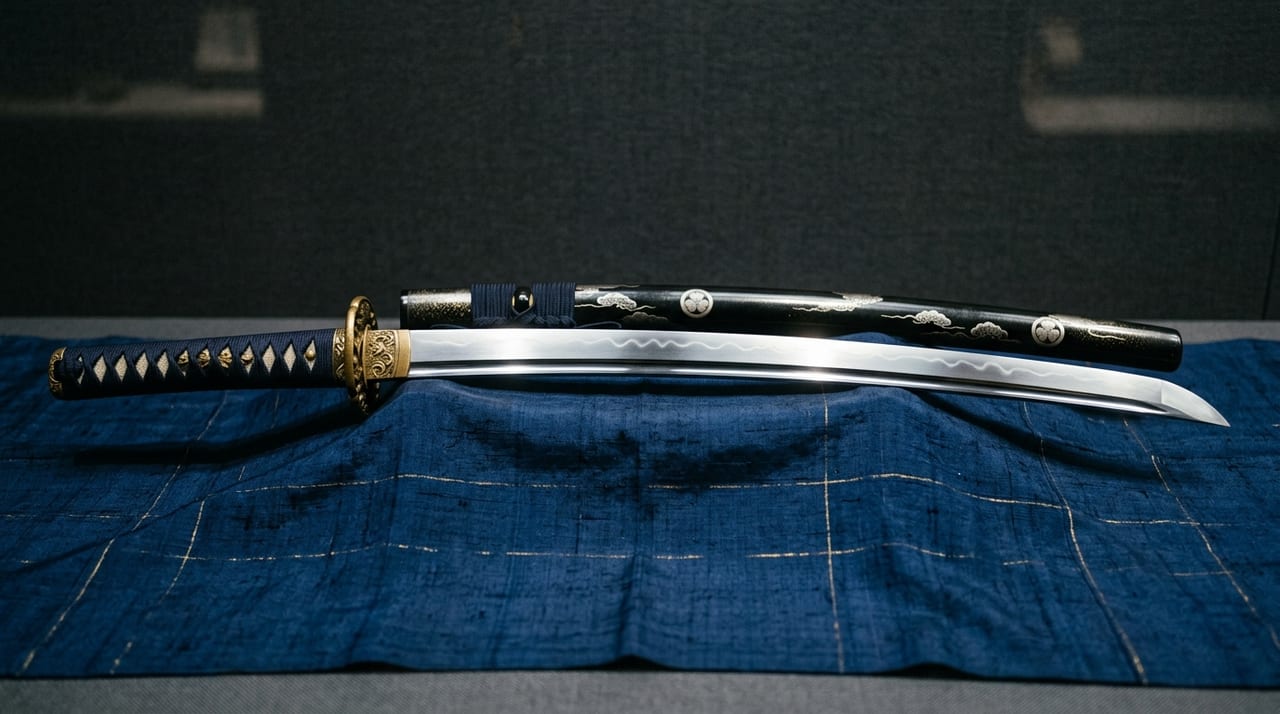
 * Image is for illustrative purposes only.
Murasame-maru
村雨丸
Also known as: The Mist-Rain Blade; Sword of the Eight Dog Warriors
Description
Murasame-maru is the legendary sword that appears in Nansō Satomi Hakkenden (南総里見八犬伝, "The Eight Dog Warriors of the Satomi Clan of Nansō"), the monumental serialized novel by Kyokutei Bakin (1767–1848), written over twenty-eight years from 1814 to 1842. The work spans ninety-eight volumes across one hundred and six books — a scale unprecedented in Japanese literature. Unlike the other blades in this collection, Murasame-maru is not a physical sword: it is a literary creation, born in the imagination of Japan's greatest Edo-period novelist. Yet its place in Japanese cultural memory is secure. No survey of famous Japanese swords would be complete without it.
The story centers on eight warriors — the Hakkenden, or "Eight Dog Warriors" — each of whom carries one of eight sacred beads inscribed with the Confucian virtues: humanity, righteousness, propriety, wisdom, loyalty, faithfulness, filial piety, and brotherly love. These warriors are destined to gather and restore the honor of the Satomi clan of Awa Province (present-day Chiba Prefecture), a real historical clan that Bakin used as his canvas for an elaborate tale of karma, fate, supernatural combat, and moral virtue. Murasame-maru is the blade that enters battle in their hands.
Its most famous property is this: after it cuts, when the blade is returned to its scabbard, water flows down it — a shower of rain, murasame, cleansing the steel of all blood. The name itself means 'scattered rain' or 'passing shower.' The sword does not carry blood. The sword does not carry stain. This detail — small, extraordinary — captures something deep in the Japanese imagination about blades and purity. A sword that kills without being defiled. A weapon that cleanses itself. It is a literary rendering of the idea that the sword in its highest form partakes of the divine.
Bakin was writing in an era of rigid censorship and social constraint, and his novel — ostensibly a historical adventure set in the Muromachi and Sengoku periods — was also a vehicle for moral and Buddhist philosophy. Murasame-maru is an artifact of that world: a sword that does not merely cut, but restores.
Legends & Stories
The Contract of Yatsufusa and the Birth of the Eight Dog Warriors—The Narrative Origins of Murasame-maru
The grand narrative of Nansō Satomi Hakkenden begins with a momentary oath spoken in jest by Satomi Yoshizane. When he declared, "Whoever brings me the head of the enemy commander attacking this castle shall have my daughter's hand in marriage," his beloved dog Yatsufusa—understanding human speech—took the words at face value. He brought the head. He claimed the princess. And so Fusehime came to live with the dog in the mountains, where she would meet her end. At the moment of Fusehime's death, her prayer beads shattered and eight spheres flew to the four directions. Each sphere miraculously came to rest in the womb of a woman and was born as one of eight men—the Eight Dog Warriors. These eight spheres granted to them the virtues of jin, gi, rei, chi, chu, shin, ko, and tei, along with superhuman power. Murasame-maru appears in the narrative as a spiritual sword wielded by these Eight Dog Warriors as they face their destined battles, depicted as a being in which the purity of the blade and the power of virtue are unified.
The Poetry of Murasame-maru's Name—The Beauty of the Word "Murasame"
"Murasame" (村雨) is a beautiful word that appears frequently in classical Japanese poetry, carrying the meaning of autumn shower or passing rain. In classical literature such as the Kokin Wakashū and the Man'yōshū, murasame has been employed as an important seasonal word and poetic term expressing the passage of seasons and the pathos of things. Bakin's choice to give this exquisite word to a spiritual sword demonstrates supreme naming sensibility, for in uniting "the tool of war" and "the world of poetry" in a single name, he created a unique realm where the beauty of the blade and the beauty of verse overlap. When one hears the name Murasame-maru, the ear catches the sound of autumn rain, and the eye sees clear water flowing down the blade—Bakin embedded such a sensory experience within the name itself.
Bakin's Blindness and the Completion Through Dictation—A Story of Human Will
One of the most moving episodes in the Hakkenden's composition is the fact that Bakin, although he lost his sight in his later years, had his daughter-in-law Michi take down his dictation and completed his great work. Bakin's vision began to fail around Tenpō 4 (1833) and he is said to have become completely blind around Tenpō 10 (1839), yet he never ceased writing. Speaking and having Michi record his words—through this collaborative labor, one old blind man's imagination continued to pour onto the page. Just as Murasame-maru maintains the quality of "preserving purity," Bakin kept the spring of creation pure even amidst the hardship of blindness. This correspondence, in which both writer and spiritual sword share the spirit of "remaining unstained by defilement," has deeply moved readers in all the ages that followed.