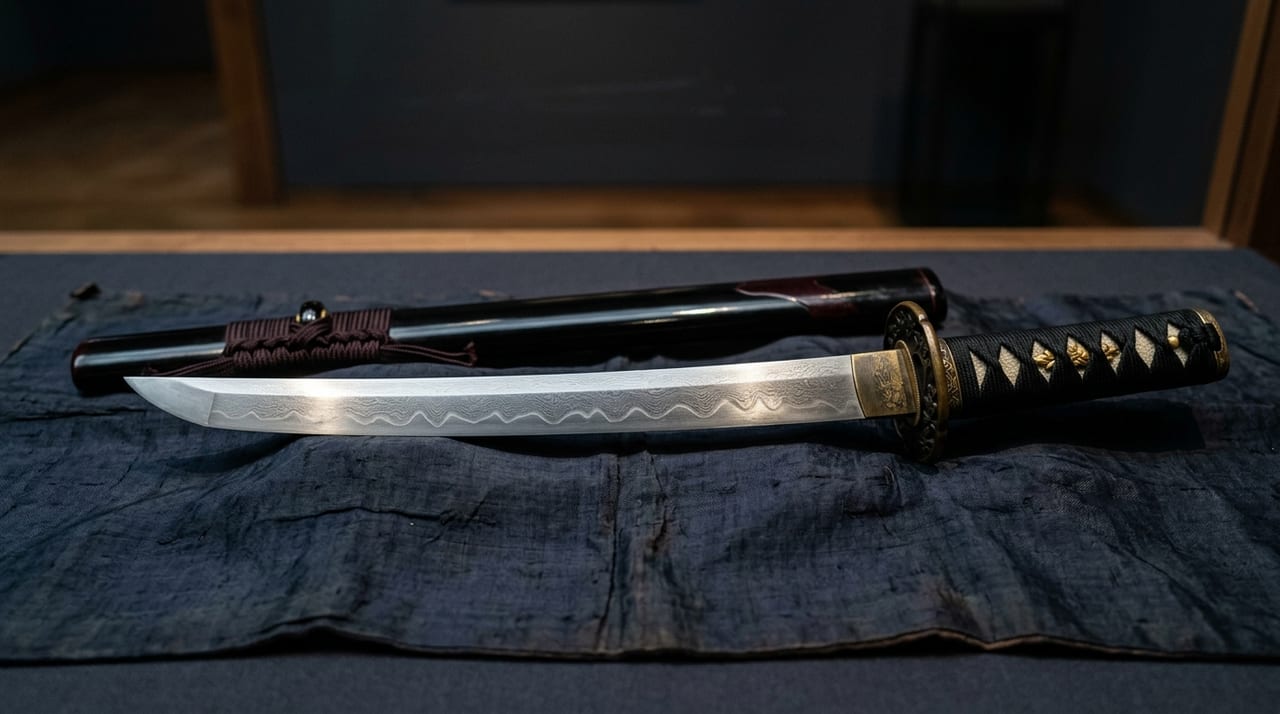
 * Image is for illustrative purposes only.
Muneyaki Masamune
棟焼正宗
Also known as: Muneyaki Masamune — Ridge-Fired Masamune of the Kyōhō Meibutsu-chō
Description
Muneyaki Masamune is a tantō forged by Masamune (Gorō Nyūdō Masamune), the great master of the Sōshū tradition, listed in the Kyōhō Meibutsu-chō (the Register of Famous Swords compiled in the Kyōhō era) as a named Masamune tantō, and designated an Important Cultural Property. The name "Muneyaki" refers to a distinctive hamon style in which the yakiba (fired zone) extends even to the mune (the back ridge of the blade, opposite the cutting edge) — a style called muneyaki — indicating that the ferocity of Masamune's hamon was so intense that the firing extended beyond the ha-machi and mune-machi to reach the mune itself, making this an exceptionally rare work. Masamune's tantō possess a fierce yet mysterious beauty in which extremely intense nie fills the ha, and the wildness of the hamon animates the entire blade. Muneyaki Masamune is a work in which these qualities are elevated to the extreme; the range of the firing extending to the mune has been spoken of with reverence by sword connoisseurs since ancient times as a symbol of the fierce heat and spiritual power of Masamune's Sōshū tradition. The Kyōhō Meibutsu-chō was compiled by Hon'ami Kōchū at the command of the eighth shogun Tokugawa Yoshimune; inclusion in it represents the highest appraisal by the leading connoisseurs of the age. The blade displays the typical tantō form while the fierce hamon characteristic of Masamune unfolds prominently: moderately wide mihaba, hira-zukuri construction, somewhat thin kasane, and a refined slight uchi-zori. The hamon is a large midare combining Masamune's characteristic fierce gunome, notare, and pointed ha; the nie blazes intensely, with kinsuji, sunagashi, and inazuma (lightning patterns) running in all directions through the ha. The defining feature — the muneyaki — extends the fired zone from near the mune-machi across part of the mune itself, directly embodying the ferocity of Masamune's forging. The jigane flows in itame-hada with abundant ji-nie and active jikei. The nakago bears the signature "Masamune" accompanied by a Hon'ami origami (appraisal certificate), and together with the listing in the Kyōhō Meibutsu-chō, constitutes the highest possible guarantee of genuine authorship.
Legends & Stories
The most celebrated legend associated with Muneyaki Masamune begins with the forging legend of this tantō. According to tradition, when Masamune was forging this tantō on a certain night, with the flames of the forge fire burning with extraordinary intensity, the entire blade was enveloped in divine fire (shinka) in a single moment by the blessing of the forge deity. When the blade was examined after the divine fire had cooled, the yakiba — which normally should have remained above the ha-machi and mune-machi — had extended to the mune. It is said that Masamune regarded this as "proof that the divine work (miwaza) of the gods had taken up residence in this sword" and completed it as his supreme masterpiece.
According to another tradition, when a warrior who possessed this tantō found himself in dire straits on the battlefield, the Muneyaki Masamune at his waist vibrated and emitted a faint heat. Sensing this strange occurrence, the lord instinctively spun aside and narrowly avoided an arrow. After his safe return, when he examined it, the muneyaki portion was shining more vividly than usual, and it was believed that the spiritual fire (reika) of Masamune residing in the mune had protected its master, giving rise to the saying: "The muneyaki is the fire of self-protection." The rare and unusual workmanship of the muneyaki — of which there are few comparable examples — has formed an independent legend in sword history as proof of Masamune's divine craftsmanship and continues to be handed down to the present day.