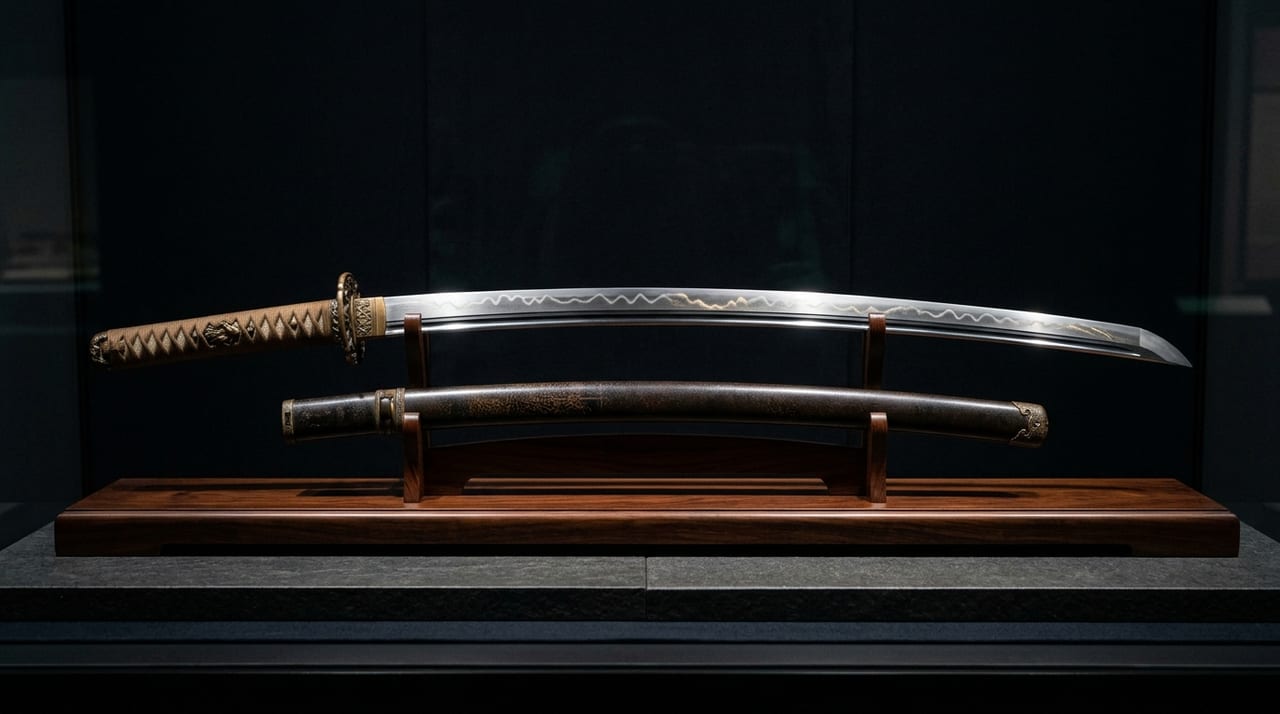
 * Image is for illustrative purposes only.
Wakasa Masamune
若狭正宗
Also known as: Meibutsu Wakasa Masamune; unsigned Masamune valued at 1,000 gold pieces
Description
Origin of the Name and the Blade
Wakasa Masamune is an unsigned blade by Masamune, the master smith who perfected the Sōshū tradition, and measures just under 2 shaku 2 sun 6 bu (approximately 68.5 centimeters) in blade length. Masamune's works whose signatures are certain are extremely few, and most of the surviving examples are unsigned blades attributed to him through appraisal by the Hon'ami family; yet Wakasa Masamune has been handed down as one of the outstanding masterpieces among them.
The Hon'ami Family's Origami
This work was attested as a Masamune by the Hon'ami family, and it is said to have received an origami (certificate of appraisal) of 1,000 pieces of gold, the highest rating among Masamune's origami. Its splendid style, which prominently displays nie-deki, the true hallmark of the Sōshū tradition, is regarded as one of the important benchmark works in Masamune studies.
Provenance
The name Wakasa Masamune derives from Kinoshita Katsutoshi, lord of Obama Castle in Wakasa Province, who was the nephew of Kita-no-Mandokoro, the wife of Toyotomi Hideyoshi. Katsutoshi, whose domain had been confiscated after the Battle of Sekigahara, is said to have presented this sword to Tokugawa Ieyasu. In the ninth month of Keichō 17 (1612), Ieyasu bestowed it on Ikeda Terumasa, lord of Himeji, who had visited Suruga. In Kanbun 12 (1672), Ikeda Tsunamasa, second lord of the Okayama domain, presented it to the fourth shogun, Tokugawa Ietsuna, after which it became an heirloom of the Tokugawa shogunal family. In Meiji 20 (1887), Tokugawa Iesato presented it to Emperor Meiji, and it became Gyobutsu (Imperial Collection); after the death of Emperor Shōwa, it was transferred to the state. It is now housed in The Museum of the Imperial Collections, Sannomaru Shozokan.
Designation and Current Status
It has not received designation as a National Treasure or an Important Cultural Property. Opportunities for public viewing are limited, though it is sometimes exhibited at special exhibitions and other events held by The Museum of the Imperial Collections, Sannomaru Shozokan.
Among the Tenka Sansaku
Masamune is counted, together with Awataguchi Yoshimitsu of Yamashiro and Gō Yoshihiro of Etchū, among the master smiths of the Tenka Sansaku; and Wakasa Masamune, as one of his representative works, is positioned as a blade that demonstrates the peak of Masamune's artistic range.
Legends & Stories
The name "Wakasa" comes from a former owner, Kinoshita Katsutoshi, lord of Obama Castle in Wakasa Province, who is said to have presented the blade to Tokugawa Ieyasu after the Battle of Sekigahara. As an unsigned Masamune attribution carrying the exceptional valuation of 1,000 pieces of gold, the blade has been spoken of among sword connoisseurs since the Edo period as a piece apart. Since its presentation to the Imperial Household it has rarely been seen by the public as Gyobutsu, and this very rarity has only enhanced its reputation.