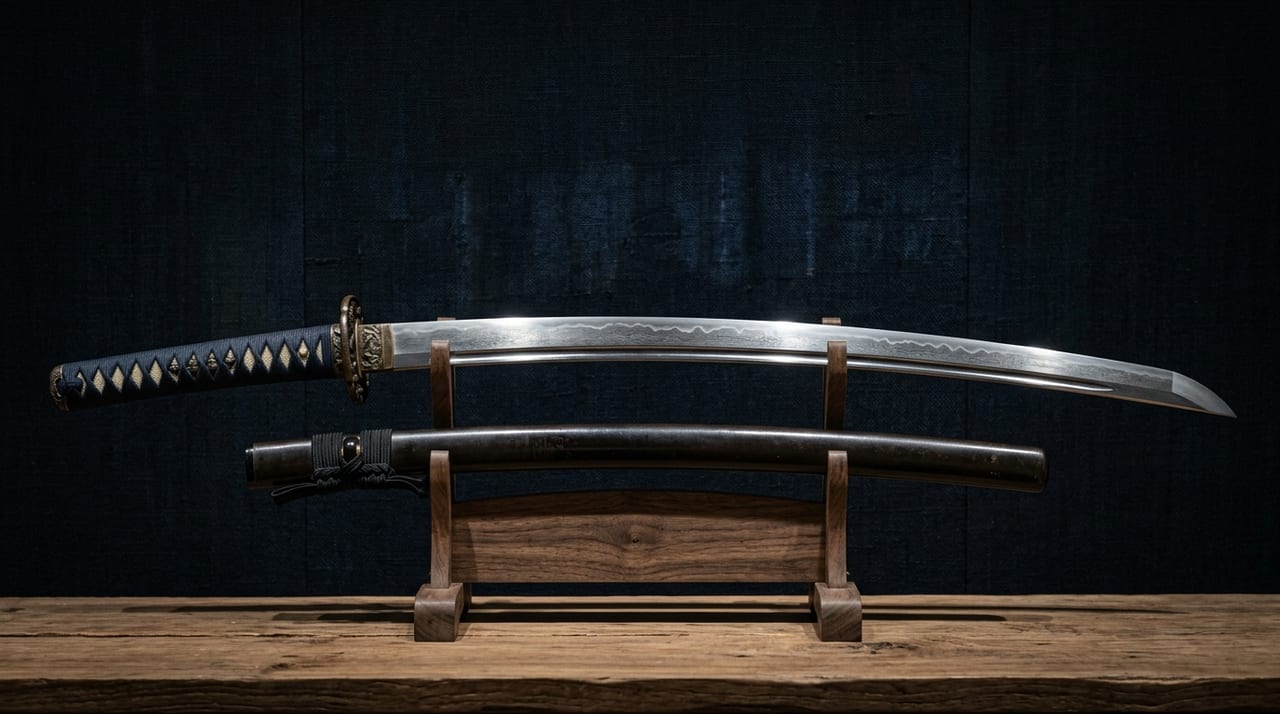
 * Image is for illustrative purposes only.
Kuki Masamune
九鬼正宗
Also known as: Kuki Masamune — Masamune Tantō Listed in Kyōhō Meibutsucho, Owned by Kuki Moritaka
Description
Kuki Masamune is an unsigned tantō (dagger) attributed to Masamune, the great swordsmith of Sagami Province (present-day Kanagawa) in the late Kamakura period, and is designated a National Treasure. About 24.8 cm long, it is recorded under the name "Kuki Masamune" in the Kyōhō Meibutsuchō, and is held at the Hayashibara Museum of Art in Okayama.
The smith Masamune and the blade's workmanship
Masamune of Kamakura is regarded as the supreme master in the history of Japanese swords and the perfecter of the Sōshū tradition. The steel of Kuki Masamune is a finely forged ko-itame grain with abundant ji-nie and frequent chikei; the temper line is notare mixed with gunome, with well-formed ashi, a deep nioi, thick nie and sunagashi, and the bōshi sweeps to a small rounded point. This energetic, nie-laden manner is quintessential Masamune. Its gold double habaki by Umetada Jusai is designated as an attachment to the treasure.
Origin of the name and provenance
The name comes from the Kuki family, daimyo of Toba in Shima, who once owned it. The blade is said to have originally belonged to Kobayakawa Takakage. A younger brother of Kuki Moritaka—a skilled dancer—received it as a reward for a dance at Fushimi Castle (then unauthenticated). After his father Kuki Yoshitaka took his own life having sided with the Western Army at Sekigahara (1600), the blade returned to Moritaka, who had it authenticated by the Hon'ami family as a genuine Masamune, with an origami certificate valuing it at 300 plaques. Moritaka presented it to Tokugawa Ieyasu; it then passed to Tokugawa Yorinobu of the Kii branch and to his son Matsudaira Yorizumi, lord of Saijō in Iyo, as a Matsudaira heirloom.
Designation and present location
Kuki Masamune was designated a National Treasure on 19 February 1957. A representative unsigned Masamune tantō, it is preserved at the Hayashibara Museum of Art in Okayama, founded on the collection of the businessman Ichirō Hayashibara.
Legends & Stories
The name Kuki Masamune derives from the descent of this tantō in the house of Kuki Moritaka, a naval commander active from the Sengoku into the early Edo period. The Kuki clan, based in Shima Province, was a distinguished family that served the Oda, Toyotomi, and Tokugawa regimes in turn at the head of a powerful navy, and Moritaka made Toba Castle his seat.
The blade was originally owned by Kobayakawa Takakage, a daimyo of the Chūgoku region, but Kuki Moritaka's younger brother is said to have received it as a reward for a dance. When the brother sided with the Western army at the Battle of Sekigahara and took his own life, the blade returned to his elder brother Moritaka, who had joined the Eastern army. Moritaka in time presented this Masamune to Tokugawa Ieyasu.
After Ieyasu's death the blade was passed, as a memento, to Tokugawa Yorinobu, founder of the Kii Tokugawa house. It was then handed down to Yorinobu's son Matsudaira Yorizumi, lord of the Saijō domain in Iyo, and was carefully transmitted as a meibutsu associated with the Tokugawa collateral houses.
Masamune's tantō are renowned for the brilliant nie-laden workmanship that expresses the essence of the Sōshū tradition, and since almost no signed works of Masamune survive, a meibutsu of secure provenance is especially valuable as documentary evidence. Kuki Masamune is now preserved as a National Treasure in the Hayashibara Museum of Art, which houses the collection of the Okayama businessman Hayashibara Ichirō, and ranks among that museum's representative masterworks.