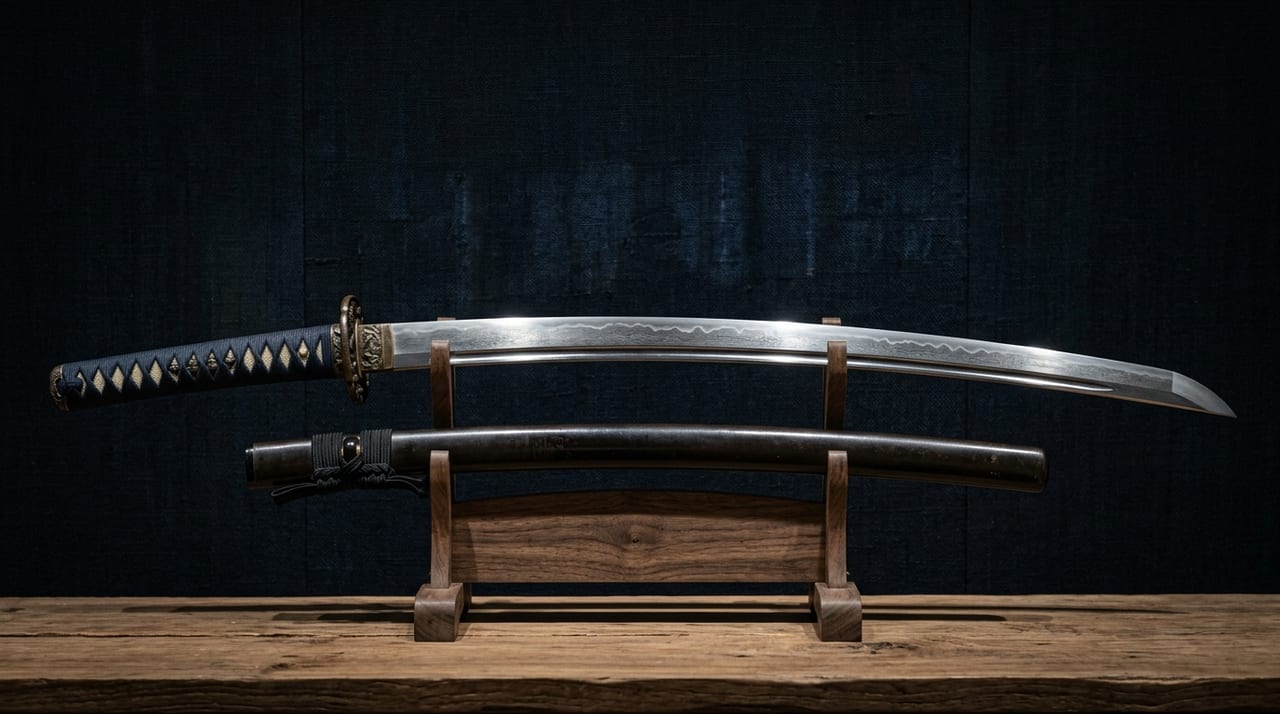
 * Image is for illustrative purposes only.
Ichian Masamune
一庵正宗
Also known as: Ichian Masamune — Masamune Tantō Listed in Kyōhō Meibutsucho
Description
Ichian Masamune is an unsigned short sword attributed to Masamune, the master craftsman of the Sōshū tradition from the late Kamakura period. It is a famous blade listed in the Kyōhō Meimotsucho, a catalog of famous objects compiled under the command of Tokugawa Yoshimune, the eighth shogun.
Origin of the Name
The name derives from Yokohama Ichian Hōin, who possessed this short sword during the Sengoku period. Though unsigned, it is attributed to Masamune and was greatly treasured as a famous object.
Characteristics
With a blade length of approximately 24.7 centimeters, this unsigned short sword is attributed to Masamune of the Sōshū tradition. The steel displays a refined, tightly packed small wood-grain pattern, and both the steel and edge display the excellence befitting a superior work of the Masamune school. As an unsigned short sword listed in the Kyōhō Meimotsucho and attributed to Masamune, this blade is considered a typical example of unsigned Masamune short swords.
Provenance
From the possession of Yokohama Ichian Hōin, it passed through the hands of Toyotomi Hideyoshi, Tokugawa Iemitsu (third shogun), and other military rulers and shoguns. It subsequently passed through the Ii family, Tokugawa Tsunayoshi (fifth shogun), and came into the possession of the Owari Tokugawa family, principal house of the Gosanke. The transmission through military rulers and shoguns demonstrates the esteem in which this blade has been held as a famous object throughout history.
Designation and Current Holdings
It was designated as an Important Cultural Property in Showa 28 (1953). The Tokugawa Art Museum (Tokugawa Reimeikai, a public interest incorporated foundation) in Nagoya currently holds it as one of the famous swords transmitted down from the Owari Tokugawa family.
Legends & Stories
The name Ichian Masamune comes from Yokohama Ichian Hōin, who owned this tantō during the Azuchi-Momoyama period. Ichian was originally the warrior Yokohama Ryōkei, who later took the tonsure and the priestly title Hōin. The blade subsequently entered the possession of the unifier Toyotomi Hideyoshi, who is said to have presented it to Kyōgoku Takatomo, the daimyo of Miyazu in Tango Province.
In the Edo period the blade passed into the hands of the Tokugawa shogunal house. In 1623 (Genna 9), the third shogun Tokugawa Iemitsu stopped at Hikone Castle in Ōmi while traveling to Kyoto and bestowed Ichian Masamune upon his hereditary senior retainer Ii Naotaka. The blade was thereafter handed down in the Ii family of the Hikone domain, until in 1701 (Genroku 14) Ii Naooki presented it to the fifth shogun Tokugawa Tsunayoshi upon his retirement from office.
The sword later passed to the Owari Tokugawa family as a meibutsu associated with Tsunayoshi. Among Masamune's many works, his tantō are especially prized, and this blade displays the brilliant nie that is the essence of the Sōshū tradition together with a lively hamon of notare mixed with ko-midare. Since almost no signed works of Masamune survive, a meibutsu of such secure provenance carries high documentary value.
It is now preserved as an Important Cultural Property in the Tokugawa Art Museum, which houses the treasures handed down in the Owari Tokugawa family, and is exhibited alongside the museum's other Masamune works such as the National Treasure Hōchō Masamune as a fine example transmitting the culture of the Sōshū sword tradition.